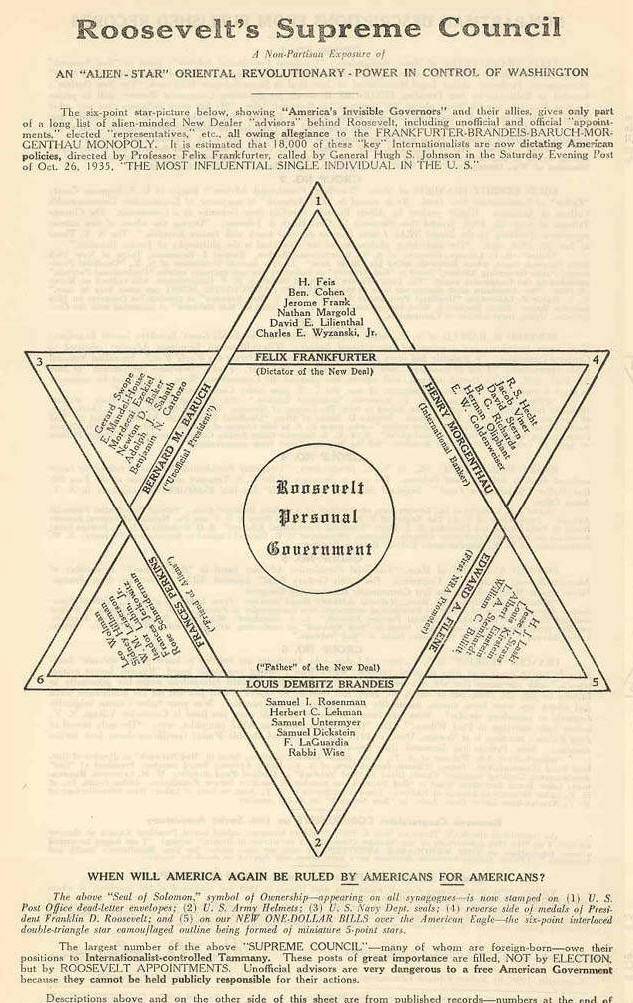
Charles E. Coughlin was an American Catholic priest and a popular radio
figure of the 1930s. Coughlin ministered at the Shrine of the Little Flower in
Royal Oak, Michigan, from 1926 to 1966, when he retired.
In the first year of the Franklin D. Roosevelt administration, Coughlin
supported the Democratic president, but broke with him after a short time.
Throughout the 1930s Coughlin used his popular weekly radio program — which
averaged 3.5 million listeners every week--and his magazine, Social Justice, to
spread his ideas and attack his enemies. From 1934 onward Coughlin's targets
included Roosevelt, individual Jewish leaders, and Jewish institutions, all
branded as Communists.
Coughlin, a right-wing populist, advocated a form of corporatism influenced by
Italian Fascism. In 1934, Coughlin organized the National Union for Social
Justice through which he argued that neither capitalism nor democracy had a
future in America. In 1938 the National Union developed into the Christian Front
which was even more ardent in its support of fascism and became a mouthpiece for
Nazi propaganda. Subsequently, as war loomed in Europe, Coughlin supported
isolationism, charging that Jewish financiers were secretly behind efforts to
involve the United States in the war.
Coughlin believed in the existence of a secret world Jewish conspiracy. In 1938,
his magazine Social Justice serialized the discredited Protocols of the Elders
of Zion, which Coughlin believed to be accurate. This tsarist forgery purported
to be the minutes of a conference of Jewish leaders plotting to take over the
world.
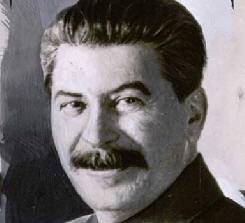 |
Stalin a jew
Coughlin repeatedly used the “Judeo-Bolshevik threat” as a theme,
asserting that the entire Soviet leadership, including both
Lenin and Joseph Stalin, was
Jewish. Coughlin also accused American Jewish financiers, primarily
the Wall Street firm of Kuhn-Loeb, of collaboration with the Bolsheviks in
their efforts to uproot Christianity in Russia. Publicly proclaiming that
he was not an antisemite, Coughlin nevertheless argued that all the ills
of modern society were caused by a Communist-Jewish conspiracy.
|
During the 1930s, Jewish efforts to force Coughlin to tone down his
anti-Jewish rhetoric or to get him off the air altogether failed due to his
popularity and the support he received from the Bishop of Detroit. Coughlin
continued to argue against American participation in World War II even after the
Japanese attack on Pearl Harbor. These arguments led to his undoing.
Jews wanted Coughlin arrested
When a sedition trial seemed possible, the Bishop of Detroit ordered Coughlin
to cease broadcasting and leave politics altogether.
At the height of his popularity, Coughlin received more mail than President
Roosevelt. Indeed, a public opinion poll taken in 1938 showed that 25 percent of
those polled supported all or most of Coughlin's ideas. Coughlin was thus the
most visible of the American right-wing activists during the 1930s and his
antisemitism deeply troubled American Jewry.
--------------------------------------------------------------------------------
Sources: Holocaust Encyclopedia
 Charles Edward Coughlin (October 25, 1891 – October 27, 1979) was a
Canadian-born Roman Catholic priest at Royal Oak, Michigan's National Shrine
of the Little Flower Church. He was one of the first political leaders to
use radio to reach a mass audience, as more than forty million tuned to his
weekly broadcasts during the 1930s. This radio program included praises of
Hitler and Mussolini[1] and was "a variation of the Fascist agenda applied
to American culture."[2] His chief topics were political and economic rather
than religious with his slogan of "Social Justice" against the New Deal.
Charles Edward Coughlin (October 25, 1891 – October 27, 1979) was a
Canadian-born Roman Catholic priest at Royal Oak, Michigan's National Shrine
of the Little Flower Church. He was one of the first political leaders to
use radio to reach a mass audience, as more than forty million tuned to his
weekly broadcasts during the 1930s. This radio program included praises of
Hitler and Mussolini[1] and was "a variation of the Fascist agenda applied
to American culture."[2] His chief topics were political and economic rather
than religious with his slogan of "Social Justice" against the New Deal.
[edit] Early broadcasts and political activism
. He was an early supporter of Roosevelt's New Deal reforms, and
coined the phrase "Roosevelt or ruin," which was famous during the early
days of the FDR administration as well as "The New Deal is Christ's
Deal."[3] However, Coughlin's focus changed during the 1930s as he preached
more and more about the negative influence of "international bankers"
and of
Wall Street on the general welfare and about the need for monetary reform.
Coughlin claimed that the Depression was a cash famine, and proposed
monetary reforms, including the elimination of the Federal Reserve System,
as the solution.
By 1934 Coughlin was perhaps the most prominent Catholic spokesman on
political and financial issues, with a radio audience that reached millions
of people every week. When he began criticizing the New Deal, Roosevelt sent
Joseph P. Kennedy and Frank Murphy, prominent Irish Catholics, to try to
tone him down. Ignoring them, Coughlin began denouncing Roosevelt as a tool
of Wall Street. He supported Huey Long until Long was killed in 1935, and
then supported William Lemke's third party in 1936. Thus, as Coughlin became
a bitter opponent of the New Deal, his radio talks escalated in vehemence
against Roosevelt, capitalists and Jewish conspirators.
Kennedy, who
strongly supported the New Deal, warned as early as 1933 that Coughlin was
"becoming a very dangerous proposition" as an opponent of Roosevelt and "an
out and out demagogue." Kennedy worked with Roosevelt, Bishop Francis
Spellman and Eugenio Cardinal Pacelli (the future Pope Pius XII) in a
successful effort to get the Vatican to shut Coughlin down in 1936.[4] In
1940-41, Kennedy attacked the isolationism of Coughlin (and aviator Charles
Lindbergh).[5]
Coughlin in 1935 proclaimed, "I have dedicated my life to fight against the
heinous rottenness of modern capitalism because it robs the laborer of this
world's goods. But blow for blow I shall strike against Communism, because
it robs us of the next world's happiness."[6] He accused Roosevelt of
"leaning toward international socialism or sovietism on the Spanish
question." Coughlin founded the National Union for Social Justice, an
organization with a strong following among nativists and opponents of the
Federal Reserve, especially in the Midwest. As Kazin notes, Coughlinites saw
Wall Street and Communism as twin faces of a secular Satan. They defended a
"people" who cohered more through piety, economic frustration, and a common
dread of powerful, modernizing enemies than through any class identity.[7]
One of Coughlin's campaign slogans was: "Less care for internationalism and
more concern for national prosperity" which went well with the isolationist
movement in the United States. Coughlin's organization appealed especially
to Irish Catholics. In 1936, Coughlin helped found a short-lived political
party, the Union Party, which nominated William Lemke for President.
Coughlin promised to retire if Lemke did not get 9 million votes, and when
he received only 900,000 Coughlin stopped broadcasting briefly. He resumed
in 1937.
[edit] Antisemitism
After 1936, Coughlin increasingly expressed sympathy for the fascist
policies of Hitler and Mussolini, as an antidote to Bolshevism, though this
was before World War II began. His CBS radio broadcasts also became overtly
antisemitic. He blamed the Depression on an "international conspiracy of
Jewish bankers", and also claimed that Jewish bankers were behind the
Russian Revolution. On 27 November 1938, he said "There can be no doubt that
the Russian Revolution ... was launched and fomented by distinctively Jewish
influence."
He began publication of a newspaper, Social Justice, during this period, in
which he printed antisemitic polemics such as The Protocols of the Elders of
Zion. Like Joseph Goebbels, Coughlin claimed that Marxist atheism in Europe
was a Jewish plot. The 5 December 1938 issue of Social Justice included an
article by Coughlin which closely resembled a speech made by Goebbels on 13
September 1935 attacking Jews, atheists and communists, with some sections
being copied verbatim by Coughlin from an English translation of the speech
published in 1935.
On November 20, 1938, two weeks after Kristallnacht, when Jews across
Germany were attacked and killed, and Jewish businesses, homes and
synagogues burned, Coughlin blamed the Jewish victims,[8] saying that
"Jewish persecution only followed after Christians first were persecuted."
After this speech, and as his programs became more antisemitic, some radio
stations, including those in New York and Chicago, began refusing to air his
speeches without pre-approved scripts; in New York, his programs were
cancelled by WINS and WMCA, leaving Coughlin to broadcasting on the Newark
part-time station WHBI. This made Coughlin a hero in Nazi Germany, where
papers ran headlines like: "America is Not Allowed to Hear the Truth." On
December 18, 1938 two thousand of Coughlin's followers marched in New York
protesting potential asylum law changes that would allow more Jews
(including refugees from Hitler's oppression) into the US, chanting, "Send
Jews back where they came from in leaky boats!" and "Wait until Hitler comes
over here!" The protests continued for several months. Donald Warren, using
information from the FBI and German government archives, has also argued
that Coughlin received indirect funding from Nazi Germany during this
period.
Additionally, after 1936, Coughlin began supporting an organization called
the Christian Front, which claimed him as an inspiration. In January, 1940,
the Christian Front was shut down when the FBI discovered the group was
arming itself and "planning to murder Jews, communists and 'a dozen
Congressmen'"[9] and eventually establish, in J. Edgar Hoover's words, "a
dictatorship, similar to the Hitler dictatorship in Germany." Coughlin
publicly stated, after the plot was discovered, that he still did not
"disassociate himself from the movement," and though he was never linked
directly to the plot, his reputation suffered.[10]
[edit] Cancellation of radio show
At its peak in the early 1930s, his radio show was phenomenally popular: his
office received up to 80,000 letters per week from listeners, and his
listening audience was estimated to be as much as one-third of the nation.
Coughlin is often credited as one of the major demagogues of the 20th
century for being able to influence politics through broadcasting, without
actually holding a political office himself.
Boyea (1995) argues that the Catholic Church did not approve of Coughlin.
The Vatican, the Apostolic Delegation in Washington, D.C., the archbishop of
Cincinnati, and the chairman of the National Catholic Welfare Conference (NCWC)
all wanted the priest silenced. They recognized that only Coughlin's
superior, Detroit Bishop Michael Gallagher, had the canonical authority to
curb him; and Gallagher supported the "Radio Priest." Therefore, due to
Gallagher's autonomy and the prospect of Coughlin leading a schism, the
Catholic leadership was impotent, a clear example of the limits of
ecclesiastical power.
A radio battle was fought in the late 1930s between The Reverend Walton E.
Cole, a Unitarian minister in Toledo, Ohio, and Coughlin. Coughlin, became
highly controversial when his broadcasts took a political turn toward Nazism
and anti-Semitism. Rev. Cole tried to prevail upon the Catholic hierarchy to
have his inflammatory broadcasts stopped. Walton Cole’s widow, Lorena M.
Cole, donated papers to the Claremont School of Theology with personal notes
and reminiscences about this tense episode.
Coughlin's populist message was contrary to the agenda of the FDR
administration. They decided that although the first amendment protected
free speech, it did not necessarily apply to broadcasting, because the radio
spectrum was a "limited national resource." New regulations and restrictions
were created to force Coughlin off the air. For the first time, operating
permits were required of those who were regular radio broadcasters. When
Coughlin's permit was denied, he was temporarily silenced.
Unwilling to give up without a fight, Coughlin worked around the restriction
by purchasing air time and having his speeches played via record. However,
having to buy the time on individual stations seriously reduced his reach
and strained his resources. And while Coughlin's voice grew dimmer, the
voices of his critics grew louder.
According to Marcus' book, Coughlin's opposition to the repeal of a
neutrality-oriented arms-embargo law triggered more successful efforts to
force him off the air. In October 1939, one month after the invasion of
Poland, the Code Committee of the National Association of Broadcasters (NAB)
adopted new rules which placed "rigid limitations on the sale of radio time
to spokesman of controversial public issues." Manuscripts were required to
be submitted in advance. Radio stations were threatened with the loss of
their licenses if they failed to comply. This ruling was clearly aimed at
Coughlin due to his leadership in opposition to the growing American
involvement in the Second World War. As a result, the September 23, 1939
issue of Social Justice stated that he had been forced from the air "...by
those who control circumstances beyond my reach" (pp 173-177).
Coughlin reasoned that although the government had assumed the right to
regulate any on-air broadcasts (a right they still maintain to this day),
the first amendment still guaranteed and protected freedom of the written
press. He could still print his editorials without censorship in his own
newspaper, Social Justice. However, FDR's administration stepped in again,
this time revoking his mailing privileges and making it impossible for
Coughlin to deliver the papers to his readers. He had the right to publish
whatever he wanted, but not the right to use the United States Post Office
Department to deliver it. The lack of a conduit to his followers seriously
reduced his influence, and after the attack on Pearl Harbor and the
declaration of war, the peace movement began to sputter out and
isolationists like Coughlin were seen as being sympathetic to the enemy. In
1942, a new bishop of Detroit ordered Coughlin to stop his controversial
political activities and to return to his duties as a parish priest.
Coughlin complied and remained the pastor of the Shrine of the Little Flower
until retiring in 1966. He refused numerous interview opportunities, and
continued to write pamphlets denouncing Communism until his death at
Bloomfield Hills, Michigan in 1979, at the age of 88.
1000 synagogues
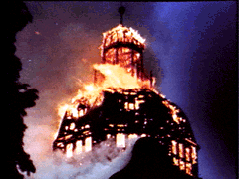 |
Gilbert's definitive chronicle The Holo caust (1985) was
followed by seven more books on this painful subject. His new one is an
account of the Night of Broken Glass, which was unleashed against the
Jewish communities across Germany on November 10, 1938. The Nazi SS
ordered synagogues, Jewish homes, and Jewish
shops to be burned to the ground, and Jews fleeing the flames were shot.
Jewish property not destroyed by the fire was vandalized, and Jews were
randomly arrested. A
thousand
synagogues
were destroyed, their holy objects desecrated.
|
These acts of intimidation and brutality were carried out ostensibly in
rage against the assassination in Paris of a German diplomat by a young relative
of a Polish Jewish family forcibly expelled from Germany some weeks earlier.
Gilbert begins with the events of the night itself, and then he examines the six
years leading up to it, tracing the response of the German Jews, the German
government, and the world. A powerful account of the helplessness of the Jews.
George Cohen
Copyright © American Library Association. All rights reserved --This
text refers to the
Hardcover
edition.