 US History Encyclopedia: Battle of Little
Bighorn
US History Encyclopedia: Battle of Little
Bighorn
Little Bighorn, Battle of (25 June 1876). The Sioux Indians in Dakota Territory
bitterly resented the opening of the Black Hills to settlers, which occurred in
violation of the Treaty of Fort Laramie of 1868. Owing also to official graft
and negligence, they faced starvation in the fall of 1875. They began to leave
their reservations contrary to orders, to engage in their annual buffalo hunt.
They were joined by tribespeople from other reservations until the movement took
on the proportions of a serious revolt. The situation was one that called for
the utmost tact and discretion, for the Sioux were ably led, and the treatment
they had received had stirred the bitterest resentment among them. But an order
originating with the Bureau of Indian Affairs was sent to all reservation
officials early in December, directing them to notify the Indians to return by
31 January under penalty of being attacked by the U.S. Army. This belated order
could not have been carried out in the dead of winter even if the Indians had
been inclined to obey it.
Early in 1876 Gen. Philip H. Sheridan,
from his headquarters at Chicago, ordered a concentration of troops on the upper
Yellowstone River to capture or disperse the numerous bands of Dakotas who
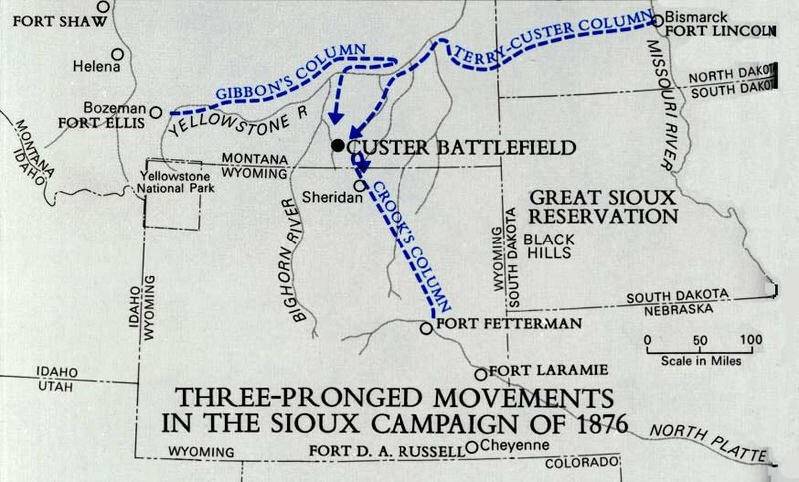
hunted there. In June, Gen. Alfred H. Terry, department commander, and Col.
George A. Custer, with his regiment from Fort Abraham Lincoln, marched overland
to the Yellowstone, where they were met by the steamboat Far West with
ammunition and supplies. At the mouth of Rosebud Creek, a tributary of
the Yellowstone, Custer received his final orders from Terry—to locate and
disperse the Indians. Terry gave Custer absolutely free hand in dealing with the
situation, relying on his well-known experience in such warfare.
With twelve companies of the Seventh Cavalry, Custer set out on his march and
soon discovered the Sioux camped on the south bank of the Little Bighorn River.
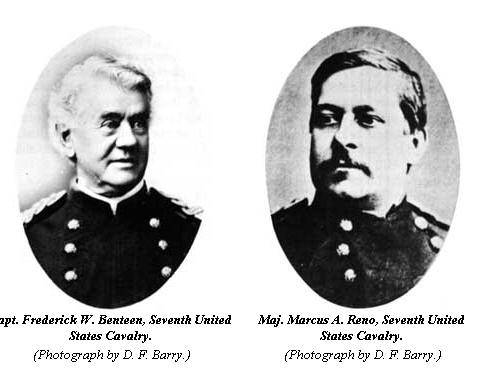
He sent Maj. Marcus Reno with three companies of cavalry and all the Arikara
scouts across the upper ford of the river to attack the southern end of the
Sioux camp. Capt. Frederick Benteen, with three companies, was sent to the left
of Reno's line of march. Custer himself led five companies of the Seventh
Cavalry down the river to the lower ford for an attack on the upper part of the
camp. One company was detailed to bring up the pack train.
This plan of battle, typical of Custer, was in the beginning completely
successful. Suddenly faced by a vigorous double offensive, the Indians at first
thought only of retreat. At this critical juncture, and for reasons still not
fully explained, Reno became utterly confused and ordered his men to fall back
across the river. Thereupon the whole force of the Indian attack was
concentrated upon Custer's command, compelling him to retreat from the river to
a position at which his force was later annihilated. The soldiers under Reno
rallied at the top of a high hill overlooking the river where they were joined
by Benteen's troops and, two hours later, by the company guarding the pack
train.
In 1879 an official inquiry into Reno's conduct in the battle cleared him of all
responsibility for the disaster. Since that time the judgment of military
experts has tended to reverse this conclusion and to hold both Reno and Benteen
gravely at fault. In Sheridan's Memoirs it is stated: "Reno's head failed him
utterly at the critical moment." He abandoned in a panic the perfectly
defensible and highly important position on the Little Bighorn River. Reno's
unpopularity after the battle was one of the reasons he was brought up on
charges of drunkenness and "peeping tomism" and court-martialed. Reno was found
guilty and dishonorably discharged. However, in December 1966 Reno's
grandnephew, Charles Reno, asked the Army Board for the Correction of Military
Records to review the court-martial verdict, citing disclosures in G. Walton's
book Faint the Trumpet Sounds. In June 1967 the secretary of the army restored
Reno to the rank of major and the dishonorable discharge was changed to an
honorable one. The action was taken on the grounds that the discharge had been
"excessive and therefore unjust." However, the guilty verdict still stands. In
September 1967 Reno was reburied in Custer Battlefield National Cemetery in
Montana.
As to Benteen, he admitted at the military inquiry following the battle that he
had been twice ordered by Custer to break out the ammunition and come on with
his men. Later, at 2:30 P.M., when he
had joined Reno, there was no attacking force of Indians in the vicinity, and he
had at his disposal two-thirds of Custer's entire regiment, as well as the
easily accessible reserve ammunition. Gen. Nelson A. Miles, in his Personal
Recollections, found no reason for
Benteen's
failure to go to Custer's relief. He asserted, after an examination of the
battlefield, that a gallop of fifteen minutes would have brought reinforcements
to Custer. Miles's
opinion contributes to the mystery of why, for more than an hour—while Custer's
command was being overwhelmed—Reno and
Benteen
remained inactive.
Bibliography
 |
Following the war, Custer was appointed first lieutenant in the 7th
Cavalry in 1866. He was wounded in the Washita campaign of the Indian
Wars, in 1868. He later served on Reconstruction duty in South Carolina
and participated in the Yellowstone Expedition of 1873 and the Black Hills
Expedition of 1874. He was appointed captain in 1875 and given command of
Company C of the 7th Cavalry. Custer participated in the arrest of the
Lakota Rain-in-the-Face for murder at the trading post at Standing Rock
Agency.
During the 1876 Little Bighorn campaign of the Black Hills War, he served
as aide-de-camp to Lt. Col. George A. Custer and died with his brother.
Lt. Henry Harrington actually led Company C during the battle. Younger
brother Boston Custer also died in the fighting, as did other Custer
relatives and friends. It was widely rumored that Rain-in-the-Face, who
had escaped from captivity and was a participant at the Little Bighorn,
had cut out Tom Custer's heart as revenge. This tale seems apocryphal.
However, Custer's body was badly mutilated post-mortem. His remains were
identified by a recognizable tattoo of his initials on his arm.
|
Tom Custer was buried on the battlefield, but exhumed the next year and
reburied in Fort Leavenworth National Cemetery. A stone memorial slab marks
the place where his body was discovered and initially buried.
|
Little Bighorn, battle of (1876), second defeat (the first was of Crook's
column at the Rosebud on 17 June) of an attempt by the US army to trap
rebellious Lakota and Arapaho/Cheyenne on their Montana hunting grounds. On 25
June Custer sent part of his 7th Cavalry under Reno to ‘beat’ the hostiles out
of their encampment, while led by Crow scouts he hooked around to drive off
their pony herd and envelop them, a standard Indian-fighting tactic. On 25 June
he was outmanoeuvred and his detachment of 215 men was annihilated between an
anvil led by the Hunkpapa Gall that cut off his retreat and a head-on mounted
hammer led by the Oglala Crazy Horse. The rest of the regiment lost a further
100 men when Reno was forced back upon the reserve elements under Benteen in the
hills along Custer's line of advance, where they were besieged for 36 hours.
Coming nine days before the centenary of the USA, the battle immediately assumed
mythic status and it is probably the most written-about skirmish in military
history. The lonely battlefield, with poignant white markers showing where
Custer's men fell, is among the most visited US National Parks.
Battle of the Little Bighorn
George Armstrong Custer (December 5, 1839 – June 25, 1876) was a United States
Army officer and cavalry commander in the American Civil War and the Indian
Wars. At the start of the Civil War, Custer was a cadet at the United States
Military Academy and his class's graduation was accelerated so that they could
enter the war; Custer graduated last in
his class. He served at the First
Battle of Bull Run and was a staff officer for Maj. Gen. George B. McClellan
in the Army of the Potomac's 1862 Peninsula Campaign. Early in the
Gettysburg Campaign, Custer's association with cavalry commander Maj. Gen.
Alfred Pleasonton earned him promotion from first lieutenant to brigadier
general of United States Volunteers at the age of 23.[1]
Custer established a reputation as an aggressive cavalry brigade commander
willing to take personal risks by leading his Michigan Brigade into battle, such
as the mounted charges at Hunterstown and East Cavalry Field at the Battle of
Gettysburg. In 1864, with the Cavalry Corps under the command of Maj. Gen.
Philip Sheridan, Custer led his "Wolverines", and later a division, through the
Overland Campaign, including the Battle of Trevilian Station, where Custer was
humiliated by having his division trains overrun and his personal baggage
captured by the Confederates. Custer and Sheridan defeated the Confederate army
of Lt. Gen. Jubal A. Early in the Valley Campaigns of 1864. In 1865, Custer
played a key role in the Appomattox Campaign, with his division blocking Robert
E. Lee's retreat on its final day.[2]
At the end of the Civil War (April 15,
1865), Custer was promoted to major general of United States Volunteers.[1]
In 1866, he was appointed to the regular army position of lieutenant colonel of
the 7th U.S. Cavalry and served in the Indian Wars. He was defeated and killed
at the Battle of the Little Bighorn in 1876, against a coalition of Native
American tribes composed almost exclusively of Sioux, Cheyenne, and Arapaho
warriors, and led by the Sioux chiefs Crazy Horse and Gall and by the Hunkpapa
seer and medicine man, Sitting Bull. This confrontation has come to be popularly
known in American history as Custer's Last Stand.
[edit] Birth and family
Custer was born in New
Rumley,
Ohio, to Emanuel Henry Custer (1806-1892), a farmer and blacksmith, and
Marie Ward Kirkpatrick (1807-1882).[3] Throughout his life Custer was known by a
variety of nicknames. He was called alternately Autie (his early attempt to
pronounce his middle name) and Armstrong. The names Curley and Jack (a phonetic
name for his initials GAC which was on his satchel) were used by his troops.
When he went west, the Plains Indians called him Yellow Hair and Son of the
Morning Star. His brothers Thomas Custer and Boston Custer died with him at the
Battle of the Little Big Horn, as did his brother-in-law, James Calhoun, and
nephew, Autie Reed. His other full siblings were Nevin Custer and Margaret
Custer; he also had several older half-siblings.
The Custer family had emigrated to America in the late 17th century from
Westphalia, Germany. Their surname
originally was "Küster".
George Armstrong Custer was a great great grandson of Arnold Küster from
Kaldenkirchen, Duchy of Jülich (today North Rhine-Westphalia state), who settled
in Hanover, Pennsylvania.
Custer's mother's maiden name was Marie Ward. At the age of 16, she married
Israel Kirkpatrick, who died in 1835. She married Emanuel Henry Custer in 1836.
Marie's grandparents, George Ward (1724-1811) and Mary Ward (nee Grier)
(1733-1811), were from County Durham, England. Their son James Grier Ward
(1765-1824) was born in Dauphin, Pennsylvania and married Catherine Rogers
(1776-1829), and their daughter, Marie Ward, was Custer's mother. Catherine
Rogers was a daughter of Thomas Rogers and Sarah Armstrong. According to family
letters in The Custer Story, Custer was named after George Armstrong, a
minister, in the hopes of his devout father that his son might become part of
the clergy.
[edit] Early life
USMA Cadet George Armstrong "Autie" Custer, ca. 1859Custer spent much of his
boyhood living with his half-sister and his brother-in-law in Monroe, Michigan,
where he attended school and is now honored by a statue in the center of
town.[4] Before entering the United States Military Academy, Custer attended the
McNeely Normal School, later known as Hopedale Normal College, in Hopedale, Ohio
and known as the first coeducational college for teachers in eastern Ohio. While
attending Hopedale, Custer, together with classmate William Enos Emery, was
known to have carried coal to help pay for their room and board. Custer
graduated from McNeely Normal School in 1856 and taught school in Ohio.
Custer was graduated a year early, last in the Class of 1861 from the United
States Military Academy, just after the start of the Civil War.[5] Ordinarily,
such a showing would be a ticket to an obscure posting and career, but he had
the fortune to graduate just as the war caused the army to experience a sudden
need for new officers. His tenure at the academy was a rocky one and he came
close to expulsion each of his four years due to excessive demerits, many from
pulling pranks on fellow cadets. His distinguished war record, which started
with riding dispatches for General Scott, has been overshadowed in history by
his role and fate in the Indian Wars.
[edit] Civil War
[edit] McClellan and Pleasonton
Second Lieutenant George Custer (right) with captured Confederate Lieutenant
Washington, at Fair Oaks, 1862 (Library of Congress)Custer was commissioned a
second lieutenant in the 2nd U.S. Cavalry and immediately joined his regiment at
the First Battle of Bull Run, where Army commander Winfield Scott detailed him
to carry messages to Maj. Gen. Irvin McDowell. After the battle he was
reassigned to the 5th U.S. Cavalry, with which he served through the early days
of the Peninsula Campaign in 1862. During the pursuit of Confederate General
Joseph E. Johnston up the Peninsula, on May 24, 1862, Custer persuaded a colonel
to allow him to lead an attack with four companies of Michigan infantry across
the Chickahominy River above New Bridge. The attack was successful, capturing 50
Confederates. Maj. Gen. George B. McClellan, commander of the Army of the
Potomac, termed it a "very gallant affair", congratulated Custer personally, and
brought him onto his staff as an aide-de-camp with the temporary rank of
captain. In this role, Custer began his lifelong pursuit of publicity. On one
occasion when McClellan and his staff were reconnoitering a potential crossing
point on the Chickahominy River, they stopped and Custer overheard his commander
mutter to himself, "I wish I knew how deep it is." Custer dashed forward on his
horse out to the middle of the river and turned to the astonished officers of
the staff and shouted triumphantly, "That's how deep it is, General!"
Custer (extreme right) with President Lincoln, George B. McClellan and other
officers at the Battle of Antietam, 1862When McClellan was relieved of command
in November 1862, Custer reverted to the rank of first lieutenant. Custer fell
into the orbit of Maj. Gen. Alfred Pleasonton, who was commanding a cavalry
division. The general was Custer's
introduction to the world of extravagant uniforms and political maneuvering and
the young lieutenant became his protégé, serving on
Pleasonton's
staff while continuing his assignment with his regiment. Custer was quoted as
saying that "no father could love his son more than General Pleasonton
loves me." After the Battle of Chancellorsville, Pleasonton became the commander
of the Cavalry Corps of the Army of the Potomac and his first assignment was to
locate the army of Robert E. Lee, moving north through the Shenandoah Valley in
the beginning of the Gettysburg Campaign. In his first command, Custer affected
a showy, personalized uniform style that alienated his men, but he won them over
with his readiness to lead attacks (a contrast to the many officers who would
hang back, hoping to avoid being hit); his men began to adopt elements of his
uniform customization. Custer distinguished himself by fearless, aggressive
actions in some of the numerous cavalry engagements that started off the
campaign, including Brandy Station and Aldie.
[edit] Brigade command and Gettysburg
Captain Custer (left) with General Alfred Pleasonton (right) on horseback in
Falmouth, Virginia.On June 28, 1863, three days prior to the Battle of
Gettysburg, General Pleasonton promoted Custer from lieutenant to brigadier
general of volunteers.[1][6] Despite having no direct command experience, he
became one of the youngest generals in the Union Army at age 23. Two
captains—Wesley Merritt and Elon J. Farnsworth—were promoted along with Custer,
although they did have command experience. Custer lost no time in implanting his
aggressive character on his brigade, part of the division of Brig. Gen. Judson
Kilpatrick. He fought against the Confederate cavalry of J.E.B. Stuart at
Hanover and Hunterstown, on the way to the main event at Gettysburg.
Custer's style of battle was often
claimed to be reckless or foolhardy, but military planning was always the
basis of every Custer "dash". As the Custer Story in Letters explained, "George
Custer meticulously scouted every battlefield, gauged the enemies weak points
and strengths, ascertained the best line of attack and only after he was
satisfied was the "Custer Dash" with a Michigan yell focused with complete
surprise on the enemy in routing them every time. One of his greatest attributes
during the Civil War was what Custer wrote of as "luck" and he needed it to
survive some of these charges.
At Hunterstown, in an ill-considered charge ordered by Kilpatrick against the
brigade of Wade Hampton, Custer fell from his wounded horse directly before the
enemy and became the target of numerous enemy rifles. He was rescued by the
bugler of the 1st Michigan Cavalry, Norville Churchill, who galloped up, shot
Custer's nearest assailant, and allowed Custer to mount behind him for a dash to
safety.
One of many of Custer's finest hours in the Civil War was just east of
Gettysburg on July 3, 1863. In conjunction with Pickett's Charge to the west,
Robert E. Lee dispatched Stuart's cavalry on a mission into the rear of the
Union Army. Custer encountered the Union cavalry division of David McM. Gregg,
directly in the path of Stuart's horsemen. He convinced Gregg to allow him to
stay and fight, while his own division was stationed to the south out of the
action. At East Cavalry Field, hours of charges and hand-to-hand combat ensued.
Custer led a mounted charge of the 1st Michigan Cavalry, breaking the back of
the Confederate assault. Custer's brigade lost 257 men at Gettysburg, the
highest loss of any Union cavalry brigade.[7] For this General Custer and the
division were given the honor of leading the army on point after the
battle.[citation needed]
[edit] Marriage
George and Libbie Custer, 1864Custer married Elizabeth Clift Bacon (1842–1933)
on February 9, 1864. She was born in Monroe, Michigan, to Daniel Stanton Bacon
and Eleanor Sophia Page.[citation needed] Following the Battle of Washita River
in November 1868, Custer was alleged (by Captain Frederick Benteen, chief of
scouts Ben Clark, and Cheyenne oral tradition) to have had a sexual relationship
during the winter and early spring of 1868-1869 with Monaseetah, daughter of the
Cheyenne chief Little Rock (killed in the Washita battle).[8] Monahsetah gave
birth to a child in January 1869, two months after the Washita battle; Cheyenne
oral history also alleges that she bore a second child, fathered by Custer, in
late 1869.[8]
[edit] The Valley and Appomattox
When the cavalry corps of the Army of the Potomac was reorganized under Philip
Sheridan in 1864, Custer took part in the various actions of the cavalry in the
Overland Campaign, including the Battle of the Wilderness (after which he
ascended to division command), the Battle of Yellow Tavern, where Jeb Stuart was
mortally wounded, and the Battle of Trevilian Station, where Custer was
humiliated by having his division trains overrun and his personal baggage
captured by the Confederates. When Confederate General Jubal A. Early moved down
the Shenandoah Valley and threatened Washington, D.C., Custer's division was
dispatched along with Sheridan to the Valley Campaigns of 1864. They pursued the
Confederates at Winchester and effectively destroyed Early's army during
Sheridan's counterattack at Cedar Creek.
Brevet Major General George Armstrong Custer, US Army, 1865Custer and Sheridan,
having defeated Early, returned to the main Union Army lines at the Siege of
Petersburg, where they spent the winter. In April 1865 the Confederate lines
were finally broken and Robert E. Lee began his retreat to Appomattox Court
House, pursued by the Union cavalry. Custer distinguished himself by his actions
at Waynesboro, Dinwiddie Court House, and Five Forks. His division blocked Lee's
retreat on its final day and received the first flag of truce from the
Confederate force. Custer was present at the surrender at Appomattox Court House
and the table upon which the surrender was signed was presented to him as a gift
for his gallantry. Before the close of the war Custer received brevet promotions
to brigadier and major general in the Regular Army and major general in the
volunteers. As with most wartime promotions, these senior ranks were only
temporary.
[edit] Indian Wars
Lieutenant Colonel George A. Custer, 7th
U.S. Cavalry, ca. 1875On February 1, 1866, Custer was mustered out of the
volunteer service and returned to his permanent rank of captain in the Regular
Army, assigned to the 5th U.S. Cavalry. Custer took an extended leave,
exploring options in New York City,[9] where he considered careers in railroads
and mining.[10] Offered a position as adjutant general of the army of Benito
Juárez of Mexico, who was then in a struggle with Maximilian, Custer applied for
a one-year leave of absence from the U.S. Army, but his appointment was blocked
by U.S. Secretary of State William H. Seward, who feared offending France.[10]
Following the death of his father-in-law in May 1866,
Custer returned to Monroe, Michigan,
where he considered running for Congress and took part in public discussion over
the treatment of the American South in the aftermath of the Civil War,
advocating a policy of moderation.[10] In September 1866 he accompanied
President Andrew Johnson on a train journey to build up public support for
Johnson's policies towards the South. Custer denied a charge by the newspapers
that Johnson had promised him a colonel's commission in return for his support,
though Custer had written to Johnson some weeks before seeking such a
commission.[11]
Custer was offered command of the U.S. 10th Cavalry Regiment (otherwise known as
the Buffalo Soldiers)[12][citation needed], a position with the permanent rank
of full colonel, but turned the command down in favor of a lieutenant colonelcy
of the newly created U.S. 7th Cavalry Regiment,[13] headquartered at Fort Riley,
Kansas.[14] As a result of a plea by his patron General Philip Sheridan, Custer
was also recipient of a brevet rank of major general.[13] He then took part in
General Winfield Scott Hancock's expedition against the Cheyenne in 1867.
His career took a brief detour following
the Hancock campaign when he was court-martialed at Fort Leavenworth, Kansas for
being AWOL, after abandoning his post to see his wife, and was suspended for
duty for one year. He returned to duty in 1868, before his term of
suspension had expired, at the request of General Philip Sheridan, who wanted
Custer for his planned winter campaign against the Cheyenne.
Under Sheridan's orders, Custer took part in establishing Camp Supply in Indian
Territory in early November 1868 as a supply base for the winter campaign.
Custer then led the 7th U.S. Cavalry in an attack on the Cheyenne encampment of
Black Kettle - the Battle of Washita River on November 27, 1868. Custer reported
killing 103 warriors, though estimates by the Cheyenne themselves of the number
of Indian casualties were substantially lower; some women and children were also
killed, and 53 women and children were taken prisoner. Custer had his men shoot
most of the 875 Indian ponies the troops had captured. This was regarded as the
first substantial U.S. victory in the Indian Wars, helping to force a
significant portion of the Southern Cheyennes onto a U.S. appointed reservation.
In 1873, he was sent to the Dakota
Territory to protect a railroad survey party against the Sioux. On August 4,
1873, near the Tongue River, Custer and the 7th U.S. Cavalry clashed for the
first time with the Sioux. Only one man on each side was killed. In 1874, Custer
led an expedition into the Black Hills and announced the discovery of gold on
French Creek near present-day Custer, South Dakota. Custer's announcement
triggered the Black Hills Gold Rush and gave rise to the lawless town of
Deadwood, South Dakota.
[edit] Battle of the Little Bighorn
Main article: Battle of the Little Bighorn
An 1899 chromolithograph entitled Custer Massacre at Big Horn, Montana — June
25, 1876, artist unknown.By the time of Custer's expedition to the Black Hills
in 1874, the level of conflict and tension between the U.S. and many plains
Indians tribes (including the Lakota Sioux and the Cheyenne) had become
exceedingly high. Indians killed settlers and railroad workers, white Americans
continually broke treaty agreements and advanced further westward. To take
possession of the Black Hills (and thus the gold deposits), and to stop Indian
attacks, the U.S. decided to corral all remaining free plains Indians. The Grant
government set a deadline of January 31, 1876 for all Lakota and Northern
Cheyenne to report to their designated agencies (reservations) or be considered
a "hostile".
The 7th Cavalry departed from Fort Lincoln on May 17, 1876, part of a larger
army force planning to round up remaining free Indians. Meanwhile, in the spring
and summer of 1876, the Hunkpapa Lakota chief Sitting Bull had called together
the largest ever gathering of plains Indians at Ash Creek, Montana (later moved
to the Little Bighorn River) to discuss what to do about the whites.[15] It was
this united encampment of Lakota, Northern Cheyenne, and Arapaho Indians that
the 7th met at the Battle of the Little Bighorn.
On June 25, some of Custer's Crow Indian scouts identified what they claimed was
a large Indian encampment along the Little Bighorn River.
Custer divided his forces into three
battalions: one led by major Marcus Reno, one by Captain Frederick
Benteen,
and one by himself. Captain Thomas M. McDougall and Company B were with the pack
train. Benteen was sent south and west, to cut off any attempted escape
by the Indians, Reno was sent north to charge the southern end of the
encampment, and Custer rode north, hidden to the east of the encampment by
bluffs, and planning to circle around and attack from the north.[16][17]
Reno began a charge on the southern end
of the village, but halted midway and had his men dismount and form a skirmish
line.[18][17] They were soon overcome by the Lakota and Cheyenne warriors who
counterattacked en masse,[19] forcing Reno and his men to take cover in
the trees along the river. Eventually, however, this position became untenable
and the troopers were forced into a bloody retreat up onto the bluffs above the
river, where they made their own stand.[20][21] This, the opening action of the
battle, cost Reno a quarter of his command.
Meanwhile, unaware of Reno's failure, Custer had led his command to the northern
end the main encampment, where he apparently planned to sandwich the Indians
between his attacking troopers and Reno's command. According to Grinnell's
account, based on the testimony of the Cheyenne warriors who survived the
fight,[22] at least part of Custer's command attempted to ford the river at the
north end of the camp but were driven off by stiff resistance from the Indians
and were pursued by hundreds of warriors onto a ridge north of the encampment.
There, Custer was prevented from digging
in by Crazy Horse, whose warriors had outflanked him and were now to his north,
at the crest of the ridge.[23] Traditional white accounts attribute to
Gall the attack that drove Custer up onto the ridge, but Indian witnesses have
disputed that account.[24] For a time, Custer's men were deployed by company, in
standard cavalry fighting formation--the skirmish line, with every fourth man
holding the horses. This arrangement, however, robbed Custer of a quarter of his
firepower, and as the fight intensified, many soldiers took to holding their own
horses or hobbling them, further reducing their effective fire. When Crazy Horse
and White Bull mounted the charge that broke through the center of Custer's
lines, pandemonium broke out among the men of Calhoun's command,[25] though
Keogh's men seem to have fought and died where they stood. Many of the panicking
soldiers threw down their weapons[26] and either rode or ran towards the knoll
where Custer, the other officers, and about 40 men were making a stand. Along
the way, the Indians rode them down, counting coup by whacking the fleeing
troopers with their quirts or lances.[27]
Initially, Custer had 208 officers and men under his command, with an additional
142 under Reno and just over a hundred under Benteen. The Indians fielded over
1800 warriors,[28] although historically, the numbers do seem to have been
exaggerated to explain Custer's defeat, and again, to exculpate him from his
numerous errors before and during the battle. As the troopers were cut down,
moreover, the Indians stripped the dead of their firearms and ammunition, with
the result that the return fire from the cavalry steadily decreased, while the
fire from the Indians steadily increased. With Custer and the survivors shooting
the remaining horses to use them as breastworks and making a final stand on the
knoll at the north end of the ridge, the Indians closed in for the final attack
and killed all in Custer's command. As a result, the Battle of the Little
Bighorn has come to be popularly known as "Custer's Last Stand".
When the cavalry's main column did
arrive three days later, they found most of the soldiers' corpses stripped,
scalped, and mutilated.[29] Custer’s body had two bullet holes, one in the left
temple and one just above the heart.[30] Following the recovery of Custer's
body, he was given a funeral with full military honors, and was buried on the
battlefield, and later reinterred
in the West Point Cemetery on October 10, 1877. The site of the battle was
designated a National Cemetery in 1876.
[edit] Controversial legacy
George A. Custer in civilian clothes, ca. 1876After his death, Custer achieved
the lasting fame that eluded him in life. The public saw him as a tragic
military hero and gentleman who sacrificed his life for his country. Custer's
wife, Elizabeth, who accompanied him in many of his frontier expeditions, did
much to advance this view with the publication of several books about her late
husband: Boots and Saddles, Life with General Custer in Dakota (1885), Tenting
on the Plains (1887), and Following the Guidon (1891). General Custer himself
wrote about the Indian wars in My Life on the Plains (1874) and was the
posthumous co-author of The Custer Story (1950).
Today Custer would be called a "media personality" who understood the value of
good public relations and leveraged media effectively; he frequently invited
correspondents to accompany him on his campaigns, and their favorable reportage
contributed to his high reputation that lasted well into the 20th century.
After being promoted to brigadier general, Custer sported a uniform that
included shiny jackboots, tight olive corduroy trousers, a wide-brimmed slouch
hat, tight hussar jacket of black velveteen with silver piping on the sleeves, a
sailor shirt with silver stars on his collar, and a red cravat. He wore his hair
in long glistening ringlets liberally sprinkled with cinnamon-scented hair oil.
Later in his campaigns against the Indians, Custer wore a buckskin outfit along
with his familiar red tie.
The assessment of Custer's actions during the Indian Wars has undergone
substantial reconsideration in modern times[citation needed]. For many critics,
Custer was the personification of the U.S. Government's ill-treatment of the
Native American tribes, while others see him as a scapegoat for the Grant Indian
policy, which he personally opposed.[citation needed] His testimony on
behalf of the abuses sustained by the
reservation Indians nearly cost him his command by the Grant
administration. Custer once wrote that if he were an Indian, he would rather
fight for his freedom alongside the hostile warriors "than be confined to the
limits of a reservation".[citation needed]
Many criticized Custer's actions during the battle of the Little Bighorn,
claiming his actions were impulsive and foolish,[citation needed] while others
praised him as a fallen hero who was betrayed by the incompetence of his
subordinate officers.[citation needed]
The controversy over who is to blame for the disaster at Little Bighorn
continues to this day. Critics at the time through the present have asserted at
least three military blunders. First, Custer refused the support offered by
General Terry on 21 June of an additional battalion. At the same time, he left
behind at the steamer Far West on the Yellowstone a battery of
Gatling
guns, knowing he was facing superior numbers. Finally, on the day of the battle,
he divided his 600-man command in the face of superior numbers. Certainly
reducing the size of his force by at least a sixth, and rejecting the firepower
offered by the Gatling
guns played into the events of 25 June to the disadvantage of the 7th
cavalry.[31]
[edit] Monuments and memorials
Custer Memorial at his birthplace in New Rumley, Ohio* Counties are named in
Custer's honor in five states: Colorado, Montana, Nebraska, Oklahoma and South
Dakota. Custer County, Idaho, is named for the General Custer mine, which, in
turn, was named after Custer. There are several townships named for Custer in
Minnesota and Michigan. There are also the towns of Custer, Michigan, Custer,
South Dakota, Custar, Ohio, and the unincorporated town of Custer, Wisconsin. A
portion of Monroe County, Michigan, is informally referred to as "Custerville."
[1]
Custer National Cemetery is within Little Bighorn Battlefield National Monument,
the site of Custer's death.
There is an equestrian statue of Custer in Monroe, Michigan, his boyhood home.
Originally located near city hall, in the center of town, it was moved years
later to Soldiers and Sailors Memorial Park, a small park near the River Raisin
and away from the main thoroughfares of the city. Due to lobbying by Libbie
Custer and others, it was eventually moved to its current location, on the
corner of Monroe and Elm Streets, on the edge of downtown Monroe.
Fort Custer National Military Reservation, near Augusta, Michigan, was built in
1917 on 130 parcels of land, mainly small farms leased to the government by the
local chamber of commerce as part of the military mobilization for World War I.
During the war, some 90,000 troops passed through Camp Custer. Following the
Armistice of 1918, the camp became a demobilization base for over 100,000 men.
In the years following World War I, the camp was used to train the Officer
Reserve Corps and the Civilian Conservation Corps. On August 17, 1940, Camp
Custer was designated Fort Custer and became a permanent military training base.
During World War II, more than 300,000 troops trained there, including the famed
5th Infantry Division (also known as the "Red Diamond Division") which left for
combat in Normandy, France, June 1944. Fort Custer also served as a prisoner of
war camp for 5,000 German soldiers until 1945. Today Fort Custer's training
facilities are used by the Michigan National Guard and other branches of the
armed forces, primarily from Ohio, Illinois, and Indiana. Many Reserve Officer
Training Corps (ROTC) students from colleges in Michigan, Ohio, Illinois, and
Indiana also train at this facility, as well as do the FBI, the Michigan State
Police, and various other law enforcement agencies. (https://www.mi.ngb.army.mil/ftcuster/default.asp)
The establishment of Fort Custer National Cemetery (originally Fort Custer Post
Cemetery) took place on September 18, 1943, with the first interment. As early
as the 1960s, local politicians and veterans organizations advocated the
establishment of a national cemetery at Fort Custer. The National Cemeteries Act
of 1973 directed the Veterans' Administration to develop a plan to provide
burial space to all veterans who desired interment in a national cemetery. After
much study, the NCS adopted what became the regional concept. Fort Custer became
the Veterans' Administration's choice for its Region V national cemetery. Toward
this goal, Congress created Fort Custer National Cemetery in September 1981. The
cemetery received 566 acres from the Fort Custer Military Reservation and 203
acres from the VA Medical Center. The first burial took place on June 1, 1982.
At the same time, approximately 2,600 gravesites were available in the post
cemetery, which made it possible for veterans to be buried there while the new
facility was being developed. On Memorial Day 1982, more than 33 years after the
first resolution had been introduced in Congress, impressive ceremonies marked
the official opening of the cemetery.(http://www.cem.va.gov/nchp/ftcuster.htm)
Custer Hill is the main troop billeting area at Fort Riley, Kansas.
The US 85th Infantry Division was nicknamed The Custer Division.
The Black Hills of South Dakota is full of evidence of Custer, with a county,
town, and the Custer State Park all located in the area.
Custer Observatory is the oldest observatory on Long Island. Located in
Southold, New York, it was founded in 1927 by Charles Elmer (co-founder of the
Perkin-Elmer Optical Company ), along with a group of fellow
amateur-astronomers. This name was chosen to honor the hospitality of Mrs.
Elmer, formerly May Custer, the Grand Niece of General George Armstrong Custer.
[edit] See also
Custer’s last stand and defeat is one of
the most famous military blunders in history, yet compared with most
events in military history it is a very small affair with a mere 250 dead, but
it is as well known to most people as the D Day landings, or the battle of
Waterloo. Custer was born 5th December 1839 near New Rumley Ohio and entered the
West Point military academy in July 1857.
In a shadow of things to come his West Point career was filled with demerits and
near dismissals. With many of his class mates heading south for
commissions in the Confederate cause (American Civil War) he passed out last in
his class of 34 in June 1861 and was commissioned as a 2nd Lieutenant in the US
2nd Cavalry.
Civil War service
George Armstrong Custer
He was present at the First Battle of Bull Run but did not see action. He
transferred in August to the 5th Cavalry and was promoted to a 1st Lieutenant in
July 1862. Since the June he had been an aide to General McClellan with the
acting rank of captain and he remained as the Generals aide until March 1863.
In June 1863 he was made
Brigadier-General of volunteers while he was only 23. He distinguished
himself while in command of the Michigan Cavalry Brigade at the battle of
Gettysburg and leading a cavalry charge 2 days later with the 7th Michigan
Cavalry. In typical Custer style he described this by saying “ I challenge the
annals of war to produce a more brilliant charge of cavalry” Custer served with
the Army of the Potomac throughout 1864 and gained further renown during the
battles of the Shenandoah Valley. He ended the civil war as a major general of
volunteers leading a cavalry division. He was an over the top character who
loved publicity and gained more than other more accomplished officers, the press
for their part loved him a young showman with long red hair and a taste for
velvet jackets with gold braid he would not have been out of place in Napoleon's
cavalry of half a century earlier.
Already he was autocratic and a dictatorial leader, who had risen so quickly
through the ranks he had had little time to learn from his mistakes, although
his incredible arrogance would have probably prevented him
recognising
any mistakes as his own.
Post War service
Custer’s first post war command ended when his
Michigan Cavalry was disbanded after a
mutiny, which was partly caused by his heavy-handed discipline. Many
volunteer units were pushing for disbandment but Custer had reintroduced the
lash as a form of discipline. He
mustered out of voluntary service in Feb 1866 and reverted to his army rank of
captain but he still liked to be referred to as General Custer. He made
some moves to becoming the Commander of the Mexican cavalry and was offered but
refused command of the 9th Negro Cavalry and in July 1866 took command as a
Lt-Colonel of the newly formed 7th Cavalry, its Colonels being mainly on
detached duties.
In early 1867 while on a recon mission Custer’s behaviour led to a courts
martial and he was found guilty of absenting himself from his command, and using
some troopers as an escort while on unofficial business, abandoning two men
reported killed on the march and failing to pursue the Indians responsible,
failing recover the bodies, and ordering a party going after deserters to shoot
to kill which resulted in 1 death and 3 wounded, and finally unjustifiable
cruelty to those wounded. He was sentenced to suspension from rank and pay for a
year, but a lack of a replacement meant he was returned to duty early. The
incident caused much bad feeling among the regiment’s officers for several
years. The regiment saw minor skirmishes against the native Indians for the next
few years. Custer didn’t see any action but published exaggerated accounts of
the 7th cavalry’s actions.
Squaw Killer
In November 1868 the 7th cavalry
fought at the battle of Washita during which over a hundred Indians were killed
including some women and children which the Cheyenne nicknamed Custer ‘Squaw
killer” for. Custer’s incompetence led to some deaths during the
campaign, which also increased ill feeling towards him.
In spring 1873 the Regiment was moved to Dakota under command of Col D.S Stanley
at fort Rice. While protecting some
railway engineers the regiment skirmished with local Indians and during these
Custer was charged with insubordination but his friends persuaded the Col to
drop the charges. In 1874 a ‘Scientific’ expedition was sent to the Black
Hill country with Custer leading the escort of ten companies of the 7th, some
infantry and scouts and a detachment of Gatling guns. He was charged with recon
of a site for a new fort by the size of his force suggests another agenda. Some
have accused Custer of spreading stories of a gold find and although the force
was too strong the Indians attacked the gaggle of lawless prospectors that
followed. In 1875 the government tried to get the Indians to sell the area but
by 1876 this had been abandoned and a military campaign was planned. The attacks
on the trespassing prospectors were used as an excuse and the campaign was under
General A Terry with Custer commanding the whole of the
7th Cavalry 600 men.
Custer had command only because of Terry’s support; he was in disgrace again
having offended President (former General) Grant, Army Commander General William
Sherman and his division commander Sheridan.
The allegations are complex but
centred
around irregularities in trading post allocation. Custer always looking
for publicity had repeated rumours and hearsay to the press but was found to
know nothing under oath. The battle of Little Big Horn will be covered in detail
elsewhere but basically Custer was ordered specifically to continue south to
prevent any break out of Indian forces under Crazy horse as two main armies
tried to trap them. On 24th June Custer found the enemies trail lead towards
Little Big Horn and typically he choose not to follow orders. On the 25th he
could see the Indians in the valley below probably around 15,000 strong, he then
decided to split his force into 3 and attack the encampment from three
directions. Considering the size of the enemy force this was pure lunacy.
The other two parts of his attack were
driven back but made it to the safety of high ground to be relieved by the main
force the next day. Custer’s force was cut off and slaughtered by Crazy
Horse’s Sioux.
Total incompetent and sycophant
Custer’s actions that day were
typical of one of the worse commanders in history, and typical of his glory
seeking, arrogant incompetent character. He had risen to a position of power due
to friends and supporters at a time when in the aftermath of the American Civil
war the press wanted a hero and the Army had a shortage of good commanders.
Custer would have been pleased his name went down in history but this is little
comfort to the families of those that died to serve his glory.
The Approaching Clouds of War
Early in June Crook's company was on the northeast slope of the Big Horn, and
General Sheridan, planning the entire operation, saw with fear that large
numbers of Indians were daily leaving the reservations south of the Black Hills
and going around General Crook to join Sitting Bull. The Fifth Regiment of
Cavalry was sent from Kansas to Cheyenne, and marched rapidly to the Black Hills
to cut off these reinforcements. The great mass of the Indians lay between Crook
at the head waters of Tongue River and Terry and Gibbon near its mouth,
completely stopping all communications between the commanders. They harassed
Crook's outposts and supply trains, and by June Crook decided to engage them and
see the strength of their force. On June 17th Crook skirmished with the Sioux on
the bluffs of the Rosebud. He had several hundred Crow allies. The combat lasted
much of the day; but long before it was half over Crook was on the defensive and
was actually withdrawing his men. He had found a hornets' nest, and knew it was
too much for his small command. Pulling out as best he could, he fell back to
the Tongue, sent for the entire Fifth Cavalry and all available infantry, and
rested until they could reach him. Crook had not managed to even get within site
of Sitting Bull's Great Indian Village.
Meantime Terry and Gibbon sent their scouts up stream. Major Reno, with a strong
battalion of the Seventh Cavalry, left camp to scout up the Wolf Mountains.
Sitting Bull and his people decided it was time to move. Their camp stretched
for six miles, and their thousands of horses had eaten all the grass. While they
had been victorious, they decided it was time to move to the valley of the
Little Big Horn. Marching up the Rosebud, Major Reno was confronted by the sight
of an immense trail turning suddenly west and crossing the great divide over
toward the west. Experienced Indian fighters in his command told him that
thousands of Indians had crossed that way within the last few days. Reno wisely
turned back, and reported what he had seen to Terry.
Enter George Armstrong Custer
At the head of Terry's cavalry was Brevet Major-General George Armstrong Custer,
a daring, dashing, impetuous soldier, who had won high honors as a division
commander during the Civil War, and who had developed a reputation as an Indian
Fighter when he led his gallant regiment against the
Kiowas
and the Cheyennes
on the Southern plains. Custer had entered the Sioux country two times in recent
campaigns. While Custer no doubt had experience, there were those who were
superiors and subordinates who feared that Custer lacked the judgment needed to
face a man like Sitting Bull on the Battlefield.
General George A. Custer, Commanding the 7th Cavalry at Little Big Horn
Custer had experienced conflict with both his commanders in the Dakota
Department, and within his regiment. It is clear, however, that everyone honored
his bravery and daring.
Some have speculated that the flamboyant Custer was considering a bid for the
presidency, and that he sought one more bold and dramatic victory to secure his
future.
When General Terry decided to send his
cavalry to "scout the trail" reported by Reno, Custer was given command of the
expedition.
Terry concluded that the Sioux had moved their camp across the Little Big Horn
Valley, and he planned to send Custer to hold them from the east, while he and
Gibbon's troops pushed up the Yellowstone in boats. He would then march
southward until he reached Sitting Bull's flank.
Terry's orders to Custer showed an unusual combination of anxiety and tolerance.
He seems to have feared that Custer would be impetuous, but he resisted issuing
an order that might wound the high spirited commander of the 7th Cavalry. Terry
warned Custer to keep watch well out toward his left as he rode westward from
the Rosebud, in order to prevent the Sioux from moving southeastward between the
column and the Big Horn Mountains. He would not impede him with distinct orders
as to what he must or must not do when he came in contact with the warriors, but
he named the 26th of June as the day on which he and Gibbon would reach the
valley of the Little Big Horn, and it was his hope and expectation that Custer
would come up from the east about the same time, and between them they would be
able to soundly whip the assembled Indians.
Custer let him down in an unexpected way. He got there a day ahead of time, and
had ridden night and day to do it. Men and horses were exhausted when the
Seventh Cavalry rode into sight of the Indian Village on the Little Big Horn
that cloudless Sunday morning of the 25th. When Terry came up on the 26th, it
was all over for Custer and his regiment.
Custer started on the trail with the 7th Cavalry, and nothing else. A battalion
of the 2nd was with Gibbon's column; but, luckily for the Second, Custer wanted
none of them. Two field guns were with Terry, but Custer wanted only his own
people. He rode 60 miles in 24 hours. He pushed ahead with focus and without
hesitation. He created an impression
that he wanted to have one dramatic battle with the Indians, in which he and the
Seventh would be the only participants, and hence the heroes. The idea that he
could be defeated apparently never crossed his mind. Custer sought glory, but in
the end, found only infamy.
Crook had over 2,000 men only 30 miles to Custer's left. If Custer had been
scouting as instructed, he would have run into Crook's outposts, and Crook could
have reinforced him. Custer wanted nothing of the sort, and was savoring the
chance to have all the Glory to himself. At daybreak his scouts had come across
two or three warriors killed in the fight of the 17th, and they sent back word
that the valley of the Little Horn was in sight ahead, and there were "signs" of
the Indian Camp.
Pride Comes Before the Fall
Custer then decided to divide his column. He kept 5 companies, commanded by
close friends, with himself. He left Captain McDougal with some troops to guard
the rear. He divided the remaining companies between
Benteen
and Reno. Benteen
was sent two miles to the left, and Reno remained between
Benteen
and Custer. This formed three small columns of 7th cavalry, which moved quickly
westward over the divide.
Custer's troops went into battle with the pomp and parade of war that
distinguished them around their camps. Bright guidons flew in the breeze; many
of the officers and soldiers wore the casual uniform of the cavalry. George
Custer, his brother Tom Custer, Cook and Keogh were all dressed alike in
buckskin jackets and broad rimmed scouting hats, with long leather riding boots.
Captain Yates seemed to prefer his undress uniform, as did most of the
lieutenants in Custer's column.
The brothers Custer and Captain Keogh rode Kentucky Sorrels. The trumpeters were
at the heads of columns, but the band of the Seventh Cavalry had been left
behind. Custer's last charge was started in the absence of the Irish fighting
tunes he loved so dearly.
Following Custer's trail, you will come in sight of the Little Big Horn, snaking
northward to its intersection with the broader stream. Looking southward you
will see the cliffs and canyons of the mountains. To your North, the prairie
reaches the horizon. To your West you see a broad valley on the other side of
the stream. The fatal Greasy Grass is not seen below the steep bluffs that
contain it. The stream comes into sight far to the left front, and comes toward
you bordered by cottonwood and willow trees. It is lost behind the bluffs. For
nearly six miles of its winding course, it can not be seen from where Custer got
his first view of the village. Hundreds of "lodges" that lined its western bank
could not be seen. Custer eagerly scanned the distant tepees that lay far to the
North, and shouted "Custer's luck! The biggest Indian Village on the Continent!"
At this point he could not have seen even 1/3 of the village!
But what he could see was enough to fire the blood of a man like Custer. Huge
clouds of dust, nervous horses, frantic horsemen making a run for it, and down
along the village, lively turmoil an confusion. Tepees were being taken down
quickly, and the women and children were fleeing the carnage that was about to
come. We know now that the men he saw running westward were the young men going
out to round up the horses. We know now that behind those sheltering bluffs were
still thousands of fierce warriors eager and ready to meet George Custer. We
know that the indications of the Indians panicking and retreating was due mainly
to simply trying to get the families away from the fight that was to come. The
warriors were by no means running from the fight, the brave warriors were making
ready for battle!
Custer interpreted this confused scene as the Warring Indians being in full and
speedy retreat. Custer determined that Reno should attack straight ahead, get to
the valley and cross the stream. Reno could then attack the southern end of the
camp. This would leave Custer and his companies to go into the long winding
ravine that ran northwestward to the stream, and then attack aggressively from
the east.
Custer sent a dispatch to Benteen and MacDougall, notifying them of his actions,
and ordering them to hurry back with the pack trains, supplies, and extra
ammunition. Custer placed himself at the
head of his column, and charged down the slope, with his troops close behind.
The last that Reno and his people saw of Custer was the tail of the column
disappearing in a cloud of dust. Then only the cloud of dust could be seen
hanging over the trail.
Moving forward, Reno came quickly to a gully that led down through the bluff to
the stream. A quick run brought him to the ford; his soldiers plunged through,
and began to climb the bank on the western shore. He expected from his orders to
find an unobstructed valley, and five miles away the lodges of the Indian
village. It was with surprise and grave concern that he suddenly rode into full
view of a huge camp, whose southern border was less than two miles away. As far
as he could see, the dust cloud rose above an excited Indian Camp. Herds of war
horses were being run in from the west. Old men, women, children, and ponies
were hurrying off toward the Big Horn. Reno realized that he was in front of the
congregated warriors of the entire Sioux Nation in preparation for battle.
Most people think that Custer expected
Reno to lead a dashing charge into the heart of the Indian Camp, just as Custer
had done at Washita. Reno did not dash as Custer had expected. The sight of the
Assembled Sioux Nation removed any desire Reno had ever had to dash into the
camp. Reno attacked, but the attack was tentative and half-hearted. He
dismounted his men, and advanced them across a mile or so of the prairie.
He fired as he got within range of the village. He did not meet any resistance.
The appearance of Reno's command apparently came as a surprise to the Uncapapa
and Blackfeet, who were on the South side of the camp. The scouts had given sign
of Custer's troops coming down the ravine. Those who had not run for cover were
apparently running toward the Brule village, anticipating that Custer would
strike there first.
Reno could have charged into the south end of the village before his approach
could have been recognized. Instead, he approached slowly on foot. Reno had had
no experience in fighting Indians. He simply concluded that his small column
would not drive the mass of warriors from the valley. In much trepidation, he
sounded a halt, rally, and mount. He then paused, as if he did not know what to
do.
The Indians correctly sensed his hesitation, fear, and indecision. He lost the
element of surprise, he lost his momentum, and he lost the confidence of his own
troops. He emboldened his enemy; "The White Chief was scared"; and now was their
opportunity. Warriors, men and boys, came tearing to the location. A few
well-aimed shots knocked some men off of their horses. Reno quickly ordered a
movement by the flank toward the bluffs across the stream to his right rear. He
never thought to dismount a few cool guns to turn around and cover the enemy. He
placed himself at the new head of column, and
led the retreating movement. Out
came the Indians, with shots and triumphant yells. The rear of the column began
to overtake the head; Reno was walking while the rear was running. The Indians
came dashing up on both flanks and the rear. At this point the poorly led and
helpless troops had no choice. Military
discipline and order were abandoned. In one mad rush they ran for the river,
jumped in, splashed through, and climbed up the steep bluff on the eastern shore
-- an inexcusable panic, due mainly to the incompetent conduct of a cowardly
commander.
Battle Map of the Battle of Little Big Horn
In vain several of the best officers of the column (Donald McIntosh and Benny
Hodgson) tried to rally and protect the rear of the column. The Indians were not
in overpowering numbers at that point, and a bold stand could have saved the
day. But with the Major on the run, the Lieutenants could do nothing, but die
bravely, and in vain. Donald McIntosh was surrounded, knocked from his horse and
butchered. Hodgson, shot off his horse, was rescued by a friend, who dove into
the river with him, but close to the farther shore the Indians killed him, a
bullet tore through his body, the gallant and brave man rolled dead into the
muddy waters.
Once well up the bluffs, Reno's command turned around and considered the
situation. The Indians had stopped their pursuit, and even now were retreating
from range. Reno fired his pistol at the distant warriors in useless defiance of
the men who had stampeded him. He was now up some two hundred feet above them,
and it was as safe as it was harmless. Two of his best men lay dead down on the
banks of the river, and so did more than ten other of his soldiers. The Indians
had swarmed all around his troops, and butchered them as they ran. Many more had
been wounded, but things appeared safe for the moment. The Indians had
mysteriously retreated from their front. Reno did not know what it meant, did
not know what had happened to Custer, and did not know where the commands of
Benteen and MacDougal were.
Over toward the villages, which they could now see stretching for five miles
down the stream, all was total pandemonium and confusion; but northward the
bluffs rose still higher to a point nearly opposite the middle of the villages
-- a point some two miles from them -- and beyond that they could see nothing.
But that is where Custer had gone, and suddenly, splitting through the moist
morning air, came the sound of loud and rapid gunfire; complete volleys followed
by continuous rattle and roar. The sounds of war grew more intense for the next
ten minutes. Some thought they could hear the victory yells of their friends,
and they were ready to yell in reply. Others thought they heard the sound of
"charge" being blown on the trumpets. Many wanted to mount their horses, and
join the fight, which sounded to be just over the bluffs.
But, almost as suddenly as it had started, the sound of gunfire faded away. The
continuous peals of musketry settled into sporadic skirmishing fire. Reno's men
looked at each other in confusion. They could not figure out what had just
happened.
Reno's men were soon encouraged as they heard the reports of scouts that Benteen
and MacDougal were approaching from the east. When they arrived the first thing
they asked was, "Have you seen anything of Custer?"
Benteen and Weir scouted up to a mile or more to the north, had seen swarms of
Indians in the valley below, but not a sign of Custer and his cavalry.
They concluded that there would be no help from Custer, and they did the only
thing they could under these circumstances; they dug in and would try and hold
out until Terry and Gibbon got there. Reno did not have the pack train, which
gave him ample ammunition and supplies.
The question remained, what had happened to George Custer and his men? The
question can only be answered by the Indians who were victorious that day, and
one Indian who had been working for Custer. There was one Crow scout in Custer's
command who managed to escape the carnage of that day in a Sioux blanket.
Between the lone survivor of Custer's command, and the victorious Indian
warriors, a fairly consistent story emerges. From all these sources it was not
hard to trace Custer's every move during that fateful battle.
Custer's Last Stand
Never comprehending the overwhelming odds against him, believing that the
Indians were "on the run", and thinking that between himself and Reno he could
"double them up" in short order, Custer had sealed his fate. It was about five
miles from where Custer first saw the northern end of the village and where he
attacked the center of the village. During this 5 mile ride, Custer never saw
the complete magnitude of the Indian Camp. As he attacked, and rounded the
bluff, he found himself confronted with thousands skilled and well equipped
warriors, all ready for the fight. He
had hoped to attack the center of the village unmolested, and to meet Reno's men
there, coming from the other direction. Instead he faced an intense attack from
the thickets and trees. He could not ignore the attack, and had to deal
with the threat at hand. He had his men dismount, and begin engaging the fire
coming from the thickets. This was a perilous move, as he was outnumbered ten to
one at this point. Worse than that, hundreds of young braves had mounted their
horses and dashed across the river below him, hundreds more were following and
circling all about him. It is likely that this is the point that Custer realized
that he was in trouble, and that he must cut his way out and escape the
overwhelming enemy surrounding him.
His trumpeters sounded "Mount!", and leaving many injured companions on the
ground, the men ran for their mounts. With skill and daring, the Ogalallas and
Brulés recognized the opportunity, and sprang to their horses, and gave chase.
"Make for the heights!" must have been Custer's order, for the first dash was
eastward, and then more to the left as their progress was blocked.
Map of Custer's Last Stand
Then, as Custer and the remainder of his regiments of 7th cavalry reached higher
ground, they must have fully realized the gravity of their situation. For from
this vantage point, all they would have been able to see would be throngs of
skilled Sioux warrior on horseback, circling and laying down a furious fire.
Custer and his command was fully hemmed in, cut off, and losing men quickly.
Custer must have realized that at this point retreat was impossible. Some of the
Indian victors later reported that at this point Custer ordered that the horses
be turned loose, after losing about half of his men.
A skirmish line was then formed down the slope, and there the men fell at 25
feet intervals (It was here that their fellow soldiers found them two days
later). At last, on a mound that stands at the northern end of a little ridge,
Custer, Cook, Yates, Tom Custer, and some dozen other soldiers, (the only white
men left alive at this point), gathered for the last stand. They undoubtedly
fought fiercely, but lost their lives to the superior numbers, and superior
leadership and strategy of the Indian Nation.
Keogh, Calhoun, Crittenden, had all been killed along the skirmish line. Smith,
Porter, and Reily were found dead with the rest of their men. So were the
surgeons, Lord and De Wolf; and, also, were Custer's other brother, "Boston"
Custer and the Herald correspondent.
Two men were not found among the dead. Lieutenants Harrington and Jack Sturgis.
About 30 men had made a run for their lives down a little gully. The banks of
the gully were teamed with Indians, who managed to shoot down the escaping
soldiers as they ran. One officer was reported by the Sioux to have managed to
break through the deadly circle of Indians, the only white man to do so that
day. Five warriors gave chase. It is reported that as the pursuing band was worn
down, and giving up the chase, the officer concluded that all was lost, and took
his pistol, and shot himself in the head. This soldiers skeleton was pointed out
to the officers of the Fifth Cavalry the following year by one of the pursuers.
It had not been found before then. Was it Harrington or could it have been
Sturgis? Some years later yet another skeleton was found even further from the
battle scene. Remnants found at the scene indicated that it was a cavalry
officer. If so, all the missing would be accounted for.
The Sole U.S. Army Survivor
Of the twelve troops of the Seventh Cavalry, Custer led five that hot Sunday
into eternity and infamy at the battle of the Little Big Horn, and of his part
of the regiment only one living thing escaped the deadly skill of the Sioux
warriors. Bleeding from many arrow wounds, weak, thirsty and tired, there came
straggling into the lines some days after the fight Keogh's splendid horse
"Comanche". Who can ever even imagine the scene as the soldiers thronged around
the gallant steed?
Comanche- The only US Army Survivor at the Battle of Little Big Horn.
Editorial Note: There are endless descriptions referring to this horse
"Comanche" as the "only survivor of the Battle of Little Big Horn". Please
remember that there were thousands of brave and victorious survivors among the
Indian Nations. They won the battle and they survived the battle. They were
fighting for their lands, their family, and maybe most of all, for their way of
life. In the end, their cause was lost, and their battle in vain, but we must
remember, and honor their skill, bravery, and honor at this great event in our
history.
As a tribute to his service and bravery, the war horse Comanche was never ridden
again. He was stabled at Fort Riley, and would periodically be paraded by the US
Army. He lived to the age of 29, and when he died his body was mounted and put
on display at the University of Kansas, where it stands to this day.
With Custer's men all dead, the
triumphant Indians left their bodies to be plundered by their women. The
warriors once more focused on Reno's front. There were two nights of celebration
and rejoicing in the Indian Camp, though not one instant was the watch on Reno
eased. All day of the 26th they kept him penned down in his rifle pits. Early on
the morning of the 27th, with great excitement, the lodges were suddenly taken
down, and tribe after tribe, village after village, family after family, six
thousand Indians passed before his eyes, moving towards the mountains.
Terry and Gibbon had arrived. Reno's
small remnant of the 7th cavalry had been saved. Together they reconnoitered the
battlefield, and hastily buried their fallen comrades. They then hurried
back to the Yellowstone while the Sioux were hiding in around the Big Horn. The
Indians were shrewd enough to realize that Crook and Terry would be reinforced.
They also realized that their victory would result in the US Army relentlessly
pursuing them. As they heard that great numbers of troops were assembling near
the Yellowstone and Platte, they took the only reasonable strategy that they
could; the great Alliance of Indian Nations quietly dissolved. Sitting Bull,
with many close associates, made for the Yellowstone, and was driven northward
by General Miles. Others took refuge across the Little Missouri, where Crook
pursued. With much hard pursuit, and even harder fighting, many bands and many
famous chiefs were forced into submission that fall and winter. Among these,
bravest, most skilled, most victorious of all, was the hero of the Powder River
battle, the famed warrior Crazy Horse.
The fame of Crazy Horse, and his
exploits had become the stuff of legends among the Indian camps along the
Rosebud, even before he joined Sitting Bull. He was a key part of the battle
with General Crook on June 17. No chief was as honored or trusted as Crazy
Horse.
Up to the time of Little Big Horn, Sitting Bull had no real claims as a warrior,
or as a war chief. Eleven days before the fight Sitting Bull had a "sun dance."
His own people report that while he was in a trance, he had a vision of his
people being attacked by a large force of white men, and that the Sioux would
enjoy a great victory over them. The battle of the 17th of June was a partial
fulfillment of this vision.
Scouts in the Indian Camp had seen Reno's column approaching, but it was decided
that nothing would come of that. Sitting Bull believed that the army was waiting
for reinforcements, and he had no expectations that an attack was imminent. Then
on the morning of the 25th, two Cheyenne Scouts came running into camp,
indicating that a large group of soldiers was approaching. Undoubtedly, this led
to the commotion that Custer misread as a panic retreat.
Of course, such a report would mean that the women and children had to be
hurried away, the great herds of horses brought in, and the warriors assembled
to meet the coming adversary. Even as the great chiefs were running to the
council lodge there came the report of gunfire from the south. This was Reno's
attack, which the Indians were not expecting.
It is reported that the unexpected
attack of Reno, and the report that "Long Hair" was dashing up the ravine was
too much for Sitting Bull. He is reported to have gathered his family and made
his escape to safety. Several miles from the battle, he realized that he
was missing one of his children. As he began to return for the missing child, he
was surprised to hear the battle waning, and everything becoming quiet. He
returned to camp in about 30 minutes, where he found his child. He also found
that the battle had been won in his absence.
Without him the Blackfeet and Uncapapas had pushed Reno back and penned him on
the bluffs. Without him the Ogalallas, Brulés, and Cheyennes had repulsed
Custer's daring assault, then rushed forth and completed a circle of death that
consumed Custer, and all the men with him.
Again, it was Crazy Horse who was
foremost in the fray, riding in and clubbing the bewildered soldiers with his
immense club of war.
On this day, Sitting Bull's vision was fully realized, but he was not there.
Some loyal followers claimed that he had directed the battle from the lodge. The
truth lay in the names given to Sitting Bull's twins- "The one that was Taken",
and "The one that was Left".
In the years after the conflict, many warriors would tell of their great
exploits in the great battle. Rain in the Face would even brag that he had
killed Custer with his own hand. In the midst of all the bravado and story
telling one man emerged as the man most respected by his comrades on that
glorious day. The man most respected by
the Indians on that day, for his bravery and leadership, was Crazy Horse. Crazy
Horse was killed not long after the battle as he tried to escape Crook's guard.
George Armstrong Custer
(1839-1876)
Flamboyant in life, George Armstrong Custer has remained one of the best-known
figures in American history and popular mythology long after his death at the
hands of Lakota and Cheyenne warriors at the Battle of the Little Bighorn.
Custer was born in New Rumley, Ohio, and spent much of his childhood with a
half-sister in Monroe, Michigan. Immediately after high school he enrolled in
West Point, where he utterly failed to distinguish himself in any positive way.
Several days after graduating last in his class, he failed in his duty as
officer of the guard to stop a fight between two cadets. He was court-martialed
and saved from punishment only by the huge need for officers with the outbreak
of the Civil War.
Custer did unexpectedly well in the Civil War. He fought in the First Battle of
Bull Run, and served with panache and distinction in the Virginia and Gettysburg
campaigns. Although his units suffered enormously high casualty rates -- even by
the standards of the bloody Civil War -- his fearless aggression in battle
earned him the respect of his commanding generals and increasingly put him in
the public eye. His cavalry units played a critical role in forcing the retreat
of Confederate General Robert E. Lee's forces; in gratitude, General Philip
Sheridan purchased and made a gift of the Appomatox surrender table to Custer
and his wife, Elizabeth Bacon Custer.
In July of 1866 Custer was appointed
lieutenant-colonel of the Seventh Cavalry. The next year he led the
cavalry in a muddled campaign against the Southern Cheyenne. In late 1867 Custer
was court-martialed and suspended from duty for a year for being absent from
duty during the campaign. Custer maintained that he was simply being made a
scapegoat for a failed campaign, and his old friend General Phil Sheridan
agreed, calling Custer back to duty in 1868. In the eyes of the army, Custer
redeemed himself by his November 1868 attack on Black Kettle's band on the banks
of the Washita River.
Custer was sent to the Northern Plains
in 1873, where he soon participated in a few small skirmishes with the Lakota in
the Yellowstone area. The following year, he lead a 1,200 person
expedition to the Black Hills, whose possession the United States had guaranteed
the Lakota just six years before.
In 1876, Custer was scheduled to lead part of the anti-Lakota expedition, along
with Generals John Gibbon and George Crook. He almost didn't make it, however,
because his March testimony about Indian Service corruption so infuriated
President Ulysses S. Grant that he relieved Custer of his command and replaced
him with General Alfred Terry. Popular disgust, however, forced Grant to
reverse his decision. Custer went West to meet his destiny.
The original United States plan for defeating the Lakota called for the three
forces under the command of Crook, Gibbon, and Custer to trap the bulk of the
Lakota and Cheyenne population between them and deal them a crushing defeat.
Custer, however, advanced much more quickly than he had been ordered to do, and
neared what he thought was a large Indian village on the morning of June 25,
1876. Custer's rapid advance had put him far ahead of Gibbon's slower-moving
infantry brigades, and unbeknownst to him, General Crook's forces had been
turned back by Crazy Horse and his band at Rosebud Creek.
On the verge of what seemed to him a certain and glorious victory for both the
United States and himself, Custer ordered an immediate attack on the Indian
village. Contemptuous of Indian military prowess, he split his forces into three
parts to ensure that fewer Indians would escape. The attack was one the greatest
fiascos of the United States Army, as thousands of Lakota, Cheyenne and Arapaho
warriors forced Custer's unit back onto a long, dusty ridge parallel to the
Little Bighorn, surrounded them, and killed all 210 of them.
Custer's blunders cost him his life but gained him everlasting fame. His defeat
at the Little Bighorn made the life of what would have been an obscure 19th
century military figure into the subject of countless songs, books and
paintings. His widow, Elizabeth Bacon Custer, did what she could to further his
reputation, writing laudatory accounts of his life that portrayed him as not
only a military genius but also a refined and cultivated man, a patron of the
arts, and a budding statesman.
Countless paintings of "Custer's Last Stand" were made, including one
mass-distributed by the Anheuser-Busch brewing company. All of these paintings
-- as did the misnomer "the Custer massacre" -- depicted Custer as a gallant
victim, surrounded by bloodthirsty savages intent upon his annihilation.
Forgotten were the facts that he had started the battle by attacking the Indian
village, and that most of Indians present were forced to surrender within a year
of their greatest battlefield triumph.
Alfred Terry was born in Hartford, Connecticut, on 10th November, 1827. He was
commissioned colonel of the 2nd Connecticut Infantry in May, 1861. A member of
the Union Army during the American Civil War he ended the conflict as a Major
General of Volunteers.
In 1866 Terry was given commanded of the Department of Dakota. He was therefore
overall commander during the Sioux Wars.
In 1876 the Sioux and Cheyenne attempted
to resist the advance of white migration in Montana. On 17th June 1876, General
George Crook and about 1,000 troops, supported by 300 Crow and Shoshone, fought
against 1,500 members of the Sioux and Cheyenne tribes. The battle at Rosebud
Creek lasted for over six hours. This was the first time that Native Americans
had united together to fight in such large numbers.
General George A. Custer and 655 men were sent out to locate the villages of the
Sioux and Cheyenne involved in the battle at Rosebud Creek. An encampment was
discovered on the 25th June. It was estimated that it contained about 10,000
men, women and children. Custer assumed the numbers were much less than that and
instead of waiting for the main army under General Terry to arrive, he decided
to attack the encampment straight away.
Custer divided his men into three groups. Captain Frederick Benteen was ordered
to explore a range of hills five miles from the village. Major Marcus Reno was
to attack the encampment from the upper end whereas Custer decided to strike
further downstream.
Reno soon discovered he was outnumbered
and retreated to the river. He was later joined by
Benteen
and his men. Custer continued his attack but was easily defeated by about
4,000 warriors. At the battle of the Little Bighorn George A. Custer and all his
264 men were killed. The soldiers under
Reno and Benteen
were also attacked and 47 of them were killed before they were rescued by the
arrival of General Terry and his army.
In October 1877 he went to Canada to negotiate with Sitting Bull but he refused
to return to a Indian Reservation in the United States.
Terry became a Major General in 1886 and was given command of the Missouri until
he retired. Alfred Terry died in New Haven, Connecticut on 16th December, 1890.
(1) General Alfred Terry, orders to General George A. Custer (22nd June, 1876)
The Brigadier General commanding directs that as soon as your regiment can be
made ready for the march, you proceed up
the Rosebud in pursuit of the Indians whose trail was discovered by Major Reno a
few days ago. It is, of course, impossible to give you any definite
instructions in regard to this movement, and were it not impossible to do so,
the Department commander places too much confidence in your zeal, energy and
ability to wish to impose upon you precise orders which might hamper your action
when nearly in contact with the enemy. He will, however, indicate to you his own
views of what your action should be, and he desires that you should conform to
them unless you shall see sufficient reason for departing from them. He thinks
that you should proceed up the Rosebud until you ascertain definitely the
direction in which the trail above spoken of leads. Should it be found, as it
appears to be almost certain that it will be found, to turn toward the Little
Big Horn he thinks that you should still proceed southward, perhaps as far as
the headwaters of the Tongue, and then turn toward the Little Big Horn, feeling
constantly however, to your left so as to preclude the possibility of the escape
of the Indians to the south or southeast by passing around your left flank.
(2) General Alfred Terry, report to General Philip H. Sheridan (July, 1876)
I think I owe it to myself to put you more fully in possession of the facts of
the late operations. While at the mouth of the Rosebud I submitted my plan to
General Gibbon and to General Custer. They approved it heartily. It was that
Custer with his whole regiment should move up the Rosebud till he should meet a
trail which Reno had discovered a few days before but that he should not follow
it directly to the Little Big Horn; that he should send scouts over it and keep
his main force further to the south so as to prevent the Indians from slipping
in between himself and the mountains. He was also to examine the headwaters of
Tullock's creek as he passed it and send me word of what he found there. A scout
was furnished him for the purpose of crossing the country to me. We calculated
it would take Gibbon's column until the twenty-sixth to reach the mouth of the
Little Big Horn and that the wide sweep which I had proposed Custer should make
would require so much time that Gibbon would be able to cooperate with him in
attacking any Indians that might be found on that stream. I asked Custer how
long his marches would be. He said they would be at first about thirty miles a
day. Measurements were made and calculation based on that rate of progress. I
talked with him about his strength and at one time suggested that perhaps it
would be well for me to take Gibbon's cavalry and go with him. To this
suggestion he replied that without reference to the command he would prefer his
own regiment alone. As a homogeneous body, as much could be done with it as with
the two combined and he expressed the utmost confidence that he had all the
force that he could need, and I shared his confidence. The plan adopted was the
only one that promised to bring the Infantry into action and I desired to make
sure of things by getting up every available man.
I offered Custer the battery of
Gatling guns but he declined it
saying that it might embarrass him: that he was strong enough without it.
The movements proposed for General Gibbon's column were carried out to the
letter and had the attack been deferred until it was up I cannot doubt that we
should have been successful. The Indians had evidently nerved themselves for a
stand, but as I learn from Captain Benteen, on the twenty-second the cavalry
marched twelve miles; on the twenty-third, thirty-five miles;
from five a.m. till eight p.m. on the twenty-fourth, forty-five miles and then
after night ten miles further; then after resting but without unsaddling,
twenty-three miles to the battlefield. The proposed route was not taken but as
soon as the trail was struck it was followed. I cannot learn that any
examination of Tullock's creek was made. I do not tell you this to cast any
reflection upon Custer. For whatever errors he may have committed he has paid
the penalty and you cannot regret his loss more than I do, but I feel that our
plan must have been successful had it been carried out, and I desire you to know
the facts. In the action itself, so far as I can make out, Custer acted under a
misapprehension. He thought, I am confident, that the Indians were running. For
fear that they might get away he attacked without getting all his men up and
divided his command so that they were beaten in detail. I do not at all propose
to give the thing up here but I think that my troops require a little time and
in view of the strength which the Indians have developed I propose to bring up
what little reinforcement I can get. I should be glad of any that you can send
me. I can take two companies of Indians from Powder River and there are a few
recruits and detached men whom I can get for the cavalry. I ought to have a
larger mounted force than I now have but I fear cannot be obtained. I hear
nothing from General Crook's operations. If I could hear I should be able to
form plans for the future much more intelligently.
Battle of the Rosebud
From Wikipedia, the free encyclopedia
• Interested in contributing to Wikipedia? •Jump to: navigation, search
Battle of the Rosebud
Part of the Black Hills War
Battle on the Rosebud River, 1876
Date June 17, 1876
Location Big Horn County, Montana
Result Strategic Lakota victory
Tactical U.S. Victory
Powder River – Rosebud – Little Bighorn – Warbonnet Creek – Slim Buttes – Cedar
Creek – Dull Knife Fight – Wolf Mountain
The Battle of the Rosebud (also known the Battle of the Rosebud Creek) occurred
June 17, 1876, in the Montana Territory between the United States Army and a
force of Lakota Native Americans during the Black Hills War. The Cheyenne called
it the Battle Where the Girl Saved Her Brother because of an incident during the
fight involving Buffalo Calf Road Woman.
General Crook
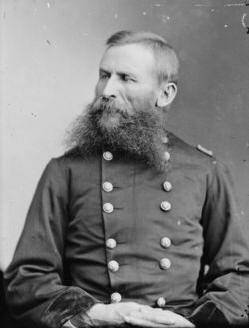 |
[edit] Background
General George Crook commanded a
mixed force of some 970 cavalry and mule-mounted infantry, 80
civilian teamsters and miners, and 260 Crow (or Absaroke) and Shoshone
Indian scouts, traditional foes of the Lakota desiring to retake old
hunting grounds. The expedition was part of a three-pronged campaign by
some 2,400 soldiers to force roughly 2,500 Lakota and Cheyenne warriors
and thousands of noncombatants to return to their reservations.
Crook had made a previous attempt in March, deceived by pleasant weather,
to corner the Lakota. When his force got within a hundred miles of the
Yellowstone River it was struck by a full blizzard that forced him to
abandon his supply train and resulted in numerous frostbite casualties.
When the force managed to locate a track of horses, Crook sent three
companies of the 2nd Cavalry under its commander, Colonel J. J. Reynolds,
to continue the search.
|
Reynolds blundered in attacking a village of Cheyenne reputedly returning to the
reservation, then saw his command dissolve in panic when resistance unexpectedly
stiffened. Crook abandoned the expedition and court-martialed three
2nd Cavalry commanders, including
Reynolds.
[edit] Attacked on the Rosebud
The battle began shortly after 8 a.m. when Crook's Indian scouts who had been
out to the front and flanks returned after being attacked by a large mixed party
of Sioux and Cheyenne.
The battle was waged in hilly terrain, with fighting from ridge to ridge. The
Indian attack initially took the soldiers by surprise as Crook had not posted
pickets due to a general feeling of overconfidence. A hard fight ensued for six
hours. Hard fighting by Crooks
indian
allies during early stages saved his command as they repeatedly charged the
Sioux. Even after the soldiers were fully involved Crow and Shoshone scouts
helped to save isolated units from complete disaster several times during the
action. Crook had sent a detachment of eight companies sent along the
Rosebud canyon to find and attack the assumed Indian camp. After not finding the
camp they returned following the sound of the guns. As this force climbed a
ravine leading up to the battleground from the Rosebud, the Lakota and Cheyenne
broke off their attack and withdrew.
[edit] Results
The Battle of the Rosebud was a draw although Crook remained on the
battleground. Crook reported a loss of 10 dead and 21 wounded, but many later
accounts list the U.S. losses at 28 dead and 56 wounded. Although Crook's force
was left in possession of the battlefield and he claimed a victory, his Indian
scouts refused to continue, halting his advance and preventing him from joining
up with the 7th Cavalry under George Armstrong Custer.
Crook withdrew to a position on Big
Goose Creek, near present-day Sheridan, Wyoming, and to await reinforcements
from the 9th Infantry and 5th Cavalry before resuming the campaign on August 5.
The battlesite
is preserved at the Rosebud Battlefield State Park in Big Horn County, Montana.

http://www.nps.gov/history/history/online_books/hh/1a/hh1m.htm
The Battle of the Little Bighorn—also known as Custer's Last Stand, and, in
the parlance of the relevant Native Americans, the Battle of the Greasy
Grass—was an armed engagement between a Lakota-Northern Cheyenne combined force
and the 7th Cavalry of the United States Army.
It occurred between June 25 and June 26, 1876, near the Little Bighorn
River in the eastern Montana Territory.
The battle was the most famous action of the Indian Wars, and was a remarkable
victory for the Lakota and Northern Cheyenne, led by Sitting Bull. A sizeable
force of U.S. cavalry commanded by Lieutenant Colonel George Armstrong Custer
was defeated; Custer himself was killed in the engagement along with two of his
brothers. It was, however, not the highest infliction of casualties by Native
Americans against U.S. forces, which occurred in the 1791 Battle of the Wabash.
[edit] Prelude to the Battle of Little Bighorn
After the 1875 Sun Dance alliance, made by Sitting Bull between the Lakota and
Cheyenne, thousands of Indians had slipped away from their reservations through
early 1876. Military officials planned a summer campaign to corral them and
force them back to the reservations, using both infantry and cavalry in three
expeditions:
Col. John Gibbon's column of six
companies (A, B, E, H, I, and K) of the 7th Infantry and four (F, G, H, and L)
of the 2nd Cavalry marched east from Fort Ellis in western Montana on March 30,
patrolling the Yellowstone River.
Brig. Gen. George Crook's column of ten companies (A, B, C, D, E, F, G, I, L,
and M) of the 3rd Cavalry, five (A, B, D, E, and I) of the 2nd Cavalry, two
companies (D and F) of the 4th Infantry, and three (C, G, and H) of the 9th
Infantry, moved north from Fort
Fetterman in the Wyoming
Territory on May 29, marching toward the Powder River area.
Brig. Gen. Alfred Terry's command (the entire 7th Cavalry; Companies C and G,
17th U.S. Infantry; and the
Gatling gun detachment of the
20th Infantry) departed westward from Fort Abraham Lincoln in the Dakota
Territory on May 17. They were accompanied by teamsters and packers with 150
wagons and a large contingent of pack mules. Companies C, D, and I, 6th U.S.
Infantry, moved up the Yellowstone from Fort Buford on the Missouri River to set
up a supply depot, and joined Terry on May 29 at the mouth of the Powder River.
The coordination and planning went awry on June 17 when Crook's column was
delayed after the Battle of the Rosebud. Surprised and, according to some
accounts, astonished by the unusually large numbers of Indians faced in the
battle, Crook was essentially defeated in battle and forced to stop and regroup.
Unaware of Crook's battle, Gibbon and Terry proceeded, joining forces in late
June near the mouth of the Rosebud River. They formulated a plan, based on the
discovery of a large Indian trail on June 15, that called for Custer's regiment
to proceed up the Rosebud River, while Terry and Gibbon's united columns would
move towards the Bighorn and Little Bighorn rivers. The officers hoped to trap
the Indian village between these two forces. The 7th Cavalry split from the
remainder of the Terry column on June 22 and began a rapid pursuit along the
trail. Custer was offered the use of the Gatling guns but declined, saying they
would slow his command.[1] He also declined the offer of two further companies
of cavalry on the basis that his regiment could handle anything they found
without additional assistance.
While the Terry/Gibbon column was marching toward the mouth of the Little
Bighorn, on the evening of June 24 Custer's scouts arrived at an overlook known
as the Crow's Nest, 14 miles (23 km) east of the Little Bighorn River. At
sunrise on June 25, Custer's scouts reported to him they could see signs of the
Indian village roughly 15 miles (24 km) in the distance. Custer's initial plan
was a surprise attack on the village the following morning on June 26, but a
report came to him that several hostile Indians had discovered the trail left by
his troops. Assuming their presence had been exposed, Custer decided to attack
the village without further delay. Unbeknownst to Custer, this group of Indians
were actually leaving the encampment on the Big Horn and did not alert the
village. Custer's scouts repeatedly warned him about the size of the village,
with scout Mitch Bouyer saying, "General, I have been with these Indians for 30
years, and this is the largest village I have ever heard of." Custer's
overriding concern was that the Indians would break up and scatter in different
directions. The command began its approach to the Indian village at 12 noon and
prepared to attack in full daylight.[2]
[edit] Seventh Cavalry organization and deployment
The Seventh Cavalry was a veteran organization created just after the American
Civil War. Many men were veterans of the war, including most of the leading
officers. A significant portion of the regiment had previously served
four-and-a-half years at Ft. Riley, Kansas, during which time it fought one
major engagement and numerous skirmishes, experiencing casualties of 36 killed
and 27 wounded. Six other troopers had died of drowning and 51 from cholera
epidemics.
US Seventh Cavalry Battle GuidonHalf of the 7th Cavalry's companies had just
returned from 18 months of constabulary duty in the deep South, having been
recalled to Fort Abraham Lincoln to reassemble the regiment for the campaign.
About 20 percent of the troopers had been enlisted in the prior seven months
(139 of an enlisted roll of 718), were only marginally trained, and had no
combat or frontier experience. A sizable number of these recruits were
immigrants from Ireland, England and Prussia, just as many of the veteran
troopers had been before their enlistments. Archaeological evidence also
suggests that many of these troopers were malnourished and in poor physical
condition. However, this was often the case in the army at this time.[3]
Of the 45 officers and 718 troopers then assigned to the 7th Cavalry (including
a second lieutenant detached from the 20th Infantry and serving in Company L),
14 officers (including the regimental commander, Col. Samuel D. Sturgis) and 152
troopers did not accompany the 7th during the campaign. Among those left behind
at Fort Abraham Lincoln was the regimental band. The ratio of troops detached
for other duty (approximately 22%) was not unusual for expeditions of this
size,[4] and part of the officer shortage was chronic, due to the Army's rigid
seniority system: three of the regiment's 12 captains were permanently detached,
and two had never served a day with the 7th since their appointment in July
1866.[5] Three second lieutenant vacancies (in E, H, and L Companies) were also
unfilled.
Following a forced night march on June 24–June 25 and the discovery of the
Indian village the morning of June 25, Custer rode down into the valley of the
Little Big Horn in preparation to attack. At roughly 12:15 p.m.,[6] he divided
the 7th Cavalry into four groups:
The largest battalion consisted of Companies C, E, F, I, and L, personally led
by Custer. It numbered 13 officers, 198 men (seven of whom would eventually be
detached before the "last stand") and three civilians—newspaper reporter Mark
Kellogg and two scouts. Commander of Company I and second-in-command of the
Custer's battalion was Irishman, Captain Myles Keogh. Two of Custer's relatives
later joined the column. Troop C was commanded by Custer's brother, Capt. Thomas
Custer and L Company by his brother-in-law, 1st Lt. James Calhoun. This
battalion marched along a ridge line on the east bank of the Little Bighorn in
an attempt to enter the encampment from the north. Four of the battalion's
officers (1st Lt. Algernon E. Smith, 2nd Lts. James G. Sturgis, John J.
Crittenden, and William V. W. Reily) were on temporary duty that resulted in
their deaths, and 2nd Lt. Charles C. DeRudio was detached from E Company and
survived as a result (see 7th Cavalry officers at the Little Bighorn).
A second battalion, led by Maj. Marcus Reno, was sent into the Little Bighorn
valley to provoke an engagement. This battalion consisted of Companies A, G and
M, and numbered 11 officers, 131 troopers and most of the approximately 35
Sioux, Ree/Arikara and Crow scouts.
A third battalion was led by a company commander, Capt. Frederick Benteen, and
was made up of Companies D, H and K, with five officers and 110 men. Custer
ordered Benteen to scout nearby valleys and attack any body of Indians he
encountered. While he did so, Benteen would be out of supporting distance from
the rest of the command.[7] Benteen himself described his mission to his wife in
a letter days after the action, "General Custer divided the 7th Cavalry into
three Battalions — about 15 miles (24 km) from an Indian village, the whereabout
of which he did not know exactly. I was ordered with three Co's., D, H, & K, to
go to the left for the purpose of hunting for the valley of the river—Indian
camp—or anything I could find. I found nothing, and after marching 10 miles (16
km) or so in pursuit of the same determined to return to Custer's trail."[8]
The last group was the regimental pack train, consisting of seven or eight
troopers from each company and escorted by Company B. Commanded by Capt. Thomas
McDougall, this sizable force had two officers, 127 troopers and seven civilian
packers.
Each of the first three detachments was to seek out the Indian encampments,
attack them, and hold them in place until the other two detachments arrived to
support. Custer had employed similar tactics in 1868 during the Battle of the
Washita.
[edit] Indian Village
The unusually large village gathered along the banks of the Little Bighorn
included Lakota, Northern Cheyenne and a small number of Arapaho. The size of
the village is unknown, though is estimated to have been 949 lodges, with
between 900 to 1,800 warriors.[9]
[edit] Battle
Movement of the 7th Cavalry
A: Custer B: Reno C: Benteen D: Yates E: Weir
[edit] Reno's attack
The first detachment to attack was Major Reno's, conducted after receiving
orders from Custer issued by Lt. William W. Cooke, as Custer's Crow scouts
reported Sioux tribe members were alarming the village. Reno was ordered to
charge, and began that phase of the battle. The orders, made without accurate
knowledge of the village's size, location, or propensity to stand and fight, had
been to pursue the Indians and "bring them to battle." Reno's force crossed the
Little Bighorn at the mouth of what is today Reno Creek around 3:00 p.m. [10]
and immediately realized that the Lakota and Northern Cheyenne were present "in
force and not running away."
Reno advanced rapidly northeast. However, he suspected "a trap" and stopped a
few hundred yards short of the encampment, dismounting and deploying in a
skirmish line, as standard army doctrine called for. In a skirmish line, every
fourth trooper handled the horses for the troopers taking firing positions, thus
immediately reducing a fighting force by 25 percent. The troopers on the
skirmish line were positioned five to ten yards apart, with officers to their
rear and troopers with horses behind the officers. After an estimated 20 minutes
of long distance firing, Reno's battalion had taken only one casualty, but the
odds against him had become more obvious (Reno estimated five to one) and Custer
had not reinforced him. Trooper Billy Jackson reported that by then, the Indians
had massed for a mounted attack of more than 500 warriors,[11] turning Reno's
exposed left flank and forcing him into a hasty withdrawal into the timber in a
loop of the river.[12] Here the Indians pinned Reno and his men down, and he was
then forced to make a disorderly retreat across the river to reach the high
ground of the bluffs on the other side. The retreat was confused and immediately
disrupted by Cheyenne attacks at close quarters. Reno later reported that three
officers and 29 troopers were killed during the retreat and subsequent fording
of the river, with another officer and 13-18 men missing. Most of these men were
left behind in the timber, although many eventually rejoined the detachment.
The battlefield today.The hasty retreat was believed to have been inspired by
the death of Bloody Knife, a prominent Crow scout. While talking to Reno in the
timber, he was shot in the head, with witnesses claiming some of his brain
matter having actually splattered Reno. This shocking development is believed to
have sufficiently unnerved Reno and to
have inspired his disorganized retreat across the river. Several
witnesses claimed Reno was in a panicked state for a considerable time following
Bloody Knife's death. Atop the bluffs, known today as Reno Hill, Reno's shaken
troops soon linked up with the detachment of Captain Benteen, arriving from the
south. This force had been on a lateral scouting mission when it had been
summoned by Custer's messenger, Italian bugler John Martin (Giovanni Martini)
with the hand-written message "Come on...big village, be quick...bring pacs" ("pacs"
referring to ammunition, meaning that by this time Custer was most likely aware
of the large numbers of Indians they were having to face). Benteen's
coincidental arrival on the bluffs was just in time to save Reno's men from
possible annihilation. Their detachments were then reinforced by McDougall and
the pack train. The 14 officers and 340 troopers on the bluffs organized an
all-around defense and dug rifle pits using whatever implements they had among
them, including knives.
Despite hearing heavy gunfire from the north, including distinct volleys at 4:20
p.m., Benteen concentrated on reinforcing Reno's badly wounded and hard-pressed
battalion, rather than continuing on toward Custer.
Benteen's
apparent reluctance to reach Custer prompted later criticism that he had failed
to follow orders. Around 5:00 p.m., Capt. Thomas Weir and Company D moved
out against orders to make contact with Custer. They advanced a mile, to what is
today Weir Ridge, and could see in the distance Indian warriors on horseback
shooting at objects on the ground. By this time, roughly 5:25 p.m., Custer's
battle had concluded, and what Weir witnessed was most likely warriors shooting
at dead bodies on the Custer battlefield. The other companies eventually
followed by assigned battalions, first Benteen, then Reno, and finally the pack
train. Growing Indian attacks around Weir Ridge forced all seven companies to
return to the bluff before the pack train, with the ammunition, had moved even a
quarter mile. There, they remained pinned down for another day, but the Indians
were unable to breach this tightly held position.
[edit] Custer's fight
Interpretations of Custer's fight are conjecture, since none of his men survived
the battle, while the accounts of surviving Indians are conflicting and unclear.
The gunfire heard on the bluffs by Reno and Benteen's men was from Custer's
fight. His force of roughly 210 men was engaged by the Lakota and Northern
Cheyenne about 3.5 miles (6 km) to the north. Having isolated Reno's force and
driven them away from the encampment, the bulk of the warriors were free to
pursue Custer. The route taken by Custer to his "Last Stand" remains a subject
of debate. One possibility is that after ordering Reno to charge, Custer
continued down Reno Creek to within about a half mile (800 m) of the Little
Bighorn, but then turned north, and climbed up the bluffs, reaching the same
spot to which Reno would soon retreat. From this point on the other side of the
river, he could see Reno charging the village.
Lieutenant Colonel Custer on horseback and his U. S. Army troops make their last
charge at the Battle of the Little Bighorn. It inaccurately shows Custer with a
cavalry saber and wearing a blue uniform {bottom center}.
Lieutenant Colonel Custer and his U. S. Army troops are defeated in battle with
Native American Lakota Sioux and Northern Cheyenne, on the Little Bighorn
Battlefield, June 25, 1876 at Little Bighorn River, Montana.
"Custer's Last Stand." Lieutenant Colonel Custer standing center, wearing
buckskin, with few of his soldiers of the Seventh Cavalry still standing.
Inaccurately shows Custer with a Cavalry saber and long hair.Custer then rode
north along the bluffs, and descended into a drainage called Medicine Tail
Coulee, which led to the river. Some historians believe that part of Custer's
force descended the coulee, going west to the river and attempting
unsuccessfully to cross into the village. According to some accounts, a small
contingent of Indian sharpshooters opposed this crossing. It is possible that
Custer himself was seriously wounded by these marksmen. Some Indian accounts
claim that one of the leaders of this advance was wounded, along with a soldier
carrying a company guidon. [13] Troopers had to dismount to help the wounded men
back onto their horses.[14]
This scenario might explain Custer's purpose for Reno's attack, indicating he
may have intended to coordinate a "hammer-and-anvil" tactic, with Reno holding
the Indians at bay at the southern end of the camp, while Custer drove them
against Reno's line from the north. Other historians have noted that if Custer
did attempt to cross the river near Medicine Tail Coulee, he may have been
inspired by the belief that it was the north end of the Indian camp, when in
fact it was only the middle.
Some traditional historians claim that Custer never approached the river, but
rather continued north across the coulee and up the other side, where he
gradually came under attack. According to this theory, by the time Custer
realized he was badly outnumbered, it was too late to break back to the south
where Reno and Benteen could have provided assistance. Two men from the 7th
Cavalry later claimed to have seen Custer engage the Indians, including the
young Crow scout Ashishishe, known by his translated name Curley, and the
trooper Peter Thompson, who allegedly fell behind Custer's column. The accuracy
of their recollections remains controversial, with battle participants and
historians almost universally discrediting Thompson's claim.
A new interpretation is based on recent archeological evidence and Indian
testimony. In the 1920s, battlefield investigators discovered hundreds of .45-70
shell cases along the ridge line, known today as Nye-Cartwright Ridge, between
South Medicine Tail Coulee and the next drainage at North Medicine Tail (also
known as Deep Coulee). Historians believe Custer divided his battalion into two
(and possibly three) company battalions, retaining personal command of one while
presumably delegating Captain George W. Yates to command the second.
One of the battalions made a feint attack down Medicine Tail Coulee to
Minneconjou Ford (the north and south forks are shaped like a "V"), with the
intent of relieving the pressure on Reno's detachment, possibly last seen by
Custer withdrawing the skirmish line into the timber on the edge of the Little
Bighorn River. The second battalion, on the heights, would have provided long
range cover fire. Warriors could have been drawn to the feint attack, forcing
the battalion back towards the heights, up the north fork drainage, away from
the troops providing cover fire above. The covering battalion would have moved
towards a reunion, delivering heavy volley fire and leaving the trail of
expended cartridges discovered 50 years later.
Custer's fight, from this point, is difficult to follow. According to the
location of the bodies found on the battlefield, Companies I and L, under
Captain Keogh's command, were possibly detached and dismounted to provide a rear
guard, and may have been the last organized defense. The remaining companies
were forced up the ridge to the top of what is known today as Custer Hill. The
hilltop itself was probably too small to accommodate the survivors and wounded.
According to Indian testimony, the command structure rapidly broke down,
although smaller "last stands" were apparently made by several groups.
By almost all accounts, within less than
an hour Custer's force was completely annihilated.[15][16][17] David
Humphries Miller, who between 1935 and 1955 interviewed the last Indian
survivors of the battle, wrote that the Custer fight lasted less than one-half
hour.[18] The Lakota asserted that Crazy Horse personally led one of the large
groups of warriors that eventually overwhelmed the cavalrymen in a surprise
charge from the northeast, causing a breakdown in the command structure and
panic among the troops. Many of these men threw down their weapons while
Cheyenne and Sioux warriors rode them down. Some Indian accounts recalled this
segment of the fight as a "buffalo run."[19][20] Eyewitness accounts from
Indians, long ignored by traditional historians, were collected for many years
after the battle and continue to be analyzed.
The exact number of Indian warriors participating in the battle has never been
determined and remains controversial. It has been estimated that in the overall
battle the warriors outnumbered the 7th Cavalry by approximately three to one,
or roughly 1800 against 600.[21] In Custer's fight, this ratio could have
increased to as high as nine to one (1800 against 200) after his isolated
command became the main focus of the fighting. Some historians, however, claim
the ratio of the Custer fight to be as low as three to one. By almost all
accounts, Custer's detachment was certainly outnumbered and was caught in the
open on unfamiliar terrain.
It has been claimed in defense of Custer that some of the Indians were armed
with repeating Spencer, Winchester rifles and Henry rifles, while the 7th
Cavalry carried single-shot Springfield Model 1873 carbines, caliber .45-70.[22]
These rifles had a slower rate of fire than the aforementioned repeating rifles
and tended to jam when overheated. The carbines had been issued with a copper
cartridge, and troopers soon discovered that the copper expanded in the breech
when heated upon firing, thus jamming the rifle. Troopers were forced to extract
the cartridges manually with a knife blade, rendering the carbines useless in
combat except as a club. Indian accounts, documented in paintings on buffalo
hides, indicate a fight between bows and arrows and cavalry pistols.[23] This
representation may support the claims of the Army's carbines malfunctioning.
The Springfield Model 1873 was selected by the Army Ordnance Board after
extensive testing in competition with other rifles. It was considered to be the
most reliable rifle after multiple weathering tests. The choice of a single-shot
rifle over repeat-firing rifles was a deliberate attempt to prevent over use of
ammunition, following the Army's emphasis at that time on marksmanship and
taking into account the expenses associated with the fact that every cartridge
arrived at the end of a 1,000-mile (1,600 km) supply line. While Indian accounts
of the Custer fight note men throwing down their rifles, possibly in fear or
anger, allegations of jammed rifles do not appear in other confrontations during
the Indian Wars.
In addition to rifles (including antiquated muzzle-loaders and Army Sharps
carbines, which the Indians acquired years earlier in trades with the settlers
along the South Platte), opposing warriors carried a large variety of primitive
weapons including bows and arrows and several styles of heavy, stone-headed war
clubs. It is believed that at least half of the Indian warriors were armed only
with bows and "many arrows," making it the primary weapon.[24] Many Indians,
including the thirteen year-old Black Elk, claimed to have acquired their first
gun from dead troopers at the battle.[25] The Sioux warrior White Bull described
the Indians as systematically stripping slain troopers of their guns and
cartridge belts so that as the losses mounted among Custer's men, the gunfire
from the Indians steadily increased.[26] The Cheyenne participants gave similar
testimony: the Indians' firepower was increased by the new carbines they took
off the soldiers, and the large amounts of ammunition they were constantly
recovering from the saddlebags of the troopers' horses.
The exposed terrain of the battlefield gave Lakota and Cheyenne bows and arrows
a deadly advantage. The heights above the Little Bighorn River, unlike the
valley itself, are considered completely unsuited for mounted troops. Custer's
men were essentially trapped on higher ground from which direct fire at the
Indians through the brush would have been difficult. On the other hand, the
Lakota and Cheyenne would have been able to shoot their arrows from heavy
sagebrush (below the ridge where Custer's men were making their stand) by aiming
an arch over obstacles at the puffs of smoke from the troopers' weapons. A large
volume of arrows could have ensured severe casualties and, in fact, many of the
slain troopers discovered were found to have multiple arrows protruding from
their bodies. Many of the dead cavalrymen also appeared to have their skulls
crushed, possibly by the stone-headed war clubs.[27] It is unknown if these
injuries occurred during the battle or post-mortem.
[edit] Custer's resistance
Recent archaeological work at the battlefield site indicates that organized
resistance in the form of skirmish lines probably took place. The remainder of
the battle possibly took on the nature of a running fight. Modern archeology and
historical Indian accounts indicate that Custer's force may have been divided
into three groups, with the Indians attempting to prevent them from effectively
reuniting. Indian accounts describe warriors (including women) running up from
the village to wave blankets in order to scare off the soldiers' horses.
Fighting dismounted, the soldiers' skirmish lines were most likely overwhelmed.
Studies show that it would have taken an hour to cover the long stretch over
which the troopers died and by most accounts, the battle was over within this
time. Army doctrine would have called for one man in four to be a horseholder on
the skirmish lines and, in extreme cases, one man in eight. As the Custer field
is unique, in that markers were placed where men were believed to have fallen a
couple of years after the battle, the placements of troops have been roughly
construed. The troops evidently died in several groups, including on Custer
Hill, around Captain Myles Keogh and strung out towards the Little Big Horn
River. As individual troopers were wounded or killed, initial defensive
positions would have become untenable.
Recent documentaries suggest that there may not have been a "Last Stand," as
traditionally portrayed in popular culture. Instead, archaeologists suggest that
Custer's troops were not surrounded but rather overwhelmed by a single charge.
This scenario corresponds to several Indian accounts stating Crazy Horse's
charge swarmed the resistance, with the surviving soldiers fleeing in panic. At
this point, the fight became a rout with warriors riding down the fleeing
troopers and hitting them with lances and coup sticks.[28] Many of these
troopers were believed to have ended up in a deep ravine 300-400 yards away from
what is known today as Custer Hill. At least 28 bodies, including scout Mitch
Bouyer, were discovered in the gulch, their deaths possibly the battle's final
actions. According to other Indian accounts, about 40 men made a desperate stand
around Custer on Custer Hill, delivering volley fire.[29] Many of the Indian
casualties were believed to have been suffered during this closing segment of
the battle.
Indian casualties have never been determined and estimates vary widely, from as
few as 36 dead (from Indian listings of the dead by name) to as many as 300. The
Sioux Chief Red Horse told Col. W. H. Wood that the Indians suffered 136 dead
and 160 wounded during the battle.[30] Many historians do not agree with these
categorical numbers, since Indians were not known to keep such statistics. It is
also believed that many Indian participants simply fabricated casualty numbers
to appease frustrated historians.
[edit] The aftermath
After the Custer force was annihilated,
the Lakota and Northern Cheyenne regrouped to attack Reno and
Benteen.
The fight continued until dark (approximately 9:00 p.m.) and for much of
the next day, with the outcome in doubt. Reno credited Benteen's leadership with
repulsing a severe attack on the portion of the perimeter held by Companies H
and M.[31] On June 26, the column under General Terry approached from the north,
and the Indians drew off in the opposite direction. The Crow scout White Man
Runs Him was the first to tell General Terry's officers that Custer's force had
"been wiped out." Reno and Benteen's wounded troops were given what treatment
was available at that time; five later died of their wounds. Two of the
regiment's three surgeons had been with Custer's column; the remaining doctor
was assisted by interpreter Fred Gerard.
The soldiers on Reno Hill were unaware of what had happened to Custer until
Terry's arrival and were reportedly stunned by the news. An examination was
immediately made of the Custer battle site, but soldiers could not determine
what exactly had transpired. There was evidence of organized resistance
including what appeared to be breastworks made of dead horses on Custer
Hill.[32] The Indian dead had mostly been removed from the field. The 7th's dead
were identified as best as possible and hastily buried where they fell. Custer
was found to have been shot in the left chest and left temple. Either wound
would have been fatal, though he appeared to have bled from only the chest
wound, meaning his head wound may have been delivered post-mortem. He also
suffered a wound to the arm. Some Lakota oral histories assert that Custer
committed suicide to avoid capture and subsequent torture. Several Indian
accounts do note multiple soldiers committing suicide near the end of the
battle, but the claim of Custer's suicide is usually discounted since he was
right-handed. His body was found near the top of Custer Hill, also known as
"Last Stand Hill," where a large obelisk inscribed with the names of the 7th's
casualties now stands. Most of the dead had been stripped of their clothing,
mutilated, and were in an advanced state of decomposition making identification
of many of the bodies impossible.[33]
Several days after the battle, Curley, Custer's Crow scout who was relieved of
duty near Medicine Tail Coulee, gave an account of the battle which indicated
that Custer had attacked the village after attempting to cross the river, but
had been driven back, retreating towards the hill where his body was found.[34]
The scenario seemed compatible with Custer's aggressive style of warfare and
with evidence found on the ground, forming the basis of many popular accounts of
the battle. The story of Custer's purported heroic attack across the river,
however, was undermined by the account of participant Chief Gall, who told Lt.
Edward Godfrey that Custer never came close to the river.[35] Gall's account,
however, was criticized by Cheyenne and Sioux participants.[36]
The 7th Cavalry suffered 52 percent casualties: 16 officers and 242 troopers
killed or died of wounds, 1 officer and 51 troopers wounded. Every soldier in
the five companies with Custer was killed, although for years rumors persisted
of survivors.[37] The sole surviving animal reportedly discovered on the
battlefield by General Terry's troops was Captain Keogh's horse Comanche.[38]
Comanche in 1887
Scene of Custer's last stand, looking in the direction the Indian village and
the deep ravine. Photo by Stanley J. Morrow, spring 1879.In 1878, the army
awarded 24 Medals of Honor to participants in the fight on the bluffs for
bravery, most for risking their lives to carry water from the river up the hill
to the wounded.[39] Few questioned the conduct of the enlisted men, but many
questioned the tactics, strategy and conduct of the officers.
Beginning in July, the 7th Cavalry was assigned new officers[40] and recruiting
efforts begun to fill the depleted ranks. The regiment, reorganized into eight
companies, remained in the field as part of the Terry Expedition, now based on
the Yellowstone River at the mouth of the Big Horn and reinforced by Gibbon's
column. On August 8, 1876, after Terry was further reinforced with the 5th
Infantry, the expedition moved up Rosebud Creek in pursuit of the Lakota. It met
with Crook's command, similarly reinforced, and the combined force, almost 4,000
strong, followed the Lakota trail northeast toward the Little Missouri River.
Persistent rain and lack of supplies forced the column to dissolve and return to
its varying starting points. The 7th Cavalry returned to Fort Lincoln to
reconstitute.
The Army as a whole was expanded by 2,500 men to meet the emergency resulting
from the disaster befalling the 7th Cavalry. The Democratic Party-controlled
House of Representatives actually abandoned for a session its campaign to
drastically curtail the size of the Army. Word of Custer's fate reached the 44th
United States Congress as a conference committee was attempting to reconcile
opposing appropriations bills approved by the House and the Republican Senate. A
measure originally sponsored by the Texas delegation to increase the size of
cavalry companies to 100 enlisted men was approved on July 24, and the ceiling
on the size of the Army temporarily lifted by 2,500 on August 15.[41]
[edit] Battle controversies
The Battle Of The Little Bighorn was the subject of an 1879 U.S. Army Court of
Inquiry, made at Reno's request, in Chicago, during which his conduct was
scrutinized. Some testimony was presented suggesting that he was drunk and a
coward, but since none of this came from army officers, Reno's conduct was found
to be without fault. The charge of cowardice has been leveled at Reno throughout
the years due to his hastily ordered retreat. Reno defenders point out that
while the retreat was disorganized, Reno did not withdraw from his position
until it was clear that he was outnumbered and outflanked.
Benteen has been criticized for "dawdling" on the first day of the fight, and
supposedly disobeying Custer's written orders to bring "pacs" (ammunition).
However, Benteen has also been acknowledged by many historians for supporting
and defending Reno's men on Reno Hill.
Critics believe Custer made strategic
errors from the start of the campaign, refusing the use of a battery of
Gatling
guns and General Terry's offer of an additional battalion of the 2nd Cavalry led
by Capt. James S. Brisbin.
Custer's reasoning was that the
Gatling guns would impede his
march up the Rosebud and hamper his mobility. Considering his rapid march
en route to the Little Big Horn, averaging almost 30 miles (48 km) a day, this
was an accurate assessment. Each gun was hauled by four horses and it often
became necessary for soldiers to drag the guns by hand over obstacles. Custer
also believed that the 7th Cavalry could handle any Indian force encountered,
and the addition of the four companies of the 2nd would not alter the outcome.
When the offer of the men of the 2nd Cavalry was made, he reportedly replied to
Brisbin that the 7th "could handle anything."[42] It is believed Custer
suspected that he would be outnumbered by the Indians, although he did not know
by how much.
The division of his force into four smaller detachments (including the pack
train) is believed to be evidence of inadequate reconnaissance on his part in
determining the size and location of the Indian village. By the time the battle
began, Custer's men were widely scattered and unable to support each
other.[43][44] It is believed one of Custer's greatest fears before the battle
was the combined tribes escaping to the south and scattering into different
groups, thus he considered an immediate attack to be the course of action.
Criticism of Custer was not universal, as Lieutenant General Nelson A. Miles
wrote in 1877 while investigating the battlefield, "The more I study the moves
here [on the Little Big Horn], the more I have admiration for Custer."[45]
For years, a debate raged as to whether Custer had disobeyed Terry's orders by
attacking the village before his reinforcements arrived. Almost 100 years after
the battle, a document surfaced indicating Terry had actually given Custer
considerable freedom to attack the Indians if he deemed the action necessary.
Death of Custer - A dramatic portrayal of Sitting Bull stabbing Custer, with
dead Native Americans lying on ground, in scene by Pawnee Bill's Wild West Show
performers. c.1905Custer's widow Elizabeth Bacon Custer actively affected the
history of the battle by suppressing criticism of her husband. A number of
participants decided to wait for her death before disclosing what they knew;
however, she outlived almost all of them. As a result, the event was recreated
along tragic Victorian lines in numerous books, films and other media. Custer's
legend was soon embedded in the American imagination as a heroic officer
fighting valiantly against savage forces, an image popularized in Wild West
extravaganzas hosted by showman "Buffalo Bill" Cody, Pawnee Bill, and others.
In November 2006, an ethnologist theory by Thomas Bailey Marquis in his 1933
book The Cheyennes of Montana was revived. Marquis stated that the Indians
present at Little Bighorn (and on the Plains in general) considered the Sioux
War of 1876 to be a misnomer, that in actuality the Lakota participated not as
the main antagonist of the U.S. government but only as allies of the Cheyenne,
whom they considered the actual objective of the military campaign. Had the
Lakota, who did not have the tribal unity and central authority epitomizing the
Cheyenne, not taken this view, the theory concludes that the close alliance
between the peoples would not have occurred and the outcomes of the campaign
could have been greatly different.[46]
By the end of the 20th century, the general recognition of the mistreatment of
the various Indian tribes in the settling of the American West, and the
perception of U.S. Cavalry's role in it, have altered the image of the battle
(and by extension, of Custer) to that of a confrontation between relentless U.S.
westward expansion and Native Americans defending their traditional lands and
way of life.
[edit] Battlefield preservation
Main article: Little Bighorn Battlefield National Monument
Indian MemorialThe site was first preserved as a national cemetery in 1879, to
protect graves of the 7th Cavalry troopers buried there. It was redesignated
Custer Battlefield National Monument in 1946, and later renamed Little Bighorn
Battlefield National Monument in 1991.
Memorialization on the battlefield began in 1879 with a temporary monument to
U.S. dead. This was replaced with the current marble obelisk in 1881. In 1890
the marble blocks that dot the field were added to mark the place where the U.S.
cavalry soldiers fell. The bill that changed the name of the national monument
also called for an Indian Memorial to be built near Last Stand Hill. On Memorial
Day 1999, two red granite markers were added to the battlefield where Native
American warriors fell. As of December 2006, there are now a total of ten
warrior markers (three at the Reno-Benteen Defense Site, seven on the Custer
Battlefield).[47]