Published
August 29th, 2007 in
Articles
New Orleans two years after
by Greg Palast
|
|
[Thurs August 30] “They wanted them poor niggers out of
there and they ain’t had no intention to allow it to be reopened
to no poor niggers, you know? And that’s just the bottom line.”
It wasn’t a pretty statement. But I wasn’t looking for pretty.
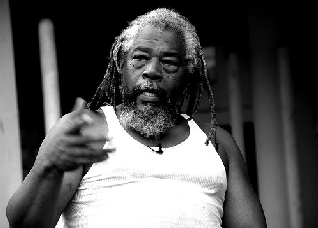
I’d taken my investigative team to New Orleans to meet with Malik
Rahim. Pretty isn’t Malik’s concern.
We needed an answer to a weird, puzzling and horrific
discovery. Among the miles and miles of devastated houses, rubble
still there today in New Orleans, we found dry, beautiful homes.
But their residents were told by guys dressed like Ninjas wearing
“Blackwater” badges: “Try to go into your home and we’ll
arrest you.”
|
| |
|
These aren’t just any homes. They are the public housing projects
of the city; the Lafitte Houses and others. But unlike the cinder
block monsters in the Bronx, these public units are beautiful
townhouses, with wrought-iron porches and gardens right next to the
tony French Quarter.
Raised up on high ground, with floors and walls of concrete, they
were some of the only houses left salvageable after the Katrina flood.
Yet, two years later, there’s still bars on the windows, the doors
are welded shut and the residents banned from returning. On the first
anniversary of the flood, we were filming this odd scene when I saw a
woman on the sidewalk, sobbing. Night was falling. What was wrong?
“They just messing all over us. Putting me out our own
house. We come to go back to our own home and when we get there
they got the police there putting us out. Oh, no, this is not
right. I’m coming here from Texas seeing if I can get my house
back. But they said they ain’t letting nobody in. But where we
gonna go at?”
Idiot me, I asked, “Where are you going to go tonight?”
“That’s what I want to know, Mister. Where I’m going to go
- me and my kids?”
With the help of Patricia Thomas, a Lafitte resident, we broke
into an apartment. The place was gorgeous. The cereal boxes still
dry. This was Patricia’s home. But we decided to get out before we
got busted.
|
 |
| |
|
I wasn’t naïve. I had a good idea what this scam was all about:
89,000 poor and working class families stuck in Homeland Security’s
trailer park gulag while their good homes were guarded against their
return by mercenaries. Two decades ago, I worked for the Housing
Authority of New Orleans. Even then, the plan was to evict poor folk
out of this very valuable real estate. But it took the cover of a
hurricane to do it.
Malik’s organization, Common Ground, wouldn’t wait for permission
from the federal and local commissars to help folks return. They
organized takeovers of public housing by the residents. And, in the
face of threats and official displeasure, restored 350 apartments in a
destroyed private development on the high ground across the
Mississippi in the ward called, “Algiers.” The tenants rebuilt their
own homes with their own sweat and their own scraps of cash based on a
promise of the landlords to sell Common Ground the property in return
for restoring it.
Why, I asked Malik, was there this strange lock-out from public
housing?
Malik shook his dreds. “They didn’t want to open it up. They
wanted them closed. They wanted them poor niggers out of there.”
For Malik, the emphasis is on “poor.” The racial politics of the
Deep South is as ugly as it is in Philadelphia, Pa. But the New
Orleans city establishment has no problem with Black folk per se.
After all, Mayor Ray Nagin’s parents are African-American.
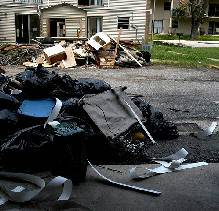 |
It’s the Black survivors without the cash that are a problem.
So where New Orleans once stood, Mayor Nagin, in connivance with a
Bush regime more than happy to keep a quarter million poor folk
(i.e. Democrats) out of this swing state, is creating a new city:
a tourist town with a French Quarter, loose-spending drunks,
hot-sheets hotels and a few Black people to perform the modern
version of minstrel shows.
|
| |
|
Malik explained, “It’s two cities. You know? There’s the city for
the white and the rich. And there’s another city for the poor and
Blacks. You know, the city that’s for the white and rich has recovered.
They had a Jazz Fest. They had a Mardi Gras. They’re going to have the
Saints playing for those who have recovered. But for those who haven’t
recovered, there’s nothing.”
So where are they now? The sobbing woman and her kids are gone: back
to Texas, or wherever. But they will not be allowed back into Lafitte.
Ever.
And Patricia Thomas? Patricia found work sweeping up tourists’ vomit
and beer each morning at a French Quarter karioke joint. Not much pay,
no health insurance, of course. A few months ago, Patricia died - in a
city bereft of health care. New Orleans has closed all its public
hospitals but for one “charity” make-shift emergency ward in an
abandoned department store.
And the one bright star, Malik’s housing project? The tenants’ work
was done this past December. By Christmastime, they received their
eviction notices - and all were carried out of their rebuilt homes by
marshals right after the New Year, including a paraplegic resident who’d
lived in the Algiers building for decades.
Hurricane recovery is class war by other means. And in this war of
the powerful against the powerless, Mr. Bush can rightly land his
fighter plane in Louisiana and declare that, unlike the war in Iraq, it
is, indeed, “Mission Accomplished.”