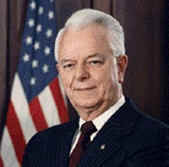
| Yet, this Chamber is, for the most part,
silent -- ominously, dreadfully silent. There is no debate, no discussion, no attempt to
lay out for the nation the pros and cons of this particular war. There is nothing. We stand passively mute in the United States Senate, paralyzed by our own
uncertainty, seemingly stunned by the sheer turmoil of events. Only on the editorial pages
of our newspapers is there much substantive discussion of the prudence or imprudence of
engaging in this particular war.
And this is no small conflagration we contemplate. This is no simple attempt to defang
a villain. No. This coming battle, if it materializes, represents a turning point in U.S.
foreign policy and possibly a turning point in the recent history of the world.
This nation is about to embark upon the first test of a revolutionary doctrine applied
in an extraordinary way at an unfortunate time. The doctrine of preemption -- the idea
that the United States or any other nation can legitimately attack a nation that is not
imminently threatening but may be threatening in the future -- is a radical new twist on
the traditional idea of self defense. It appears to be in contravention of international
law and the UN Charter. And it is being tested at a time of world-wide terrorism, making
many countries around the globe wonder if they will soon be on our -- or some other
nation's -- hit list. High level Administration figures recently refused to take nuclear
weapons off of the table when discussing a possible attack against Iraq. What could be
more destabilizing and unwise than this type of uncertainty, particularly in a world where
globalism has tied the vital economic and security interests of many nations so closely
together? There are huge cracks emerging in our time-honored alliances, and U.S.
intentions are suddenly subject to damaging worldwide speculation. Anti-Americanism based
on mistrust, misinformation, suspicion, and alarming rhetoric from U.S. leaders is
fracturing the once solid alliance against global terrorism which existed after September
11.[1]
For this speech he was honored by The Nation Magazine in
December 2003 and he uttered these words:
![Robert3.jpg]() |
As each day passes and as more American soldiers are killed and
wounded in Iraq, I become ever more convinced that the war in Iraq was the wrong war at the
wrong time in the wrong place for the wrong reasons. Contrary to the President's rosy
predictions--and the predictions of others in the Bush Administration--the United States has
not been universally greeted as a liberator in Iraq. The peace--if one can use the term
"peace" to describe the chronic violence and instability that define Iraq today--the
peace is far from being won. Iraqi citizens may be glad that Saddam Hussein is no longer in
power, but they appear to be growing increasingly resentful that the United States continues
to rule their country at the point of a gun. |
What a huge price we are now paying for the President's bullheaded rush to invoke the
unwise and unprecedented doctrine of pre-emption to invade Iraq, an invasion without
provocation, an invasion without the support of the United Nations or the international
community.
It would be tragic enough if the casualties of the Iraq war were confined to the
battlefield, but they are not. The casualties of this war will have serious repercussions
for generations to come. Truth is one casualty. Despite the best efforts of the White
House to contort the invasion of Iraq into an extension of the war on terror, there was
never a connection between Saddam Hussein and September 11. There was never a connection
between Iraq and September 11. Not a single Iraqi was among the nineteen hijackers of
those four planes. Despite dire warnings from the President, Saddam Hussein had at his
fingertips neither the means nor the materiel to unleash deadly weapons of mass
destruction on the world. Despite presidential rhetoric to the contrary, Iraq did not pose
a grave and gathering menace to the security of the United States. The war in Iraq was
nothing less than a manufactured war. It was a war served up to a deliberately misled and
deluded American public to suit the neoconservative political agenda of the Bush White
House.[2]
How noble was Byrd ?
Reading the above one might think Senator Byrd is a great noble
statesman with courage, but looking at the past indicates otherwise. In 1991 on the day of
the vote to attack Iraq, by reputation then the most powerful Senator in America, Robert
Byrd of West Virginia, complained, "We are slaves to some of the lobbying groups. I
do not have to name names, but I could".[3]
A privately published monograph on the Vietnam War examined statistics
from the National Archives for data on the dead. In the Vietnam War the United States
suffered dead at the rate of 30 per 100,000 of general population. West Virginia had the
highest per capita death rate of any state, over 40 dead per 100,000 general population.
The Jewish contribution
 |
This country's 6,000,000 Jews contributed only 269 bodies to
that war. Their death rate was 4.5 deaths per 100,000 Jews. Other Americans died at almost 7
times the rates that Jews died and sons of West Virginia at almost 10 times the rate.[4] Revealing traits can be gleaned from examining the dead of Logan County, West
Virginia. With a population of 45,000 the county had 48 young men die in Vietnam. |
Young men of Logan County died at more than three times the national
average and almost 25 times the rate of the Jews of America.
West Virginia heros

|
Two of the dead, Ted Belcher and Frankie Molnar, received the Medal of Honor
posthumously for their bravery.[5] To
put the sacrifice and courage of these men in perspective, during World War II American Jewry
with a population of almost five million in 1940 were awarded two Medals of Honor for their
courage.[6]
Yet these men from a depressed coal mining area in West Virginia were typical of men who
received no sympathy or recognition from a national media more concerned with childish
exhibitions of rectitude. |
Senator Byrd remains quiet
Senator Byrd may have plans to name those responsible on his tombstone or have their
identities engraved on his coffin. Yet even he hesitates and will sacrifice his
constituents for the benefit of the Israeli lobby or out of fear. We truly are a nation of
cowards.
[1]
http://www.commondreams.org/views03/0212-07.htm
[2]
http://www.thenation.com/doc.mhtml%3Fi=20031229%26s=byrd
[3].
Washington Post Weekly Edition, p9, Jun 24, 1991
[4].
William F. Abbott, The Names on the Wall: A Closer Look - A Sociological Analysis and
Commentary, June 1991 (Privately published by Mr. Abbott of 121 Imperial Avenue, Westport,
Connecticut, 06880)
[5].
Veteran, p14, Jan 1990 (monthly publication of Vietnam Veterans of America)
[6].
NYT, p34, Nov 5, 1989
|