African tyrant: The truth about Amin
|
|
January 16 2007 at 10:04AM
Like the young British doctor in 'The Last King of Scotland',
Richard Dowden was living in Uganda when Idi Amin seized power. But
he says the film is wrong to blame the UK for the coup that brought
the tyrant to power.
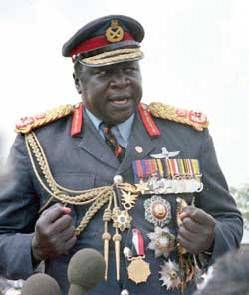
The first time I saw Idi Amin was when - as in the film - he leapt
on to a platform in my local town to address the people. He used
much the same words as he does in the film. "I am one of you, I know
you, we are going to make life better..." And, like Nicholas
Garrigan, the film's young Scottish doctor, I was swept along by
Amin's ebullient enthusiasm, joining the crowd to shout a huge "O
ye" in answer to his. He then picked us white muzungus out of the
crowd and praised us, telling the people we had come to help Uganda,
and Ugandans should welcome us and respect us. We got a huge cheer
too. If he had offered me a job at that moment...
|
| |
|
| |
|
The Hollywood Version
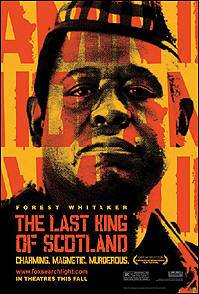
Forest Whitaker is a brilliant Idi Amin.
The voice, the stance but most of all the eyes flicking this way and
that until he chooses his mood: smile or smite. Seconds tick by as
he weighs the choice, and then the huge smile lights up his face; or
the storm breaks, menacing, murderous.
My challenges to the film are factual. The first concerns who
put Amin in power. There is a moment when he
confides in Garrigan: "Who put me here? - It was British." The
assertion is repeated by Stone, a British diplomat, who says: "Given
we were so intimately involved in him coming to power...
|
 |
'They do not want the rebels to win. They want
to keep them fighting'
Most Brits in Uganda believed their government organised the coup in
1971. Amin had been a loyal sergeant in the King's African Rifles, doing
Britain's dirty work against the Mau Mau rebellion in Kenya in the
1950s. It was assumed he was still "their boy". I too believed it was
the British, until I read papers concerning the coup at the Public
Record Office at Kew in London.
If the British did have a hand in the events of 25 January 1971, the
plotters neglected to tell the British high commissioner in Kampala,
Richard Slater. Foreign Office telegrams reveal a man shocked and
confused at reports of shooting in the streets.
|
|
Who Was Really Behind The Coup
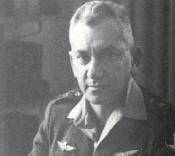
As the day rolls on, Slater reports that the man who knows all
about the coup is Colonel Bar-Lev, the Israeli defence attaché - the
ambassador was away. Quoting Bar-Lev as the source, Slater reports:
"In the course of last night, General Amin caused to be arrested all
officers in the armed forces sympathetic to Obote ... Amin is now
firmly in control of all elements of [the] army ... the Israeli
defence attaché discounts any possibility of moves against Amin."
In the following days, the Israelis take the lead. Bar-Lev is in
constant contact with Amin.
|
Slater tells London that Bar-Lev has explained to him "in
considerable detail [how] ... all potential foci of resistance, both
up-country and in Kampala, had been eliminated." How does he know
this? The Uganda military radio network had been provided by the
Israelis. Soon afterwards, Amin made his first trip as president -
to Israel.
|
At the time of the coup, Slater had recently declared that Amin had
"just enough intelligence to realise he couldn't run the country". He
also said that he was fed up with the president, Milton Obote, who had
taken a strong stand against British arms sales to South Africa, and was
threatening to nationalise British companies in Uganda.
The suspicion at the time was that the British prime minister, Edward
Heath, wanted Obote out of the way at the Commonwealth Conference then
taking place in Singapore, where arms sales to South Africa would be a
hot topic. But elsewhere in Africa, Britain tolerated critics. In
Tanzania, President Julius Nyerere had nationalised British companies
and was even more anti-apartheid than Obote. But when he had been
threatened by a coup, the British sent in the Marines to keep him to
power. The British never tried to remove President Kenneth Kaunda in
Zambia, despite his critical stance on South Africa.
'But if the British did not organise the coup, they were quick to take
advantage of it'
What's Israel's Interest?
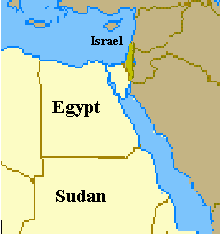
But why should Israel be interested in Uganda? Slater never
directly accused Israel of being behind the coup, but he did explain
why they might have been. In the Six-Day War, Sudan had backed the
Arab cause, and Israel wanted to take the fight to its enemies. They
were supporting rebellion in southern Sudan, supplying the Anya-Nya
fighters with weapons. As Slater said: "They do not want the rebels
to win. They want to keep them fighting."
Obote had been trying to make peace in
Sudan, but, unknown to him, Amin, then head of his army, had
been secretly supplying the Israeli weapons to the rebels. Amin had
good friends in Israel, and suddenly the Israelis had the
opportunity to remove the man who was trying to broker peace, and
put their man in power.
|
 |
| |
|
But if the British did not organise the coup,
they were quick to take advantage of it. Bruce McKenzie, MI6's senior
Africa operator, was also the Kenyan president's foreign affairs
adviser. (Perhaps that was a deal they had made with Jomo Kenyatta. The
British would keep him in power if he accepted that one of their agents
was in the heart of his government.) McKenzie urged London to support
Amin. His first trip after the coup was also to Israel, where he met the
prime minister, Golda Meir. She was said to be shocked at Amin's
shopping list for arms.
McKenzie reported to the Foreign Secretary, Alec Douglas-Home: "The way
is now clear for our high commission in Kampala to get close to Amin."
The British press also welcomed Amin. The Financial Times declared him
"Man of the Week"; The Daily Telegraph called him "a welcome contrast to
other African leaders and a staunch friend of Britain".
In Kampala, however, Slater - who comes across in the records as a
decent and honest man - is worried about Amin, and wants to keep a
distance. But, urged on by McKenzie, Douglas-Home gives Slater his
orders: "The PM will be watching this and will, I am sure, want us to
take quick advantage of any opportunity of selling arms. Don't overdo
the caution."
Despite the reports of mass murder of the ethnic groups who had
supported Obote, and the assassination or disappearance of anyone who
spoke out, the Heath government invited Amin to London for a state
visit, where he rode with the Queen in an open carriage, and dined at
Buckingham Palace. He was also taken on visits to army camps and invited
to buy whatever weapons he wanted. Sell before the Israelis do, was the
message.
Around the end of 1971, Amin visited Libya and came away a changed man -
not in character but in political direction. Perhaps they gave him nicer
weapons, or did not charge him. Maybe he felt patronised by the British,
as he had been all his life. Not even now he was president did they
really respect him. Perhaps he was persuaded that Africans should stand
with the Palestinians. He was not alone. Arab countries did a deal with
Africa: support the Palestinians, and we will support you against
apartheid in South Africa. So Amin turned on his British supporters, and
on the British in Uganda. In 1972, he expelled Uganda's Asians and took
hostages. Life became difficult for whites even out in the villages, and
when Amin declared that we were all British spies, I decided it was time
to leave.
My second problem is with the film's ending, which announces on screen
that Idi Amin was overthrown by the Tanzanian army in 1979, having
killed 300,000 people, as if that was the end of the nightmare. In fact,
it was only half way through.
When I arrived, he was very popular among the Baganda people, who had
hated Obote. He also had that streak of populism the film captures
perfectly. He could move crowds to cheer and dance and sing. In a
strange way, many Ugandans learned to duck and weave and live with him.
I had become a journalist then, and Ugandan friends begged me not to
write bad things about Amin because that would enrage him - and when he
was enraged he was dangerous.
How many people he killed can only be speculation, but the terrible
truth is that things got worse. In the next months there were three
presidents and Milton Obote, Uganda's first president, was returned to
power in a fraudulent election in 1980. To its eternal shame, the
Commonwealth gave it a stamp of approval. That is when southern Uganda's
nightmare begun.
Amin had killed anyone who threatened him, and purged the army with
massacres of ethnic groups that he thought did not support him, but on
the whole he left the little people alone. His successor was very
different. Between 1980 and 1985 in the Luwero triangle around Kampala,
the number of civilians murdered by Obote's British-trained soldiers
approached genocidal levels, as whole villages were exterminated.
And that war has, in a way, continued until today in the north. In
Acholi district the Lord's Resistance Army, which never accepted
President Yoweri Museveni's rule, has killed tens of thousands, but many
more have died in disease-ridden camps they have been forced to live in.
That war is hopefully coming to an end with peace talks in Sudan, and
this could heal the rift between the northern and southern peoples of
Uganda that politicians have kept open since colonial times.
Later this year, the Commonwealth will be able to make amends, holding
its heads of government meeting in Uganda. They will meet in the
conference centre - the very one that, in the film, Amin is shown
smiling over Dr Gilligan. (It had just been built at that stage).
I nearly met Amin in Jeddah in 1986. The Saudis had caged him there in a
comfortable house, as he was a Muslim. Through an Ethiopian journalist
who knew him, I sent him a message, and he invited me for lunch. But as
I approached his house, the Saudi secret police politely turned me back.
A few months later he escaped, flying to Nigeria in pink robes. He still
looked in perfect health - British-spread rumours that he was dying of
syphilis and alcoholism turned out to be untrue. He finally died in
Jeddah in 2003. He will never be rehabilitated, but to this day when you
mention his name many Ugandans laugh rather than weep.

Richard Dowden is the director of the Royal African
|