Saddam agreed to expel Khomeini and that’s when Khomeini went to Paris and
was able to rally and successfully oust the shah.
The Persians in Iran didn’t like the United States because the United States was
backing the corrupt and brutal regime of the shah in Iran. This leads right into
the Iran-Iraq war which began after Khomeini assumed power in Iran, after the
shah was ousted by Islamic fundamentalists.
That’s right. You see the Ba’ath Party of Iraq is a secular party. It believes
in the separation of state and religion.
So the Shiite Muslims in Iran, led by the Ayatollah Khomeini, wanted a Muslim
religious state like Khomeini brought to Iran. In fact, Khomeini wanted an
Islamic republic composed of all of the Islamic states and eventually a world
government.
But to have that, Khomeini needed to conquer not only Iraq but also Mecca and
Medina which are sites in Saudi Arabia that are holy to all Muslims—both Shiites
and Sunnis. He had to go through Iraq, which is the only Arab country with a
land border with Saudi Arabia. So Khomeini was calling on the radio for the
Shiite soldiers in Iraq to defect and assassinate Saddam. The Shiites are more
than 50 percent of the Islamic population in Iraq. There were assassination
attempts.
Saddam believed that even though Iran had more than three times the manpower of
Iraq and far greater strategic depth, he figured he could do a preemptive strike
against Iran, since there were sanctions on Iran and the country couldn’t get
spare parts.
Saddam calculated that would stop Iran from invading Iraq and the rest of the
Arab world.
haig
|

|
Alexander Haig a Crypto
In the report, Haig wrote that he was impressed with bits of useful
intelligence that he had learned. Both [Egypt's Anwar] Sadat and [Saudi
Prince] Fahd [explained that] Iran is receiving military spares for U.S.
equipment from Israel. This fact might have been less surprising to
President Reagan, whose intermediaries allegedly collaborated with Israeli
officials in 1980 to smuggle weapons to Iran behind President Carter's
back.
But Haig followed that comment with another stunning assertion: It was
also interesting to confirm that President Carter gave the Iraqis a green
light to launch the war against Iran through Fahd. In other words,
according to Haig's information, Saudi Prince Fahd (now King Fahd) claimed
that President Carter, apparently hoping to strengthen the U.S. hand in
the Middle East and desperate to pressure Iran over the stalled hostage
talks, gave clearance to Saddam's invasion of Iran. If true, Jimmy Carter,
the peacemaker, had encouraged a war.
|
Israel Behind Iran-Iraq war
|

|
However, Saddam miscalculated
the fact that, during the shah’s time, Iran had financed part of the
defense industry in Israel. There were arms factories in Israel that
belonged jointly to Israel and the Iranian government.
While Khomeini was saying that
Israel was another enemy of the Muslims, the Iranian army continued to
have the same liaison people with Israel. Israel, in turn, saw this as an
opportunity to give Iran parts for its military hardware and to get a war
started between Iraq and Iran and therefore take the attention away from
the Palestinian question.
|
And that intrigue by Israel led to the now-infamous Iran-contra arms deals, in
which Israel played a major role, though that was downplayed by the American
media.
The United States was drawn into this when U.S. officials started sending and
selling all kinds of weapons to the Iranians to fight Saddam. This was all
supposedly done by the United States to get the American hostages out of Iran.
But Israel’s agenda was to get that war started and to keep it going.
So every time one side started to lose the war, Israel would get the United
States to supply that side—either Iraq or Iran—with satellite intelligence and
spare parts. When that side got stronger, then the United States would supply
the other side. The United States was playing both sides.
|
|
Syria Saw The
Israeli Trap
The Syrians believed that the
Iran-Iraq
war
was the wrong
war
with the wrong enemy and that it would play directly into the hands of
Israel
by weakening both Baghdad and Tehran.
The Syrian regime supported
Iran
but did not send arms and money to Ayatollah al-Khomeini, the way other
Arab countries did to support Saddam Hussein
|
Green light
Sanctions
Saddam, who portrayed all this as a violation of Iraq's territorial
sovereignty, became less cooperative and more obstructive of UNSCOM activities
as the years wore on, and refused access for several years beginning in August
1998. Ultimately Saddam condemned the US for enforcing the sanctions through the
UN and demanded nothing less than unconditional lifting of all sanctions on its
country, including the weapons sanctions. The US and UN refused to do so out of
concern that Saddam's regime would rebuild its once-powerful military and renew
its WMD programs with the trade revenues. Renewed pressure in 2002 led to the
entry of
UNMOVIC, which received some degree of cooperation but failed to declare
Iraq's disarmament immediately prior to the
2003 invasion of Iraq, for which it was withdrawn and became inactive in
Iraq.
The sanctions regime was finally
ended on May 22, 2003 (with certain arms-related exceptions) by paragraph 10 of
UNSC,
after approximately 1.5 million people had
died.Resolution
1483.
[14]
Teskey
Goodbye Ms Teskey, Hello "Mrs.
Harper"
"They" *used* to say, behind every good man, there was a good woman. There is
probably a less sexist version of that today.
This story seems so disingenuous to me. Pass yourself off as an independent
female, then once your spouse is prime minister say that you are Mrs. Harper
instead of keeping the name you claimed to have for so long.
Timing, and optics, are everything in politics. This reeks.
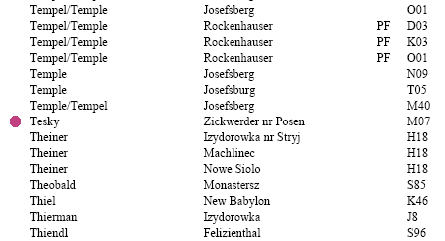
Tesky
Tesin
(Czeck
Republic) is a German Jewish name -
Czeck
Jewish
 |
Laureen : Just call me 'Mrs. Harper'
OTTAWA (CP) — Mrs. Harper goes to Ottawa.
The wife of incoming prime minister Stephen Harper has been known by a
variety of names since arriving in the capital but has settled on just
one.
Not since 1979, when Conservative Joe Clark became prime minister, has
there been so much talk about how to address the spouse of the first
minister.
Clark’s wife, Maureen, held on to her maiden name of McTeer, which was
unusual almost 30 years ago and set tongues a-wagging in the capital.
Harper’s 41-year-old spouse has
been known as Laureen
Teskey — the
online encyclopedia Wikipedia.com refers to Stephen Harper and Laureen
Teskey being married in 199
|
During the election campaign, Conservative Party news releases sometimes
referred to her as Laureen Harper.
Then, just to make things even more confusing, Thursday’s Ottawa Citizen
featured a front page photo of the prime minister designate with a kitten. The
photo was credited to Laureen Teskey Harper, no hyphen.
But the self-described small-town girl from Turner Valley, Alta., has let it
be quietly known that she now goes only by the name of Laureen Harper.
Teskey is a family name that can be found in many countries of the
English-speaking world. Around 80% to 90% of the Teskeys in the world today are
descended from the “Irish
Palatine” family of that name, founded by the man now referred to as Jacob
Teskey, or Jacob 1659 (after his apparent year of birth). The term “Irish
Palatine” was given to families that left the
German Pfalz (also known as the Southern or Rhenish Palatinate) in 1709 and
eventually settled in
Ireland.
Around 100 of these German-speaking families settled on the Southwell estate
near Rathkeale in
County Limerick. Amongst them was Jacob, with his wife and two sons.
The Teskey spelling first appeared in Ireland a few years after 1709. There
has been much conjecture as to the original spelling before the family migrated
to Ireland, and indeed much speculation about their specific place of origin.
During their arduous and eventful migration the family was recorded as Feske in
Rotterdam
and Teske in London.
After settling in Ireland they were recorded as Teshine in 1715, but soon
afterwards the name seemed to become settled as Teskey.
In 2004 Hank Jones, a leading researcher into Irish Palatine family history,
put forward a strong argument that before 1709 the family lived in a village
called Osthofen, one mile from the west bank of the River Rhine and five miles
north of the city of Worms. There, the 'founder'
Teskey,
Jacob 1659, was recorded as Jacob
Tesch. This theory is
based on somewhat circumstantial evidence, but all other theories have been
purely conjecture.
During the great Irish migrations, especially from around 1840 until the
early 1900s, several members of this Irish Palatine branch of the Teskey family
emigrated to Canada,
the northeastern
United States,
England and
Australia.
The migration continued later to many parts of the world. Today the greatest
concentration of
Teskeys
is in
Toronto, Canada.
However, there are still Teskeys, descendants of the first Teskey family,
living and farming in the area of the original Palatine settlements near
Rathkeale, Co. Limerick.
In the 1800s a branch of the family moved from Rathkeale to nearby Adare,
where they were recorded as Tuskey. The Irish who migrated to North America in
the 1800s included both Teskeys and the related Tuskeys. Today both spellings
can be found in Canada and the USA. Research into people with the name Tuskey
might conclude that they too are mostly descended from Jacob 1659 Teskey.
In addition to the major group of related Teskeys, there are other families
bearing the name, mostly in Canada and the USA. These are the descendants from a
number of immigrants who did not come from Ireland. They include at least two
families who came directly from
Germany with
the name Teske and another
originally called Teschke. A family from
Russia was
originally Tesske, whilst the families Tzrebietowski, Tyski and Tutzke came
originally from
Poland. A Tutefski emigrated from
Romania and
the origin of the Titieskey branch remains a mystery. All are known to have
changed their name to Teskey either upon immigration or shortly afterwards. The
largest of these non-Irish Teskey families comprises descendants of Stephen 1815
and Johanna, who came from
Prussia and
settled with their family in
Collingwood, Ontario some time before the 1871 Census. Then their name was
recorded as Teske; in the 1881 census it was Tesky; and by the 20th century it
had become established as Teskey.
The wife of Canada's current Prime Minister,
Stephen Harper, is
Laureen Teskey.
