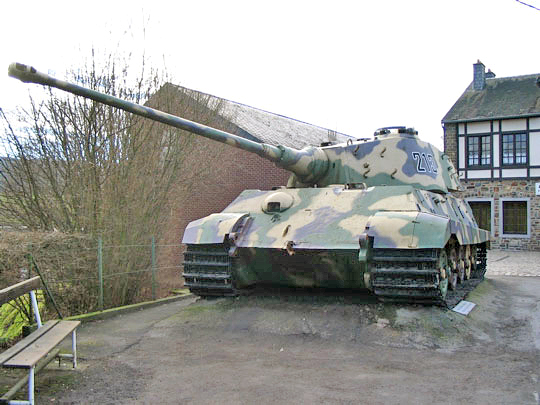
Holocaust Survivor William R. Perl Dies at 92
Scholar, Psychologist Helped Thousands of Jews Escape
Nazi-Occupied Europe
By Louie Estrada
Washington Post Staff Writer
Friday, December 25, 1998; Page D08
William R. Perl, 92, a retired
Army lieutenant colonel, Holocaust survivor, scholar and founder of the
Washington branch of the Jewish Defense League who organized a
little-known rescue effort that smuggled thousands of Jews out of Nazi-occupied
Europe and into Palestine in the late 1930s and '40s, died Dec. 24 at his home
in Beltsville. He had Parkinson's disease.
Although Dr. Perl's exploits in wartime Europe were frequently honored
abroad, he was better known in the United States as a spokesman for militant
Jewish causes and a leader of protests and demonstrations at the old Soviet
Embassy in Washington. The militant Jewish Defense League targeted the Soviet
Embassy to symbolize its fight for the emigration rights of Russian Jews.
In recent years, however, Dr. Perl, a
retired D.C. psychologist and expert on juvenile delinquency, lived a
quiet life in a simple brick ranch-style house, still haunted by the nightmares
of the genocide but surrounded by memorabilia of his heroic efforts. He won
citations from President Ronald Reagan and Congress and numerous humanitarian
service awards. In 1990, he was honored in Israel during a 50th-anniversary
reunion of the passengers of the Sakarya, a ship he chartered that carried 2,175
Jewish refugees from Constanta, Romania, to Palestine.
"I guess I've been a militant almost all my life," Dr. Perl said in an
interview with The Washington Post in 1978. "I always believed that it only
takes a few people to accomplish something."
Dr. Perl, who was born in Prague,
grew up in Vienna and had been a militant Zionist since his school days.
In the 1930s, Dr. Perl, a follower of militant Zionist Revisionist Vladimir
Ze'ev Jabotinsky, was a young Jewish lawyer and teacher in Vienna. Realizing
what Adolf Hitler's rise to power meant, he began organizing the voyages to
Palestine in the 1930s.
Persuading people to flee their homes in those early years was difficult, Dr.
Perl said. The Jewish establishment "thought more would be accomplished by
cooperating, by staying within the law," Dr. Perl recounted.
Despite being questioned and threatened by German officers, he continued with
the clandestine voyages, using cattle boats and ramshackle freighters. In other
cases, bribes were paid and forged documents were used because Britain stopped
the legal immigration of Jews into Palestine in 1939. The other problem was
Mother Nature. "Many ships never reached Palestine," he said.
The most painful memory was the job of selecting the evacuees for the limited
space aboard the ship. Denying people access was, in effect, sentencing them to
death, he said.
According to British statistics, about 20,000 Jews entered Palestine
illegally from 1939 to the end of World War II. Dr. Perl said thousands more
were rescued before 1939. By his calculations, the operation helped 40,000 Jews
escape Europe.
His own escape from Europe was
perilous. In 1940, he was arrested in Greece and placed on a train bound for
Berlin. While on the train, he faked a suicide by cutting his wrists and, after
being taken to a country farmhouse in Yugoslavia for medical treatment, he
escaped to Lisbon. He then boarded a ship for Baltimore in 1941.
In the United States, he enlisted in the Army and eventually landed in Army
intelligence. While serving as an adviser at the war crime trials at Nuremberg,
he returned to Vienna to search for his
wife, Lore, who escaped from a concentration camp in
Ravensbruck
late in 1944, when the Russians pushed into East Germany.
They were reunited and settled in Beltsville years later. After leaving
active military duty in 1958 and armed with a doctorate degree in psychology
from George Washington University, Dr. Perl began a 10-year career with what is
now the D.C. Department of Health and Human Services, retiring in the late
1960s. He also worked as a professor of psychology at George Washington
University in the 1960s and as a psychologist in private practice.
In 1971, Dr. Perl formed the Washington branch of the Jewish Defense League
and became enmeshed in a number of controversial incidents.
He was arrested and convicted on charges
of conspiring to shoot into the Prince George's County apartments of two Soviet
Embassy officials in 1976.
The conspiracy conviction was later
overturned on appeal, but he was sentenced to three years' probation for illegal
receipt of a firearm and attempting to damage property.
Dr. Perl focused on scholarly
pursuits, writing books and articles on the Holocaust. His books include "The
Four Front War," "Operation Action" and "Holocaust Conspiracy." Shortly before
his death, he completed a collaboration on a biography.
Survivors include his wife, Lore Perl
of Beltsville; two sons, Raphael Perl of Silver Spring and Solomon Perl of
Olney; and four grandchildren.
Abraham
H.
Rosenfeld
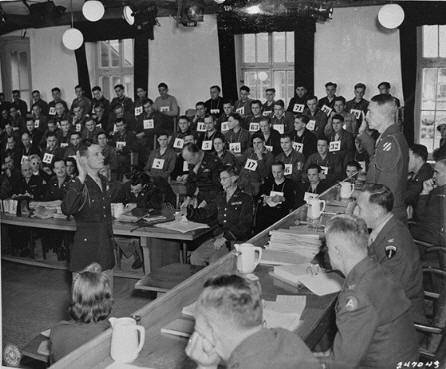
A panel of
high-ranking American army officers acted as both judge and jury. Seven members
of the panel are shown in the photograph below. The president of the panel was
Brigadier General Josiah T. Dalbey, who is the fourth man from the left in the
photo. The dominant member of the panel, Col.
Abraham
H.
Rosenfeld,
was the "law member," who ruled on all motions and legal matters during the
proceeding.
Col.
Rosenfeld
was Jewish, and a graduate of Yale.
He had had experience in over 200 court
martial cases before coming to Dachau in March 1946. "Rosenfeld"
was a name that was very familiar to General Dietrich because his close friend,
Adolf Hitler, always referred to President Franklin D. Roosevelt by that name,
claiming that FDR was both a Communist and a Jew.
Captain Dwight Fanton, a
graduate of Yale Law School,
Verdicts and aftermath
On July 16,
1946 the verdict
was delivered on 73 members of the Kampfgruppe Peiper.
- 43 sentenced to death by hanging
- 22 sentenced to life imprisonment
- 2 sentenced to 20 years imprisonment
- 1 sentenced to 15 years imprisonment
- 5 sentenced to 10 years imprisonment
- the former Colonel
Joachim Peiper was sentenced to death.
The sentences were commuted at the behest of a U.S. Senate
armed services subcommittee led by Senator
Robert
Taft. In no case was a death penalty carried out.
Murray Bernays
| |
|
|
| |
| |
|
|

|
The concept of the "common design" charge was
the innovative idea of Lt. Col. Murray C. Bernays, a Lithuanian Jew
who had emigrated to the United States at the age of 6. The following
words, written by Bernays before the end of the war, while the war
crimes trials were still in the planning stage, are quoted by Robert
E. Conot in his book "Judgment at Nuremberg":
The crimes and atrocities were not single
or unconnected, but were the inevitable outcome of the basic criminal
conspiracy of the Nazi party. This conspiracy, based on the Nazi
doctrine of racism and totalitarianism, involved murder, terrorism,
and the destruction of peaceful populations in violation of the laws
of war. A conspiracy is criminal either because it aims at the
accomplishment of lawful ends by unlawful means, or because it aims at
the accomplishment of unlawful ends by lawful means. Therefore, such
technicalities as the question whether the extermination of fellow
Germans by Nazis perpetrated before there was a state of war, would be
unimportant, if you recognize as the basic crime the Nazi conspiracy
which required for success the killing of dissident liberal Germans
and the extermination of German (and non-German) Jews before and after
the war had begun.
|
Bernays was of the opinion that the German people
should be made to feel a sense of their guilt and a realization of their
responsibility for the crimes committed by the Nazis. The German people
should come to understand the barbarism that they had supported and to
realize the criminal nature of the Nazi regime. Bernays thought that it
was necessary to prove the conspiracy of the Nazi leadership in the war
crimes that were committed so that all the Nazi criminals, large and
small, would be caught in the same web
A key member of Jackson's London
staff was Colonel
Murray C. Bernays,
who was one of the first people who had been involved in war crimes
problems. Graduated from Harvard
in 1915, he established a law practice in New York. He was given a
commission in the Army in 1942, and in October 1943, he was made chief of
the Special Projects Branch, Personnel Division, Army General Staff. His
major project in this position was the preparation of
plans for trials of German "war
criminals." After each stage of negotiations with the White House
and others, he made the appropriate revisions in the plans being
considered, although he was the author of the plan that was eventually
settled on, if one is to credit his account. In any case, shortly after
the appointment of Jackson, Bernays was awarded the Legion of Merit, the
citation reading in part:
"Early recognizing the need for
a sound basis in dealing with the problem of war criminals and war
crimes, he formulated the basic concept of such a policy and initiated
timely and appropriate action which assured its adoption as the
foundation of national policy."
Bernays returned to the U.S. in
November 1945 and immediately resigned from the Army. Because, as we have
seen, there was considerable dialogue at higher levels relating to plans
for war crimes trials, it is doubtful that one can take Bernays's claims
at full value, but he no doubt had a great deal to do with the drafting of
the plans for the trials. Moreover, he had certainly been an appropriate
choice for something as novel as the formulation of the "legal" structure
for the war crimes trials, since his views of justice were equally novel.
After his return to the U.S., he had a chat with some editors (who
characterized him as "the man behind the gavel"), and in answer to their
queries as to "how the small fry are going to be hooked," he replied:[35]
"There are a good many Nazi
criminals who will get off if the roundups aren't conducted efficiently.
But if we establish that the SS, for example, was a criminal
organization, and that membership in it is evidence per se of
criminality, the Allies are going to get hold of a great many more
criminals in one swoop. You know, a lot of people here at home don't
realize that we are now the government of Germany in our zone and that
no judicial system can exist other than one we approve.
We are the law. If we wanted to,
for instance, we could try Germans for crimes twenty, thirty, forty
years old.
We'll be too
busy with the current crop of war criminals, though, to have much time
to look into ancient wrongdoings."
|
|
| |
|
|
Marcus
| |
|
|
| |
| |
|
|

|
David Daniel Mickey Marcus, a tough Brooklyn street
kid, rose by virtue of his courage and intelligence to help save
Israel in 1948 and become its first general since Judah Maccabee.
After a distinguished career in military and public service to the
United States, the 46-year-old Marcus wrote his name forever in the
annals of Israeli history.
Born to immigrant parents in 1902, Marcus grew up
in the Brownsville section of Brooklyn where, to defend himself
against neighborhood toughs, he learned to box. His high school
athletic and academic record won him admission to West Point in 1920,
from which he graduated with impressive scores. After completing his
required service, Marcus went to law school and spent most of the
1930s as a Federal attorney in New York, helping bring Lucky Luciano
to justice. As a reward, Mayor LaGuardia named Marcus Commissioner of
Corrections for New York City.
|
Convinced that war was imminent, Marcus voluntarily went back into Army
uniform in 1940, and after the Japanese attack on Pearl Harbor served as
executive officer to the military governor of Hawaii. In 1942, he was
named commandant of the Army's new Ranger school, which developed
innovative tactics for jungle fighting. Sent to England on the eve of
D-Day, he voluntarily parachuted into Normandy with the troops of the
101st Airborne Division. Marcus helped draw up the surrender terms for
Italy and Germany and became part of the occupation government in Berlin.
Admiring colleagues identified him as one of the War Department's best
brains. He had a bright future ahead of him as a member of the Army's top
brass.
|
|
| |
|
|
Sentences reduced
| |
|
|
| |
| |
|
|
|
After the trial,
Everett attempted to get the
Supreme Court to hear the appeal of the Malmédy Case defendants. In
May 1948 the Court's decision not to hear the appeal prompted the
Secretary of the Army, Kenneth C. Royall, to order a stay of execution
of the sentences pending further investigation.
One year after the trial
ended, an
Army office carried out a review of the trial and made large
changes in the original sentences. Although no prisoner was released,
twenty-five of the forty-three death sentences were reduced to life
imprisonment, seventeen defendants had their life sentences reduced
and those with shorter prison terms had them made even shorter. Many
of these changes were made, the reviewing body said, because of the
youthfulness of the defendants at the time. The charges with these
changes were also reviewed a year later by the War Crimes Review
Board, which, after declaring the pre-trial investigation flawed and
saying the court had favored the prosecution, recommended to a higher
body a further reducing of sentences.
This higher body, the Military
Governor of the American Zone, took some of the Review Board's
suggestions into account, and its changes led to thirteen defendants
being freed, and only twelve still facing execution. Still later, the
Governor reduced the number sentenced to death to 6. As the end of the Malmedy affair approached, American military authorities reduced to
life imprisonment the death sentences for the 6 remaining defendants
|
Appeals lasted more than 10 years and involved both the
US Supreme Court and the Hague Court. The last prisoner, Peiper himself,
was released in 1956.
|
|
| |
|
|
Beatings
| |
|
|
| |
|
|
| |
|
|
| |
|
In the prison of the
Swabisch Hall, he stated, officers of the
S.S.
Leibstandarte Adolf Hitler were
flogged until they were soaked
in blood, after which their sexual organs were trampled on as they lay
prostrate on the ground. As in the notorious
Malmedy
Trials
of private soldiers, the prisoners were hoisted in the air and beaten
until they signed the confessions demanded of them.
On the basis of such
"confessions" extorted from
S.S.
Generals Sepp Dietrich and Joachim Paiper, the Leibstandarte was
convicted as a "guilty organisation".
S.S.
General Oswald Pohl, the economic administrator of the concentration
camp system, had his face smeared with faeces and was subsequently
beaten until he supplied his confession. In dealing with these cases,
Senator McCarthy told the Press: "I have heard evidence and read
documentary proofs to the effect that the accused persons were beaten
up, maltreated and physically tortured by methods which could only be
conceived in sick
brains.
They were subjected to mock
trials
and pretended executions, they were told their families would be
deprived of their ration cards. All these things were carried out with
the approval of the Public Prosecutor in order to secure the
psychological atmosphere necessary for the extortion of the required
confessions. If the
United States lets such acts committed by a few people go unpunished,
then the whole world can rightly criticise us severely and forever
doubt the correctness of our motives and our moral integrity."
The methods of intimidation
described were repeated during
trials
at Frankfurt-am-Mein and at Dachau, and large numbers of Germans were
convicted for atrocities on the basis of their admissions. The
American Judge Edward L. van Roden, one of the three members of the
Simpson Army Commission which was subsequently appointed to
investigate the methods of justice at the Dachau
trials,
revealed the methods by which these admissions were secured in the
Washington Daily News, January 9th, 1949. His account also appeared in
the British newspaper, the Sunday Pictorial, January 23rd, 1949.
The methods he
described were: "Posturing as priests to hear confessions and give
absolution;
torture
with burning matches driven under the prisoners finger-nails; knocking
out of teeth and breaking jaws; solitary confinement and near
starvation rations."
Van Roden explained: "The statements which were admitted as evidence
were obtained from men who had first been kept in solitary confinement
for three, four and five months ... The investigators would put a
black hood over the accused's head and then punch him in the face with
brass knuckles, kick him and beat him with rubber hoses ...
All but two of the Germans, in
the 139 cases we investigated, had been kicked in the testicles beyond
repair.
However, a letter from Fiske
H. Ventres to Royall, provides a different view:
… at Bremen, Germany,
I was billeted with a
member of the War Crimes Commission who had just resigned his post
because of the methods employed by
"Americans" to gain confessions and convictions. According to him
confessions were the sole evidence against the accused and no
methods were too brutal to employ in gaining the confessions.
Beaten to death
One
defendant was beaten to death because of his refusal to sign a
confession and as a lesson to his other unwilling fellow defendants.
To prove his point the resigned agent
produced from his trunk the blood-caked hood he, himself, had
removed from the head of the murdered German.
From one end of Europe to
the other, people are quite aware of the true character of these
so-called trials, from Nuremberg to the Bulge. They know full well
the identity of those conducting the proceedings and, I might add, a
great many Europeans are more than a little suspicious that what is
being done is more in the interest of another nation than to the
United States.
The following allegations were made by defendant
Hendel:
… on 4
April 1946 1
was led from my cell under a black hood, was put into
a cell facing the door and was then beaten in the abdomen and face
until I fell to the ground. When a moment later the hood was taken
off, Lieutenant Perl and Mr.
Thon stood before me. During the subsequent interrogation, I
was also beaten several times. No notice was taken of my request to
have the interrogation postponed since I was not in condition for it
at that time. The facts described happened before my interrogation.
During the interrogation, promises were made to me but since I did
not know anything and today still do not know anything of an order,
all sorts of threats were made to me and since things were
immaterial to me and I
wanted to avoid further beatings, etc., I wrote down everything that
was dictated to me.
|
|
|
| |
|
|
McGow
| |
|
|
| |
|
|
| |
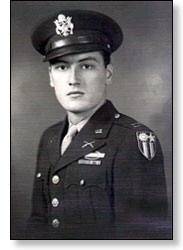 |
Harold McGown spent three days by
Peiper's side, and was released in La Glieze, when Peiper ran out of
gas Joachim Peiper was a Standartenfuehrer in
the Waffen SS who was renown for his bravery on the Russian Front, as
well as the Western Front. The fact that Joachim Peiper had no
culpability, as alleged by the Jews, in the Malmedy incident was best
demonstrated by the fact
that Lieutenant Colonel Harold D. McGown, commander of the American
soldiers allegedly massacred at Malmedy, appeared at the Dachau show
trials as a witness for Mr. Peiper. He testified that Joachim Peiper
went out of his way to make sure many Americans were safe.
source
|
He charged that Lieutenant
Colonel Harold D. McGown, commander of the American soldiers massacred
at Malmédy, had fraternized with SS Colonel Joachim Peiper, the German
commander, and this explained why McGown had appeared at Dachau as a
defense witness for Peiper and had testified that Peiper had held
talks with him and had been responsible for saving a number of
Americans.
As evidence for the fraternization, Rosenfeld claimed that McGown
and Peiper had been "en atirely
too friendly during those nights they spent talking together" and
that,when Peiper and his men were later able to escape a US Army trap,
"McGown was with them." Of coursIt will, of course, be argued that
these nightmarish Dachau "trials" have little
Actual testimony from that day
from Battle of La Gleize
As we came up a lane into
LaGleize a Mark IV tank came toward us and the Tank Cmndr. swiveled
his periscope (?) in order to get a good look at me.
I was turned over to an interrogation officer who was originally from
Chicago and spoke perfect English. He had a shrapnel hole in his
helmet. He was not happy either. From there I was taken to a house and
sent downstairs into a basement. There were 30 to 40 American soldiers
in the cellar.
Sometime much later, maybe 9 or 10pm, we heard fire crackling overhead
in the house above us, compliment of the American artillery…
The
guards ordered us out. Everyone went out in a good orderly manner. The
scene in the street beside the house was chaotic. The town was on
fire. 30 to 40 GIs huddled together, artillery shelling the town and a
very wild SS soldier waving a sub machine gun from side to side
yelling ‘Officer, Officer!’
Since he spoke with a heavy
accent it took me some moment s to realize he meant me.
When I was recognized
I was taken to Lt. Col.
Joachim Peiper’s command post.
It was in a cellar that was entered from an outside cellarway. I think
there was a blanket for a door. I went through and for some reason
recognized who was in charge and snapped probably the best salute I
have ever given. There were 4 or 5 other German officers. Peiper was
wearing a type of coverall and no helmet. A very good-looking man who
spoke slow, good but not perfect English.
Shortly thereafter Major Hal McCown was brought in. He gave me a quick
and very surprised handshake.
(At this point during the
Ardennes Offensive. The advances of Peiper’s battlegroup were being
halted. So Peiper had decided to concentrate his forces in and around
the Belgian town of La Gleize. McGown, the ex commanding officer of
the 2nd Bat of the 119th infantry regiment was captured 2 days
earlier. He recalls Peiper and his men.)
An astonishing fact to me was the youth of the members of this
organization-the bulk of the enlisted men were either 18 or 19,
recently recruited, but from my observations thoroughly trained...
The officers for the most part were veterans but were also very
young...The morale was high throughout the entire period I was with
them despite the extremely trying conditions...
The physical condition of all the personnel was good, except for lack
of proper food…The equipment was good and complete with the exception
of some reconditioned half-tracks among the motorized equipment.
All the men wore practically new boots and had adequate clothing. Some
men wore parts of American uniforms, mainly the knit cap, gloves,
sweaters, overshoes and one or two overcoats. I saw no one however, in
American uniforms or civilian clothing.
The relationship between the officers and men, particularly the
commanding officer, Col. Peiper, was closer and friendlier than I
would have expected.
Later on during the night on
the 21st of December I was taken again to the cellar HQ of Col. Peiper…
He and I talked together from 2300 until 0500 the next morning.- our
subject being mainly his defense of Nazism and why Germany was
fighting.
I have met few men who impressed me in as short a space of time as did
this officer. He was 5ft 8inches, 140 lbs. in weight, long dark hair
combed straight back, well shaped features with remarkable facial
resemblance to the actor, Ray Milland…He was completely confident of
Germany’s ability to whip the Allies.
He spoke of Himmler’s new reserve army quite at length saying that it
contained so many new divisions, both armored and otherwise, that our
G-2s would wonder where they all came from.
He did hid best to find out from me the success V1 and V2 rockets were
having and told me that more secret weapons like those would be
unloosed. The German Air force, he said, would now come forth with
many new types and which, although inferior in number, would be
superior in quality and would suffice their needs to cover the
breakthru in Belgium and Holland and later to the French Coast!!
|
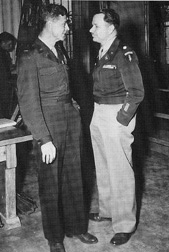
Col McGown
|
|
| |
|
|
| |
|
|
| |
| |
|
|

|
governor, General Lucius D.
Clay, to request an investigation of the trials at
Dachau. On July 29,
1948, the Secretary of the
Army appointed a commission
consisting of two American
judges, Gordon Simpson of Texas and Edward
Van Roden of Pennsylvania,
both JAG reserve colonels. They were assisted
by JAG Lieutenant Colonel
Charles Lawrence, Jr. The commission submitted
its report to the Secretary of the Army in October 1948, and
selected portions
were made public in January 1949.
German refugees." Steiner,
Kirschbaum and Thon (later
chief of the evaluation
section of the civil administration division of the US
military government)
appeared later and denied all, but they were shaken by
the testimony of
investigator Bruno Jacob, who admitted a few things.
|
One year after the trial ended, an
Army office carried out a review of the trial and made large changes in the
original sentences. Although no prisoner was released, twenty-five of
the forty-three death sentences were reduced to life imprisonment, seventeen
defendants had their life sentences reduced and those with shorter prison
terms had them made even shorter. Many of these changes were made, the
reviewing body said, because of the youthfulness of the defendants at the
time. The charges with these changes were also reviewed a year later by the
War Crimes Review Board, which, after declaring the pre-trial investigation
flawed and saying the court had favored the prosecution, recommended to a
higher body a further reducing of sentences. This higher body, the Military
Governor of the American Zone, took some of the Review Board's suggestions
into account, and its changes led to thirteen defendants being freed, and
only twelve still facing execution. Still later, the Governor reduced the
number sentenced to death to 6. As the end of the Malmedy affair approached,
American military authorities reduced to life imprisonment the death
sentences for the 6 remaining defendants
|
|
| |
|
|
| |
|
|
| |
| |
|
|
|
He said that the "most brutal" had been Lieutenant Perl, Frank
Steiner and Harry W. Thon.
|
|
|
| |
|
|
| |
|
|
| |
| |
|
 |
Search for more information on
HighBeam Research for
Lt. Col. Willis M. Everett%2C.
The author examines the war crime trial of
defendants in the Malmedy Massacre. Topics include
attorney
Willis
Mead
Everett,
Jr. defence, details of the crime and punishment.
The shooting of American
prisoners of war on 17 December 1944 by German SS troops
became one of the most notorious atrocities of World War II. Under
the command of SS-Obersturmbannfuehrer (Lieutenant Colonel) Joachim
Peiper, German soldiers surprised and captured an American motor
convoy belonging to Battery B of the 285th Field Artillery
Observation Battalion at a road intersection south of the Belgian
town of Malmedy. In what became known as the
Malmedy
Massacre, more than 100 prisoners were assembled in a field adjacent
to the crossroads and mowed down by machine gun fire; approximately
30 survived. As a result of the massacre and ensuing
international press coverage, Peiper became for many Americans the
most hated man in the German armed forces. He and 73 of his comrades
were tried by a U.S. Army court in 1946 for the Malmedy murders and
other related war crimes.
All were found guilty and 43, including
Peiper,
were sentenced to death. But none of the death sentences were
carried out, the result in large part of the continuing efforts of
Colonel
Willis
Everett Jr.,
an American lawyer from Georgia who was assigned to defend the
accused war criminals.(1)
|
The case brought together former enemies whose involuntary
association reflected the moral ambiguities of war and a shared sense
of injustice at the manner in which the Allies conducted the trials of
accused Germans, whose guilt often was assumed to be self-evident. The
relationship of the Georgia colonel and the SS officer was nurtured by
affinities both imagined and real. The story of
Everett and Peiper
juxtaposes two unlikely allies, one from the American South and the
other from Nazi Germany, who found a small area of common ground in a
world struggling to overcome the effects of history's most terrible
war.
Willis
Mead
Everett
Jr. was born on 25 January 1900 into a prosperous family in Atlanta,
Georgia. His father, one of the city's leading attorneys, had been
born during the Civil War in western New York. He married a young
Georgia woman and settled in Atlanta, which by the mid-1880s had
recovered from the ravages inflicted by Sherman's army 20 years
earlier and was booming.
Everett
junior attended Atlanta's Boys' High School and graduated in 1921 from
Washington and Lee University in Lexington, Virginia, where Robert E.
Lee had served as president during his last years. Despite a
lackluster academic record, he graduated from Atlanta Law School in
1924 and joined his father's successful law practice. With his wife, a
young woman from a good Memphis family,
Willis
Everett settled into a
comfortable life as a member of Atlanta's upper crust.(2)
Everett understood the
importance of social responsibility. On his twenty-fifth birthday, his
father wrote to him of the need to "help and live for others," and
that he would discover "the purest gold among those who are always
helping someone else and are thinking but little of themselves."(3)
Evidence of Everett's sense
of noblesse oblige can be seen in his later long and devoted service
to the African American Gammon Theological Seminary, which is still
remembered with respect and affection by older black Atlantans
today.(4)
Everett also developed a
lifelong interest in the military. Near the end of World War I, he
took temporary leave from Washington and Lee for brief service in the
U.S. Army. Although he failed to get closer to the battlefield than
the Army's Coast Artillery School at Fort Monroe, Virginia, the
attraction clearly went beyond the hyper-patriotism of a popular war.
While still a law student,
Everett applied for a
commission in the Army Reserve Corps and was appointed a second
lieutenant of infantry in May 1923. Thus began a career that
paralleled his practice of law for over 30 years. The Reserve Corps
was a rather relaxed form of duty in peacetime, involving little more
than occasional unit exercises and annual two-week excursions to
summer training camp.
Everett's service reflected an appreciation of both the
military virtues and the status that being an officer carried in
Southern society, as well as a generally conservative outlook
characteristic of the officer corps. In applying for a transfer from
the infantry to military intelligence in 1932,
Everett noted that he had
been "actively fighting in every way all forms of communism,
socialism, pacifism, etc., in and around Atlanta" for the previous two
years.(5)
Everett's comfortable
background was similar to that of Joachim Peiper, who was born in 1915
in the Wilmersdorf section of Berlin. Peiper's father was born in the
Prussian province of Silesia in 1878 to a family of Imperial Germany's
Bildungsbuergertum (educated middle class). He served as an officer in
the German army in prewar German Southwest Africa and in Turkey during
World War I. Germany had been at war for six months when Joachim
Peiper was born, only to be defeated less than four years later with
the loss of almost two million men amidst starvation and political
chaos.(6)
After the war, the elder Peiper took a position with the state
lottery administration, which permitted the family to preserve a
bourgeois existence. Joachim Peiper enrolled in Berlin/Wilmersdorf's
Goethe Oberrealschule, a school that emphasized mathematics, modern
languages, and the natural sciences and prepared its students for
university work. But, perhaps stimulated by his father's tales of
manly adventure in uniform and Germany's new militarism on the heels
of Adolf Hitler's appointment as Reich chancellor, the younger Peiper
decided on a military career shortly after his eighteenth birthday.(7)
Gravitating toward the Nazi dictatorship, Peiper joined the Hitler
Youth in the spring of 1933, and the following October he joined the
Schutzstaffel, or SS, headed by Heinrich Himmler. By 1933 Himmler had
already established the first Nazi concentration camp at Dachau, which
was to become a model and training center for the entire camp system.
That year he also laid the foundation for a military branch of the SS
that, as the Waffen-SS, would fight alongside the German army in World
War II. To help establish its image as an elite body of Nazi
activists, Himmler sought to attract "socially respectable" elements
to his black-uniformed organization. The Reiter-SS, or SS cavalry, was
designed to appeal to well-bred young men such as the 19-year-old
Joachim Peiper, who applied for active SS membership as an officer
candidate early in 1934. Peiper attended the SS officers' academy (SS-Junkerschule)
at Braunschweig, where instruction in military tactics was combined
with indoctrination in Nazi ideology. On 20 April 1936--Hitler's
birthday--he was commissioned an SS-Untersturmfuehrer (2nd lieutenant)
and immediately assigned to duty with the elite Leibstandarte Adolf
Hitler, the Fuehrer's personal guard regiment and one of the original
combat units of the SS. That Peiper was singled out as an unusually
promising young SS officer was made clear in 1938 when he was
transferred to Himmler's personal staff. The appointment not only
provided opportunities to rub elbows with the mighty of the Third
Reich, but introduced Peiper to his future wife, one of the
Reichsfuehrer's secretaries.(8)
Willis
Everett, meanwhile,
continued to combine the practice of law in his father's firm with
part-time Army reserve service. The board of officers who examined
Everett for promotion to the
rank of major in November 1935 noted approvingly that
    He is a particularly high-type civilian, well-known and prominent in
    Atlanta and his Americanism is unquestioned; ... the applicant has on
    various occasions investigated on his own initiative individuals and
    organizations purportedly of an un-American or insidious character and made
    reports of his findings to the civilian organizations who were interested
    in activities of this nature.(9)
Although Everett's
military service may have been more benign than Peiper's, there is a
certain parallel to be found in the eagerness with which both young
men associated themselves with forces opposed to the political left;
still, the similarities are limited. That
Everett's conservatism was
combined with racism is hardly surprising in one raised in early
twentieth-century Georgia, but it was a racism tempered by a
humanitarian perspective rejected by the Nazis.
Everett believed Jews in
general to be morally suspect and African Americans to be inferior to
whites, but he was capable of friendship with individual Jews, and he
regarded paternalistic support of blacks to be his Christian duty.
Peace in Europe ended on 1 September 1939 when Germany invaded
Poland, and Britain and France quickly declared war on Germany. Peiper,
still on Himmler's staff and soon to become first adjutant,
accompanied the Reichsfuehrer to Poland aboard Himmler's personal
train. The horror of Nazi extermination policies was first revealed in
Poland, where, following the quick German victory, Poland's educated
elite were slaughtered as a crucial step toward reducing the Polish
people to total subservience. The SS was to be the instrument of
annihilation, as another member of Himmler's staff later recalled
Peiper informing him.(11) Whether this incident is true or not, Peiper
could hardly have been unaware of SS atrocities. Indeed, after the
war, Peiper admitted to having attended an early experiment in the use
of poison gas on living subjects, although there was no evidence that
he planned or participated in mass murder.(12)
Still, Peiper welcomed reassignment to a purely military post in
the Leibstandarte in mid-May 1940, as the German blitzkrieg rolled
into the Low Countries and France. Here he could see action and build
the active military career for which he longed. The young SS-Obersturmfuehrer
(1st lieutenant) quickly distinguished himself in combat, first as a
platoon leader and later as a company commander, where he demonstrated
a high degree of initiative and personal bravery. The operations in
which he was involved during the spring of 1940 were of a traditional
military nature, but Peiper's career again entered a region of moral
ambiguity when he returned to Himmler's personal staff in July.(13)
As the United States moved
toward active involvement in the war,
Willis
Everett's military
career assumed a more serious character. In September 1940,
Everett
was called to active duty in the Office of the Assistant Chief of
Staff, G-2 (intelligence) for the Fourth Corps Area (later Fourth
Service Command), headquartered in Atlanta. The Fourth Service Command
included a large segment of the U.S. Army's training facilities and,
later, many prisoner of war camps. Important war production
plants, including the Manhattan Project's U-235 production facility at
Oak Ridge, Tennessee, were located within it.
Everett's charge as chief of
the Fourth Service Command's Intelligence Branch, Security and
Intelligence Division was to ferret out pro-Axis activity and provide
security against Communist subversion, as well as vigilance against
unrest among African Americans. While some cases were ludicrous, such
as the woman who reported to one of
Everett's counterintelligence officers that her neighbor's
dog was giving the Fascist salute, the challenge of maintaining the
surveillance system in the southeastern United States, for which
Everett had primary
administrative responsibility, was substantial.(14)
Peiper, meanwhile, experienced war at its most cataclysmic. He
continued to serve as Himmler's adjutant from July 1940 until August
1941, the crucial period when preparations were being made for an
ideologically charged war of annihilation against the purported
"subhuman" population of the Soviet Union and steps were taken that
would culminate in the Holocaust. While Peiper cannot be accused of
framing policies of mass murder, he certainly supported them by his
consensual presence. Although he was permanently reassigned to a
combat role in August 1941 he remained a favorite of Himmler's and
paid him friendly visits until near the end of the war.(15)
In Russia,
Peiper
proved himself a resourceful and courageous commander of mechanized
forces and was awarded the
Ritterkreuz
(Knight's Cross), the highest grade of the Iron Cross. He was given
command of the
Leibstandarte's armored
regiment in November 1943, perhaps a reflection of his
connections in high places as well as of his leadership talents. The
Russian war was characterized by brutality on both sides; German
forces commonly slaughtered both Russian prisoners of war and
civilians, and Peiper must have participated in this aspect of the
conflict. While in northern
Italy following the Allied landings in Sicily in July 1943, a
mechanized battalion Peiper commanded was involved in a brutal
incident in the town of Bores. In response to the capture of two
German soldiers by Italian partisans, Peiper's troops attacked the
town with considerable loss of civilian life.(16)
By December 1944, Germany's armed forces in both east and west were
shattered, and Allied aircraft controlled the European skies. Although
defeat was certain, Hitler planned a massive offensive designed to
split the Anglo-American forces, capture their primary supply port of
Antwerp, and turn the war around for Germany. The Ardennes offensive
was a desperate undertaking, depending on surprise, bad weather to
neutralize Allied air supremacy, and the capture of American stores of
gasoline to permit fuel-starved German tanks to reach Antwerp. Crucial
to the operation's success was the quick capture of crossings over the
Meuse river, an objective assigned to a battlegroup of the 1st SS
Panzer Division that Peiper commanded.(17)
Although the offensive, known among the Allies as the Battle of the
Bulge, temporarily threw the Allies off balance, ultimately it failed
and even hastened Germany's collapse. It was also punctuated by the
notorious event that would later bring
Everett and Peiper together
in a court of law, when on the afternoon of 17 December Peiper's
battlegroup captured and fired on more than 100 members of an American
motor convoy in a probable effort to rid themselves of inconvenient
prisoners. By death camp standards, or even in comparison with the
brutality that was commonplace in the war against the Soviet Union, it
was a crime of modest scope. But it was the most serious violation of
the laws of war perpetrated by Germans against Americans, and the
incident received widespread publicity both within the U.S. Army and
among civilians at home. Propelled by universal American outrage, the
hunt for the murderers began almost immediately.(18)
Willis
Everett must have
read newspaper accounts of the massacre as the war entered its final
months. When it finally ended with Japan's acceptance of
surrender on 14 August 1945, American military priorities changed.
There was intense political pressure to bring the "boys" home, and the
U.S. forces in Europe that had contributed so effectively to the
defeat of Nazi Germany were rapidly dismantled. But the United States
was also committed to an ambitious policy to fundamentally reform the
German nation, which twice within a quarter century had plunged Europe
into catastrophic conflict and had carried out a program of genocide
against the Jewish population. Such a reformation required a long-term
Allied presence in the conquered country, initially in the form of a
military government. Embarrassed at having passed the war years in
domestic safety, Everett
expressed no distress when in October 1945 he was ordered to a 14-week
European Staff Officers Studies Course at Columbia University to
prepare him for service in postwar Europe. Upon his arrival at USFET
(United States Forces, European Theater) headquarters at Frankfurt am
Main in March 1946, he was assigned to the Judge Advocate's Division,
then hard pressed for legal personnel.(19)
The War Crimes Branch of the Judge Advocate's Division was
responsible for the identification, trial, and punishment of Germans
guilty of crimes committed under the Third Reich. When
Everett arrived in Germany,
the Trial of Major War Criminals before the International Military
Tribunal in Nuremberg had been in progress for four months and would
continue for another six. These heavily publicized trials of major
figures in the German government and military were the most visible of
the postwar efforts to bring German war criminals to justice.
Offenders of lesser stature were tried by military courts of the
occupying Allied powers.
Everett
was assigned to such a court held at the former concentration camp at
Dachau,
where the defendants of the
Malmedy
massacre were to be tried. According to Deputy Theater Judge Advocate
Colonel Claude B.
Mickelwait, the Army
was determined to make a "big show" for this particular case.
Everett
was appointed chief defense counsel for 74 Germans accused of
responsibility for the
Malmedy and other
related atrocities, of whom the leading defendant was Joachim
Peiper.(20)
Everett was horrified by
the assignment. He had no experience in criminal law and found the
prospect of organizing the defense of more than six dozen men in the
space of six weeks daunting. Moreover, he had little sympathy for the
defendants, writing to his wife that they seemed to be "the worst
kinds of murderers," for whom "rope is probably too mild"(21) Within a
week, however, his attitude changed dramatically. Initial interviews
with the defendants through interpreters produced a lurid picture of
the pretrial investigation at the
War Crimes Branch prison at
Schwaebisch
Hall, which had identified this body of former Waffen SS
members as the likely culprits. \
Everet Suspiscious
Everett
wrote that he and his defense team "got steamed up" over the
"underhanded methods" employed by Army investigators, whom he
ironically characterized as a "gang of Nazi method boys" Some
defendants told of having been subjected to what they now realized had
been mock trials. They had been brought before a black-draped table
with illuminated candles, on which stood a cross, and Army personnel
acting as judges sat behind the table. Witnesses testified to the
guilt of the prisoners, who were condemned and sentenced to hang but
then were promised clemency if they signed confessions, as some did.
Besides mock trials, there were allegations of beatings and other
forms of duress employed to extract confessions.
Everett
concluded from the consistency of the defendants' stories that there
was a core of truth. He was deeply disturbed, less by evidence of Army
perfidy itself than by its likely impact on American public opinion
should the press get wind of it.(22)
By April 1946, when Everett
began to delve into the distressing complexities of the Malmedy case,
Joachim Peiper had been a prisoner for almost a year. World War II had
ended for Peiper and his troops while in hopeless combat against the
Red Army in Austria. The disorganized fragments of his regiment fled
westward to escape Soviet vengeance and ironically fell into American
captivity. Peiper attempted to join his wife and three children in
Bavaria, but he was seized by U.S. forces about 20 miles short of his
goal. Although Peiper was not initially recognized, the staff of the
service newspaper The Stars and Stripes discovered in August that "the
American doughboy's number one war criminal" was in a POW
compound.(23) Peiper joined the growing number of former SS men
suspected of complicity in the Malmedy massacre being assembled for
interrogation by Army investigators. In addition to the crossroads
killings, the defendants were charged with many other murders of
American prisoners and Belgian civilians during the Ardennes
offensive.
 |
Although in the absence of strong evidence against him the
American War Crimes Branch concluded in early October that "it is
very doubtful that he (Peiper)
is guilty of any war crimes,"(24) six months later
Peiper
confessed at the
Schwaebisch Hall
prison to having received and transmitted orders to kill
prisoners of war during the December 1944 offensive and to having
ordered or acquiesced in the murder of American prisoners in
several incidents. Written confessions by Peiper and many of the
remaining defendants constituted the bulk of the case brought
against them by Army prosecutors during the trial held from May
until July 1946 at Dachau. On the basis of those confessions and
the testimony of American survivors, and despite a vigorous if not
always skillful defense by
Everett and his defense team, all of the defendants were
found guilty. Forty-three of them, including Peiper, were
sentenced to death by hanging.(25)
|
For
Everett,
the verdict was devastating. The next day, he wrote to his wife that
his heart was "crushed" and his head "whirling, splitting and
hammered." He doubted the veracity of many of the sworn statements and
believed that the procedural decisions made by the panel of Army
officers who had judged the case had unfairly favored the prosecution.
The verdict, he was convinced, had been dictated to the court
by the Theater Judge Advocate. But he did not challenge the fact that
American prisoners of war had been murdered. Immediately following the
trial, he was chiefly distressed by what he perceived to be the
injustice of condemning to death young men, some still in their teens,
for having committed war crimes under superior orders that they could
not reasonably have been expected to refuse. He believed it
hypocritical to punish former enemy soldiers for violations of the
laws of war of which American troops had also been guilty.(26) In
this, he was on firm historical ground, for the killing of
inconvenient or unwanted prisoners was far from rare on either side
during World War II. But subjective factors were equally significant
in Everett's reaction to the
verdicts.
Jew black market
Everett
was sympathetic to the German people's postwar degradation and
material deprivation and may have been inclined to liken it, as did
other Southerners, to the plight of the former Confederacy following
the Civil War. Like the Germans themselves, he tended to hold the
upper Nazi leadership echelons responsible for the crimes of the Third
Reich while absolving ordinary Germans, both in and out of uniform.
Moreover, he had very quickly become disillusioned with the moral
character of the military government in the U.S. zone of occupation.
The sexual license, drunkenness, black marketeering, and general
inefficiency and lack of discipline that he observed among U.S. Army
personnel in Germany offended his strict,
teetotaling
Presbyterian conscience. Most troubling in
Everett's outlook was an
obvious element of anti-Semitism. Although like many Americans
Everett was quite capable of
respect and affection for individual Jews, he shared the antiSemitism
common in much of the United States during that period.(27)
shocked at jew brutality
The cultural anti-Semitism
Everett brought with
him to Germany was inflamed by what he believed to have been the role
of Jews in the injustice of the
Malmedy
verdicts. Several members of the American investigation-prosecution
team were Jewish. An officer alleged to have shot a prisoner during
interrogation and against whom other accusations of physical brutality
had been leveled was a Jewish refugee from Vienna. Colonel Abraham H.
Rosenfeld, the "law member" of the
Malmedy
court whom
Everett
believed responsible for many procedural decisions that had hampered
the defense, was Jewish. In
Everett's
mind, the injustices of the
Malmedy
proceedings were partly the products of Jewish vengefulness. The fact
that a Jewish civilian member of the defense team shared
Everett's
critical assessment of the investigation and trial--although not his
ethnically-based analysis--did not shake his conviction.(28)
Moreover, Everett was
deeply impressed by Joachim Peiper. He may not have been aware of
Peiper's close association with Reichsfuehrer-SS Heinrich Himmler and
all that that implied. To him, Peiper was simply a brave and capable
commander whose spectacular military career the desk-bound
Everett probably envied and
admired. Having had the misfortune to be on the losing side, he was
now a convenient scapegoat for the victors. Furthermore, Peiper could
communicate with Everett in
English, which he spoke and wrote in a stilted but often dramatic
manner. To be sure, what he wrote to
Everett was sometimes sharply evocative of the criminal
regime he had served. In a letter written at the end of the trial,
Peiper recalled the war as "a proud and heroic time! Where we were
standing was Germany and as far as my tank gun reached was my kingdom!
... Our vision always has been the `Dream of Reich!'" He mourned the
fact that at the end of the war, "when the Fuehrer was needing his
Leibstandarte the most, the (sic) fate had separated us from him."(29)
These sentiments may well have resonated in
Everett, who from his
letters had only a superficial understanding of what the "Dream of
Reich" had implied and who had been raised in a culture that treasured
memories of an earlier lost cause.
But if Peiper showed no remorse for German crimes, he could speak
in intensely human terms. In the same letter, he wrote of his concern
for his family after his death.
    Besides my charming children I leave my wife, the best and bravest comrade
    I ever met. Unfortunately, I'm not able to do anything for her
    protection.... The "thankful" population believes me to be a criminal, and
    my family has to suffer from this fame.(30)
Everett, a family man
whose daffy letters to his Atlanta home expressed constant concern for
the welfare of his wife and children, was deeply moved by such
domestic sentiments. He was moved as well by Peiper's expressions of
gratitude that Everett, an
officer of an army recently at war with Germany, was capable of a
full-blooded defense on behalf of Peiper and his comrades in a hostile
court.
    In a time of deepest human disappointment, you ... have returned to me much
    faith I already had lost. This will remain one of my best remembrance[s]
    and was worth the whole of the Malmedy case.... Only men with your
    character and chivalrous attitude are able to rebuild peace.... Perhaps our
    end will contribute a little to this goal.(31)
Peiper
pictured
Everett
as
Everett wanted to see
himself, in sharp contrast to the allegedly vengeful and morally
bankrupt U.S. occupation troops.
Everett felt personally
responsible for the outcome of the trial. Although the odds would have
been heavily against the defense under the best of circumstances,
Everett felt keenly that his
own professional inadequacies, his lack of experience in criminal
cases in particular--although that shortcoming was shared with the
prosecution--had contributed to the outcome.(32) As a result, a
burning passion to nullify the verdicts of the Malmedy trial dominated
Everett's life from that
time on.
Everett's public position
was not that innocent men had been convicted of crimes they had not
committed but rather that the character of the trial, particularly the
nature of the pretrial investigation, made it impossible to determine
guilt or innocence. The core
of the argument rested with the sworn pretrial confessions, many of
which allegedly had been secured under various forms of psychological
and physical duress. Some confessions contained blatantly fanciful
material that could only encourage skepticism of the investigative
procedure. Peiper
did not claim gross physical abuse as the motivation for his own
confessions, but he did claim to have been disoriented and depressed
by a combination of solitary confinement, assurances that he might
save his subordinates by assuming responsibility for the killings, and
confrontations arranged by Army investigators with members of his
command who, themselves subjected to duress, had testified to his
guilt.(33)
The remedy for such supposed misfeasance in the domestic legal
system would have been a new trial, and
Everett repeatedly claimed
that this was his primary objective.(34) While war crimes trials were
not subject to formal appeals and retrials, internal review was
required before sentences were confirmed, and
Everett made his views known
to the Office of the Judge Advocate General. Army analysts partially
agreed with Everett's
assessment of the pretrial investigation, although they did not
recommend wholesale nullification of the trial.(35)
General
Lucius
Clay, chief of military government in the U.S. zone of occupation who
had final authority in these matters, became convinced that "improper
methods" had been used in securing confessions. He freed 13 of the
convicted Germans in 1948 and commuted many of the death sentences to
terms of imprisonment, but he confirmed 12 death sentences (later
reduced to six), including
Peiper's.(36)
In 1948,
Everett
appealed to the U.S. Supreme Court and the International Court of
Justice at The Hague, but both efforts were in vain. The Supreme Court
divided 4-4 on accepting jurisdiction with Justice Robert Jackson
abstaining, while the International Court of Justice adhered to its
well-established principle of hearing only cases submitted by national
governments.(37) His juridical avenues seemingly exhausted,
Everett
turned to politics.
Everett's unwillingness
to abandon his "Malmedy boys" as he often called them, particularly
those still under sentence of death, had become an obsession. When
relieved of active duty by the Army in 1947, he returned to Atlanta,
but the Malmedy case occupied most of his energy and kept him from
fully resuming his general practice of law. As a prominent citizen of
the community, Everett had
connections, and he established many more as he revealed investigatory
and judicial improprieties of the war crimes trial to the press.
As a result, additional reviews of the investigation and trial were
held, including a full-blown Senate probe in 1949, in which Senator
Joseph McCarthy, best known for his determined pursuit of alleged
communists, played a prominent and not altogether unconstructive role.
Although the reviews were inconclusive, sufficient doubts were raised
in regard to the case that in 1951 the remaining death sentences were
commuted. By the end of 1956, the last of the men convicted for the
Malmedy
massacre, Joachim
Peiper, was released
from prison.(38)
Everett paid a
substantial price for his obsession with the Malmedy affair. In
addition to a neglected law practice and the economic consequences
thereof, he later estimated that he had incurred expenses of some
$40,000 in 1950s vintage dollars, for which a $5,000 honorarium from
the West German government in 1958 was inadequate restitution.(39) In
March 1949, moreover, he had suffered a major heart attack, which he
attributed to the stress of fighting the Malmedy verdicts. His son
recalls friendships strained as a consequence of years spent in the
defense of convicted Nazi war criminals, not the most popular of
causes in the postwar United States. Over ten years in prison, half of
it under sentence of death, exacted a heavy physical and psychological
toll on Peiper as well.(40)
Peiper and Everett
communicated infrequently during Peiper's years in Landsberg prison,
although Peiper was kept apprised of efforts to save him and his
comrades from the gallows, and
Everett was from time to time the recipient of Peiper's
sardonic humor. In response to
Everett's apparent recommendation that he write about his
experiences with mobile warfare in Russia, probably to demonstrate
that he would be more valuable to the U.S. Army alive than dead,
Peiper replied that such an undertaking would take a long time, as the
light in his cell was so poor that it took him two days to write a
letter to his wife. But Peiper also expressed the hope that
Everett "would grant his
sympathy to an old, honest war criminal."(41) The news in 1951 that
all of the remaining death sentences, including his own, had been
commuted to life imprisonment, produced a rare burst of jubilation:
    We have received a great victory and next to God it is you [from] whom our
    blessings flow. In all the long and dark years you have been the beacon
    flame for the forlorn souls of the Malmedy boys, the voice and the
    conscience of the good America, and yours is the present success against
    all the well known overwhelming odds. May I therefore, Colonel, express the
    everlasting gratitude of the red-jacket team (retired) as well as of all
    the families concerned.(42)
Although
Everett
remained intensely interested in the case, his precarious health and
the fact that the remaining prisoners were no longer in danger of
execution caused him to be less active on their behalf. Following
Peiper's
release, communication between the two ceased, and the former SS
officer attempted to rebuild his life in a Germany far different from
the one he had known. He secured a menial job with the Porsche company
in Stuttgart cleaning cars but, due in part to his fluency in English,
quickly rose to the position of sales manager for Porsche exports to
the United States, a circumstance characterized by a friend as "a
slight parody of fate." His three children had entered adolescence in
his absence and initially regarded him as an intruder, but the tension
was overcome as Peiper
settled into what he called, with a hint of self-deprecation, a
"bourgeois existence."(43)
Everett and Peiper
reestablished contact in the fall of 1959 when a German friend and
fellow Waffen-SS veteran, to whom Peiper had described
Everett's fight against the
Malmedy verdicts "with great admiration," discovered
Everett's Atlanta address
and wrote to him.(44) Everett's
own well-established "bourgeois existence" was now based on his law
practice, complemented by service on the board of trustees of
Atlanta's black Gammon Theological Seminary and his role as adviser to
his college fraternity's chapter at Georgia Tech. But an association
from Peiper's new life also provided impetus for renewed
communication. On 2 November 1959 William J. Sholar, executive
secretary of the Porsche Club of America, wrote to
Everett that he and other
members had attended international meetings in Germany and had come to
know and become very fond of Peiper and his "charming" family. They
hoped that Peiper and his wife, along with other Germans, might attend
a Porsche Club meeting scheduled for July 1960 in Aspen, Colorado.
Securing a visa for a convicted war criminal presented a problem,
however, and Sholar, knowing of
Everett's association with Peiper, turned to the lawyer for
help.(45)
Everett's long letter
to Peiper
of 24 November 1959, the first communication with him since long
before his release from
Landsberg,
reveals a persistent sense of guilt for perceived inadequacies in the
Dachau
courtroom and his continued rage at what he believed to have been the
Army's perfidy. These sentiments combined incongruously with
impractical advice on securing a visa for a holiday in Aspen.
Everett wrote that Peiper
should simply include his application with those of other Germans
intending to make the trip and hope his name was not recognized. If it
were, Everett would "pull
strings" with his senators and congressman.(46) It was not the most
eccentric of Everett's
schemes. While Peiper was still imprisoned,
Everett had recommended to
Secretary of the Army Frank Pace that he be brought to Fort Knox as an
adviser on armored warfare to the U.S. Army.(47)
Peiper's response was one of polite restraint. If
Everett was reliving the
past, Peiper seemed intent on trying to forget it. He had received
Everett's letter, he wrote,
"with deep joy and sincere appreciation" adding that his lack of
resentment toward the United States for having deprived him of "the
best twelve years" of his life was due to
Everett's "upright and
unfailing example and the unsurpassed way in which you represented
your country." "You have been America's best ambassador to Germany,"
he wrote, "setting an example that was respected and recognized far
beyond the defendants of the Malmedy case" But he found
Everett's suggestion for
securing a visa "more than improbable" and reacted to
Everett's reference to a
trip he planned to make to Germany in the spring with something less
than enthusiasm.(48)
In fact, Everett was a
dying man. In his last letter to Peiper, dated February 1960, he
repeated his intention to visit Stuttgart in April and asked Peiper to
arrange for him to pick up a Porsche on his arrival although, he
noted, he might have to delay his trip "a little" due to two months'
treatment "for the uncommon malady of lymphoma" On 4 April he
died.(49)
Although Peiper outlived Everett
by 16 years, he was unable to escape his past. Opposition by labor
unions and Italian "guest workers" who remembered the Bores atrocity
in Italy cost him his positions with Porsche and later with
Volkswagen. Thoroughly disillusioned with the "new Germany," he
retired to rural seclusion in eastern France.
In 1976, French communists
orchestrated a campaign to drive him from the country. He refused to
leave, and on the night of 14 July, Bastille Day, after having sent
his wife to safety in Germany, he was killed in a fire-bomb attack on
his home.(50)
Everett died believing
that Peiper had finally found well-deserved security. From his
somewhat naive perspective, a brave and honorable soldier had fallen
victim to the victor's postwar vengefulness, but this had been a
temporary aberration within an essentially moral universe. Matters
ultimately had been put right and,
Everett wrote to Peiper three months before his death, "I
certainly believe that we all have much to thank God for."(51) Peiper
knew better. Apart from what actually happened at the crossroads south
of Malmedy, Peiper occupied a responsible position in a Nazi regime
that fundamentally challenged western society's belief in a moral
universe. During a wartime furlough in which he learned of the mass
exterminations in death camps (perhaps from Himmler himself), he
reportedly told an associate, "If we lose the war, we'll be in deep
shit because of these things."(52) Peiper recognized how precarious
was his position following his release from prison, observing that he
sat on a "powderkeg" that could explode at any time.(53)
The relationship between Everett
and Peiper was based on an unusual set of circumstances growing out of
German battlefield criminality and American judicial malfeasance, but
the two men were the products of worlds that, despite superficial
similarities, were profoundly different. Their meeting in the spring
of 1960, had it taken place, would likely have been awkward.
(1) See Trevor N. Dupuy, Hitler's Last Gamble: The Battle of the
Bulge, December 1944-January 1945 (New York, 1994), 487-97.
(2) Biographical sketch of Willis M.
Everett Sr., n.d., in Everett Papers, in
possession of Willis M.
Everett III.
(3) Willis M. Everett Sr. to
Willis M. Everett Jr., 25 January
1925, Everett Papers.
(4) Telephone interview with Selma Richardson, 22 April 1997.
(5) Appointment certificate, 14 May 1923; Everett
to instructor, 326th Infantry, 24 October 1932, both in
Everett file, National Personnel Records Center, Overland,
Mo. (hereafter National Personnel Records).
(6) "Personalangaben des SS-Sturmbannfuehrer Peiper"; and
"Personal-Nachweis fuer Fuehrer der Waffen-SS" both in SS Files,
Berlin Document Center, now Bundesarchiv Berlin-Zehlendorf (hereafter
SS Biographical Files); Jens Westemeier, Joachim Peiper: Eine
Biographie (Osnabrueck, 1996), 6-7.
(7) Westemeier, Peiper, 6-7.
(8) "Personal--Nachweis fuer Fuehrer der Waffen-SS"; "Personalangaben";
Peiper to SS-Oberabschnitt Ost, 17 February 1934; "An die
Leibstandarte SS Adolf Hitler," 30 June 1938; Himmler to Peiper, n.d.,
all in SS Biographical Files; Westemeier, Peiper, 7-15.
(9) proceedings of Board of Officers, 4 November 1935, National
Personnel Records.
(10) Everett to family, 27 November 1945, 14
January 1946, and 6 September 1946, Everett Papers.
(11) Richard Breitman, The Architect of Genocide: Himmler and the
Final Solution (New York, 1991), 95.
(12) Cross-examination of Peiper, 22 June 1946, U.S. v. Valentin
Bersin et al., U.S. National Archives, record group 153, roll 3,
frames 000189-90.
(13) Westemeier, Peiper, 29.
(14) Separation Qualification Record, 15 June 1947, National
Personnel Records; Telephone interview with William Hartman, 23 April
1997; Records of the Fourth Service Command, Security and Intelligence
Division, National Archives and Record Service, record group 338,
National Archives, College Park, Md., boxes 66-73; see also Joan M.
Jensen, Army Surveillance in America, 1775-1980 (New Haven, 1991),
chap. 10.
(15) Westemeier, Peiper, 101.
(16) "Fernschreiben an Fuehrerhauptquartier. Vorschlag zur
Verleihung des Ritterkreuzes an SS-Stubaf. Joachim Peiper, 7 March
1943"; "Vorschlag Nr. (?) fur die Verleihung des Deutschen Kreuzes in
Gold, 26 February 1943"; "Eichenlaub fur Kommandeur SS-Pz. Rgt. `LSSAH,'"
all in SS Biographical Files; Michael Reynolds, The Devil's Adjutant:
Jochen Peiper, Panzer Leader (New York, 1995), 27-32; Omer Bartov, The
Eastern Front, 1941-45: German Troops and the Barbarization of Warfare
(London, 1985), passim.
(17) See Dupuy, Hitler's Last Gamble, 9-20.
(18) James J. Weingartner, Crossroads of Death: The Story of the
Malmedy Massacre and Trial (Berkeley, 1979), 51-3, 65-7.
(19) War Department, Adjutant General's Office, Subject: Temporary
Duty, 10 October 1945, National Personnel Records; Everett
to family, 30 March 1946, Everett Papers; Richard L.
Merritt, Democracy Imposed: U.S. Occupation Policy and the German
Public, 1945-1949 (New Haven, 1995), 1-5.
(20) Frank M. Buscher, The U.S. War Crimes Trial Program in
Germany, 1946-1955 (Westport, 1989), 1-3; Everett to
family, 2 April 1946, Everett Papers.
(21) Everett to family, 16 April 1946,
Everett Papers.
(22) Everett to family, 23 April 1946,
Everett Papers.
(23) "SS Colonel, Malmedy Murderer, Captured" The Stars and
Stripes, 20 August 1945.
(24) Internal Route Slip, Headquarters U.S. Forces European
Theater, Subject: SS Lt. Col. Peiper, 1 October 1945,
National Archives and Record Service, record group 319.
(25) Weingartner, Crossroads, 102-3, 161, 164.
(26) Everett to Family, 17 July 1946,
Everett Papers.
(27) See, e.g., Everett's reference to the
"over-production of Jews" in military government in Germany, ibid.
(28) Leon C. Standifer, Binding Up the Wounds: An American Soldier
in Occupied Germany (Baton Rouge, 1997), 17-23; see also Leonard
Dinnerstein, Anti-Semitism in America (New York, 1994), 128-49; and
Everett to Ralph W. Pierce, 7 November 1949,
Everett Papers.
(29) peiper to Everett, 14 July 1946,
Everett Papers.
(30) Ibid.
(31) Ibid.
(32) Everett deposition, Malmedy Massacre
Investigation: Hearings before a Subcommittee of the Committee on
Armed Services (Washington, D.C., 1949), 1556.
(33) U. S. v. Valentin Bersin et al., 153/3/000107-8.
(34) Everett to General Thomas Green, 5 November
1948, Everett Papers; Weingartner, Crossroads,
130-31.
(35) Weingartner, Crossroads, 170-71, 176-82.
(36) Lucius D. Clay, Decision in Germany (New York, 1950), 253.
(37) United States Supreme Court Reports: Lawyers' ed., Advance
Opinions, vol. 92 (Rochester, N.Y., 1948), 1051; E. Hambro to
Everett, 5 March 1949, Everett Papers.
(38) Weingartner, Crossroads, chap. 8; Reynolds, The Devil's
Adjutant, 259; Dupuy, Hitler's Last Gamble, 487-97.
(39) Everett to Dr. Karl H. Schoenbach, 30 July
1958, Everett Papers.
(40) Interview with Willis M. Everett
III, 6 June 1997; Westemeier, Peiper, 142.
(41) Peiper to Everett, 7 December 1946,
Everett Papers.
(42) Peiper to Everett, 6 February 1951,
Everett Papers. Red jackets were worn by German prisoners in
Landsberg who were under sentence of death.
(43) Dr. Benno Mueller to Everett, 25 October
1959, Everett Papers.
(44) Dr. Benno Mueller to Everett, 9 October 1959,
Everett Papers.
(45) William I. Sholar to Everett, 2 November
1959, Everett Papers.
|
|
|
(46) Everett to Peiper, 24 November 1959,
Everett Papers.
(47) Everett to Congressman James Davis, 12 July
1951, Everett Papers.
(48) Peiper to Everett, 13 December 1959,
Everett Papers.
(49) Everett to Peiper, 5 February 1960,
Everett Papers.
(50) Reynolds, The Devil's Adjutant, 260-61, 264-66.
(51) Everett to Peiper, 22 December 1959,
Everett Papers.
(52) Westemeier, Peiper, 30.
(53) Quoted in ibid., 143.
James J. Weingartner is a professor of history at Southern
Illinois University at Edwardsville.3
|
|
|
| |
|
|
| |
|
|
| |
| |
|
|

|
Piper Killed
Peiper was, of course, released despite the outcry
from "concerned citizens" and most of the veterans organizations. In
1964 he moved to France where he made a
comfortable living as a translator. But in
1976
a sensational
article on Peiper appeared in a French communist newspaper.
A two-week campaign of threats and
harassment followed, during which time
Peiper was preparing to leave
France, and on the night of
14/15
July, he was
killed in a fire-bomb attack on his house.
|
|
|
| |
|
|
Jew guards
| |
|
|
| |
| |
|
|
|
The guards
at the prison where the interrogations took place were not
under the control of the war crimes team. They also, for a time,
included Polish refugees who
harbored considerable resentment towards Germans-and especially SS
men. Some defendants specifically mention physical abuse by
these guards as they were being led between their cells and the
interrogation rooms and while waiting in halls, all the time wearing
black hoods over their heads. (The hoods were claimed to be necessary
to keep the prisoners form recognizing each other and to prevent them
form speaking to fellow soldiers.)
Kicking, punching, beating
about the arms, and pushing prisoners down stairs, in addition to
verbal abuse, was conducted frequently, much to the amusement of the
perpetrators.
|
|
|
| |
|
|
Rosenfeld
| |
|
|
| |
| |
|
|

|
The president of the panel was Brigadier General
Josiah T. Dalbey, who is the fourth man from the left in the photo.
The dominant
member of the panel, Col. Abraham H. Rosenfeld, was the "law member,"
who ruled on all motions and legal matters during the proceeding.
Col.
Rosenfeld was Jewish, and a graduate of Yale.
He had had experience in over 200 court martial cases before coming to
Dachau in March 1946
|
Another of the witnesses against Schäfer, Siegfried
Jaenckel, made a similar sworn statement concerning the methods used to
|
|
| |
|
|
Burton Ellis
| |
|
|
| |
| |
|
|

|
The chief prosecutor, called the Trial Judge
Advocate, was Lt. Col. Burton F. Ellis, a Jewish attorney who had no
prior experience in a military courtroom. He took over the case which
had been handled by another Jewish prosecutor, Dwight Fanton, during
the interrogation phase. His chief assistant prosecutor was another
Jew, Raphael Schumaker.
A week before World War II officially ended, Ellis was assigned to
be an investigator at the Europe War Crimes Group, and subsequently
was named Chief of Operations. As Chief of Operations, Ellis was in
charge of the investigation of the Malmedy Massacre. Since I didn’t
know much about the Malmedy Massacre, I had to do some research in
Ellis’ papers (photographs and letters to his wife), in the library,
and on the Internet.
|
This process has been quite a learning experience. I think the biggest
thing I have learned is how tragic the Malmedy Massacre and the
concentration camps were. The graphic photographs of death and prisoners
dying hit me hard. I couldn’t imagine what these people went through.
After studying the pictures, I wanted to learn more about this time in
history.
The Malmedy Massacre happened at the Baugnez Crossroads in the Ardennes
Forest in Belgium on December 17, 1944. The massacre took place on the
second day of fighting of the “Battle of the Bulge,” which was the largest
land battle the United States participated in. The battle went on for 40
days in the bitter December cold and was considered one of the bloodiest
battles of World War II with over 81,000 U.S. casualties, 1,400 British
killed or wounded, and 100,000 Germans killed, wounded or captured. Nearly
20,000 of the dead were Americans. In addition, a number of American
soldiers were taken prisoner in this battle.
On the second day of the “Battle of the Bulge”, Hitler’s Waffen
Schutzstaffel (armed defense squad) troops gathered up a group of unarmed
American POW’s and opened fire on them. Some escaped, but the SS troops
found them hiding in a café nearby. They lit the café on fire, and shot
the people who ran out of the building. 72 American solders died in this
massacre.
A year and a half later, on May 16, 1946, the Malmedy Massacre Trial
began in Dachau, Germany, with Burton Ellis as the Chief Prosecutor. 73
members of the Waffen-SS were put on trial, accused of ordering or
participating in the massacre. The verdicts were read on July 16, 1946 and
all 73 accused were sentenced to death by hanging; however, the verdicts
were later set aside.
After the Malmedy trial, Ellis was appointed Deputy Chief of War Crimes
in Dachau, Germany, where he was placed in charge of 900 personnel. He
operated eight trial courts and prosecuted 1,100 war crime defendants in a
six-month period. The Ellis papers contain photographs and files of
documents related to his war crimes prosecution.
The Malmedy Massacre trial is still relevant today. Recently, the
University of Idaho College of Law put on the “Post-Conflict Justice: From
Malmedy to Halabja” symposium in Coeur d’Alene, Idaho. The symposium
focused on the administration of post-conflict justice and the relevance
of international law to the Idaho community; topics particularly relevant
with U.S. troops in Afghanistan and Iraq. A related event was a series of
films concerning the Malmedy Massacre shown at the Kenworthy Theatre in
Moscow in March.
After the war crimes trials in Germany, Ellis was stationed at the
Presidio in San Francisco from 1948 to 1950 as Executive Officer and
Acting Army Staff Judge Advocate. He supervised all legal activities for
the Army in eight western states. When the Korean War broke out, Ellis was
transferred to I Corps in Korea for one year. Again, he supervised all
legal activities, including war crimes.
Subsequently, Burton Ellis was stationed in Washington, D.C. and then
Hawaii, representing defendants and later becoming Judge Advocate. In
November of 1958, Ellis retired from the military as a Colonel. During his
military career, he received the Legion of Merit, the Bronze Star, and the
Korean Service medal.
After his military retirement, Burton Ellis and his wife moved to
Merced, California, where he began a private legal practice. He had a
ranch, raised cattle in Montana with his brother, and traveled extensively
with his wife. His wife Dee passed away on May 26, 1998 at the age of 90.
Burton Ellis passed away on December 29, 2000 at the age of 97. His entire
estate was left to the University of Idaho Foundation to fund the Burton
F. "Humpy" Ellis and Dee H. Ellis Academic Excellence Endowment, 20
percent of which is specifically designated to benefit the Law Dean's
Development Fund. Included in the estate were his historic papers and
photographs which were placed in the university library.
The University of Idaho Library is fortunate to have received this
important group of historical documents from one of the university’s
exceptional alumni. Working with the Ellis photographs has helped me gain
more knowledge and appreciation of our country’s history.
|
|
| |
|
|
| |
|
|
| |
| |
|
|
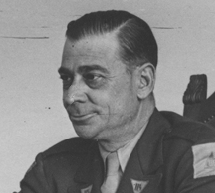 |
On April 7, 1946,
Mr. Harry W. Thon asked me at Schwäbisch Hall to write out an
affidavit accusing myself, and showed me an affidavit signed by Sepp
Dietrich admitting that there had been an order to murder the
American prisoners.
Mr.
Thon
said that what was wanted was the heads of the generals and that we
little men had nothing to fear. I told him that I was prepared to
write a report of my experiences in the Eiffel offensive, but that I
was not aware of any offenses committed against the laws of war.
Thereupon
Mr.
Thon
gave me paper and pencil, told me I had a respite of one night and
that, should I
fail to make a statement admitting my guilt, my family would be
deprived of their ration cards. He then had me shut up in the death
cell.
That night I wrote a report
of my experiences but it did not include any self-accusations.
|
Next morning
Mr.
Thon
appeared in my cell, read my report, tore it up, swore at me and
hit me.
After threatening
to have me killed unless I wrote what he wanted,
he left. A few minutes later the door of my cell opened,
a black hood incrusted with
blood was put over my head and face
and I was led to another room. In view of
Mr.
Thon's
threats the black cap had a crushing effect on my spirits. . . . Four
men of my company : Sprenger, Jaenckel, Neve, and Hoffmann accused me,
although later they admitted to having borne false testimony.
Nevertheless I still refused to incriminate myself. Thereupon
Mr. Thon said that if I
continued to refuse this would be taken as proof of my Nazi opinions,
and he would have me charged together with the generals, in which event
my death was certain.
He said I would have no chance against four witnesses, and advised me
for my own good to make a state-
ment after which I would be set
free. . . . I still refused. I told
Mr.
Thon
that although my memory was good, I was unable to recall any of the
occurrences he wished me to write about and which to the best of my
knowledge had never occurred.
Mr. Thon left
but returned in a little while with Lieutenant Perl who abused me,
and told
Mr.
Thon
that, should I not write what was required within half an hour, I should
be left to my fate. Lieutenant Perl made it clear to me that I had the
alternative of writing and going free or not writing and dying. I
decided for life and said I would sign anything they wanted.
Mr.
Thon
then dictated a statement to tally with Sprenger's and ruled out all
objections I raised.
On the 8th or 9th of April after
I had apparently not replied in the manner the investigators desired, I
was kicked in the hollow of the knee and on my backside and
beaten with a stick across my shoulders and the back of my head. A black
hood was again placed over my head
and face so I cannot testify as to who inflicted this punishment.
I hereby testify that I never
took part in any shootings of Prisoners of War, nor issued any such
orders, nor watched any shootings. I stated this to the Military Court
at Dachau.
The methods employed to obtain the
false evidence used against Schäfer are described in an affidavit, dated
January 20, 1948, at Landsberg prison, signed by Joachim Hoffmann, who
states that :
For 3 1/2
months I was kept in solitary confinement without either writing or
bathing allowed. Even when taken for a hearing a black hood was placed
over my head. The guards who took me to my hearing often struck or
kicked me. I was twice thrown down the stairs and was hurt so much that
blood ran out of my mouth and nose.
At the hearing, when I told the officers about the ill treatment I had
suffered, they only laughed. I was beaten and the black cap pulled over
my face whenever I could not answer the questions put to me, or gave
answers not pleasing to the officers.
In March,
1946, I was taken before a Summary Court. Prior to this I was beaten and
several times kicked in the genitals. At my trial I was sentenced to
death and then locked up in a cell which contained nothing but a wooden
chest and one blanket. Here I remained three weeks, after which the
investigating officers came to my cell and promised me I should
be released within two months, if I would write what they dictated. I
was unable to resist the pressure. I often witnessed the ill treatment
suffered by my comrades. Finally I agreed to write the false statement
required. I believed that if I wrote it I would be set free, but this
was an illusion.
Another of the witnesses against
Schäfer, Siegfried Jaenckel, made a similar sworn statement concerning the
methods used to
193
force him to bear false testimony.
He too had been
placed in solitary confinement
while a prisoner of war and tortured until he agreed to sign a dictated
statement. He was also one of those given a mock trial with a black hood
over his face lifted to show him the crucifix, black cloth, and candles.
The prosecutor, as
usual, was Mr. Henry Thon
and Jaenckel's "trial" lasted some twelve hours, after which he was told
he would be "taken for a ride" in a jeep and hung from a tree since he was
"not worth a bullet." Two days later he was again taken before a court and
told by Lieutenant Perl that "in consideration of his youth" and the fact
that he had acted in obedience to an order, he would be pardoned if he
would "tell the truth." At this second "trial," according to Jaenckel's
affidavit, Lieutenant Perl told him, "So you still don't want to confess?
You have no money to pay for your defense so you will hang. Look at your
comrades, they are to be released because they spoke the truth."
In his affidavit, signed two years
later, Jaenckel says he can no longer remember how often he was questioned
but he thinks a dozen times. And always he was told : "If you confess you
will go free; you need only to say you had an order from your superiors.
But if you won't
speak you will be hung."
I was beaten
and I heard the cries of the men being tortured in adjoining cells,
[writes Jaenckel] and whenever I was taken for a hearing I trembled with
fear. I was then only nineteen years old and had never had anything to
do with courts or the law. Subjected to such duress I eventually gave
in, and signed the long statement dictated to me, and copied the sketch
maps as ordered. I could never have done it otherwise, as I have
insufficient education. Captain Schumacher said to me : "The streets are
to be the same as in the statement of the other witnesses, but the other
details should be different because otherwise it will look too much like
a copy."
Jaenckel concludes his affidavit
as follows : "My charges against my comrades according to the statement
dictated to me at Schwäbisch Hall which I was forced to sign are not
true."
|

|
The names of the American
investigators in these cases. Kirschbaum, Metzger, Enders (alias
Andrews), Colombeck, and Egger, like those of Lieutenant Perl and W.
Harry Thon, will be remembered in Germany
as long, and with as much loathing, as the names of Himmler, Bormann
and other Nazi bullies and criminals are remembered in America.
|
Witness
brother
In one famous
instance Kirschbaum
brought forward a certain Einstein to prove that the accused
Menzel
had murdered Einstein's brother, but the prisoner pointed to the said
brother sitting in the witness box.
Kirschbaum,
deeply embarrassed, turned to Einstein and hissed, "How can we bring this
pig to the gallows, if you are so stupid as to bring your brother into the
court."
Mr. Metzger
grew furious, stripped up his sleeves and approached me threateningly
saying he would kill me unless I signed.
Seeing that his threats were lost on me, he added : "Well, surely I shall
find an accusation against you. I shall succeed in bringing you before an
American military court; and if you are hanged you owe it to me as surely
as I am called Metzger."
|
|
| |
|
|
Mr. Kirschbaum,
Simpson Commission
| |
|
|
| |
| |
|
|
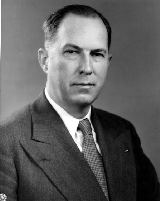
Kenneth C Royall |
When the case came to the
attention of
Secretary of the Army Kenneth C. Royall,
he ordered a stay of execution for the 12 men who were scheduled to be
hanged in just a few days, and then directed
General Lucius
D. Clay,
the highest authority
of the American occupation in Germany to
investigate Everett's charges
against the prosecution.
Not satisfied with that,
Royall then appointed a
three-man commission, headed by Judge Gordon Simpson of the Texas
Supreme Court, to investigate not only the Malmedy Massacre case, but
other Dachau proceedings, which had involved the same Jewish
interrogators. The other two members of the commission were Judge
Edward L. Van Roden and Lt. Col. Charles Lawrence, Jr.
|
After a six-week investigation
conducted from an office which they set up in Munich, the Simpson
Commission made its recommendation to Royall. The Commission had looked at
65 mass trials of German war criminals in which 139 death sentences had
been handed down. By that time, 152 German war criminals tried at Dachau
had already been executed. The 139 men who were still awaiting execution
were staff members of the Dachau concentration camp, SS soldiers accused
of shooting POWs at
Malmedy
and German civilians accused of killing Allied pilots who were shot down
on bombing missions over Germany. On January 6, 1949, they recommended
that 29 of these death sentences, including the 12 death sentences in the
Malmedy
Massacre case, be commuted to life in prison. Van Roden Report
|
|
| |
|
|
Van Roden
| |
|
|
| |
| |
|
|
Kenneth C Royall |
American Atrocities in Germany
By JUDGE EDWARD L VAN RODEN
AMERICAN investigators at the
U. S. Court in Dachau,
Germany, used the following methods to obtain confessions: Beatings and
brutal kickings.
Knocking out teeth and breaking jaws. Mock trials. Solitary confinement.
Posturing as priests. Very limited rations. Spiritual deprivation.
Promises of acquittal.
Complaints concerning these third degree
methods were received by Secretary of the Army Kenneth Royall last
Spring. Royall appointed Justice Gordon Simpson of the Texas Supreme
Court and me to go to Germany and check up on the reports.
|
Accompanied by Lt. Col. Charles
Lawrence. Jr., we went to Munich, Germany, set up offices there, and heard
a stream of testimony about the way in which American atrocities were
committed.
But first, a bit of the background. Last Spring
the Supreme Court refused the habeas corpus petition of Col. Willis N.
Everett. Jr., an American lawyer, who had served as defense counsel for
the 74 Germans accused in the famous Malmedy case. Everett is a very able
lawyer, a conscientious and sincere gentleman. He is not a fanatic.
In his petition. Everett charged that the Germans
had not received a fair trial. Everett did not claim that all the German
defendants were innocent, but since they did not have a fair trial, there
was no way of telling the innocent from the guilty.
The tragedy is that so many of us Americans,
having fought and won the war with so much sweat and blood, now say. "All
Germans should be punished". We won the war, but some of us want to go on
killing. That seems to me wicked.
If
Everett's shocking charges were true, they
would be a blot on the American conscience for eternity. The fact that
there were atrocities by the Germans during the war against Americans, or
by Americans against Germans, would not in the least lessen our disgrace
if such peacetime atrocities were to go unchallenged.
Our specific assignment was not only to examine
Col. Everett's charges, but also to examine the cases of the 139 death
sentences, which at that time remained unexecuted: 152 Germans had already
been executed.
The 139 doomed men who were still alive fell into
three groups. They were accused of involvement in the Dachau concentration
camp crimes, in the killing of American fliers, or in the Malmedy
massacres. Let me say that I believe the crimes for which these Germans
were tried actually took place, and that some Germans were guilty of them.
But we should not let the indiscriminate hate of
all Germans that was generated during and after the war, blind us to the
necessity of punishing the guilty ones only.
After this investigation, and after talking to
all sides, I do not believe that the German people knew what the German
Government was doing. I am convinced the German populace had no idea what
diabolical crimes that arch-fiend, Himmler, was committing in the
concentration camps. From the atrocities we learned about, he must have
been the very prince of devils.
But as for the Germans at large, they fought the
war as loyal citizens with a fatherland to support, and a fatherland to
defend.
Some American fliers, shot down on bombing raids
over Germany. were killed by German civilians.
These Germans felt that the American fliers were
the murderers of their defenseless wives, mothers, and children who were
In the bombed cities’ - just as the English felt that German fliers were
their murderers. That's war.
I felt deeply about these fliers. I had two sons
in the Air Force. Jimmy made 35 missions over Germany and returned safe,
thank God! Dick made 32 Missions and was finally shot down over Italy. He
spent 12 months in a German prisoner-of-war camp and was fairly well
treated. He is now in a sanitarium in Arizona recovering from TB he
contracted in the camp.
The Malmedy massacres, in which a group of
American prisoners of war were mown down after being captured during the
Battle of the Bulge, actually happened. But can't we distinguish between
the assertion that these atrocities did happen, and the assertion that
they were committed by these 74 Germans who had been in or near Malmedy at
that time?
Because some wicked sadistic German individuals
did it, are we doing the right thing by saying any and all Germans we lay
our hands on are guilty and should be destroyed? I personally don't
believe that. That's not the way of thinking I learnt in my church, or you
learned in your church.
On Russian insistence, the
Americans couldn't retry these men. The Russian philosophy in these
matters is that the investigators determine the guilt or innocence of the
accused, and the judge merely sets the sentence.
We accepted the Russian formula of no-retrial, but we won out on the
presumption of innocence before trial.
The American prohibition of
hear-say evidence had been suspended. Second and third-hand testimony was
admitted, although the Judge Advocate General
warned against the value of hearsay evidence, especially when it was
obtained, as this was. two or three years after the act. Lt. Col. Ellis
and Lt Perl of the Prosectution pleaded that it was difficult to obtain
competant evidence. Perl told the court, "We had a tough case to crack and
we had to use persuasive methods." He admitted to the court that the
persuasive methods included various "expedients, including some violence
and mock trials." He further told the court that the cases rested on
statements obtained by such methods.
The statements which were admitted as evidence
were obtained from men who had first been kept in solitary confinement for
three, four, and, five months. They were confined between four walls, with
no windows, and no opportunity of exercise. Two meals a day were shoved in
to them through a slot in the door. They were not allowed to talk to
anyone. They had no communication with their families or any minister or
priest during that time.
This solitary confinement proved sufficient in
itself in some cases to persuade the Germans to sign prepared statements.
These statements not only involved the signer, but often would involve
other defendants
Our investigators would put a
black hood over the accused's head and then punch him in the face with
brass knuckles, kick him, and beat him with rubber hose. Many of the
German defendants had teeth knocked out. Some had their jaws broken.
All but two of the Germans, in
the 139 cases we investigated, had been kicked in the testicles beyond
repair. This was Standard Operating Procedure with American investigators.
Perl admitted use of mock trials and persuasive
methods including violence and said the court was free to decide the
weight to be attached to evidence thus received. But it all went in.
One 18 year old defendant, after a series of
beatings. was writing a statement being dictated to him. When they reached
the 16th page, the boy was locked up for the night. In the early morning,
Germans in nearby cells heard him muttering. "I will not utter another
lie." When the jailer came in later to get him to finish his false
statement, he found the German hanging from a cell bar, dead. However the
statement that the German had hanged himself to escape signing was offered
and received in evidence in the trial of the others.
Sometimes a prisoner who refused to sign was led
into a dimly lit room, where a group of civilian investigators, wearing U.
S. Army uniforms. were seated around a black table with a crucifix in the
center and two candles burning, one on each aide. "You will now have your
American trial," the defendant was told.
The sham court passed a sham sentence of death.
Then the accused was told, "You will hang in a few days, as soon as the
general approves this sentence: but in the meantime sign this confession
and we can get you acquitted." Some still wouldn't sign.
We were shocked by the crucifix being used so
mockingly.
In another case, a bogus Catholic priest
(actually an investigator) entered the cell of one of the defendants,
heard his confession, gave him absolution, and then gave him a little
friendly tip: "Sign whatever the investigators ask you to sign. It will
get you your freedom. Even though it's false, I can give you absolution
now in advance for the lie you'd tell."
Our final report on these trials has been turned
over to Secretary of the Army Royall. In spite of the many instances like
those I have described, we found no general conspiracy to obtain evidence
improperly. With the exception of 29 cases, we saw no reason why the
executions should not be carried out. For the 110 others, there was
sufficient competent evidence from other sources to warrant the death
penalty, exclusive of the evidence obtained by the third-degree.
The 29 men whose sentences we recommended for
commutation certainly did not have a fair trial by American standards.
Twenty-seven of them were to have their terms reduced to life, one of them
was to get 10 years, and one would get two and one-half years, according
to our recommendations. We also recommended a permanent program of
clemency for reconsideration of the sentences of other prisoners convicted
in war crimes cases.

Prosecute The Jews
| |
| |
|
|
Jew Interogator |
Secretary Royall has saved our
national conscience. Could we as Americans ever have held our heads up
if he hadn't looked into it? He has saved our national prestige and
our international reputation.
However, in spite of Secretary Royall's
action in this matter, there is little real room for complacency on
the part of Americans. Rather our report reveals, by implication, that
we still have a serious situation in Germany to clear up. Moreover,
five of the men for whom we recommended commutations have been hanged
since we turned in our report. In all 100 of the 139 we set out to
investigate are now dead.
|
The American investigators
who committed the atrocities in the name of American Justice and under
the American flag are going scot-free. At
this point there are two objectives which should be aimed for:
1. Those prisoners whose death sentences have
not been commuted and who have not yet been hanged should be saved,
pending full judicial review.
2. American investigators
who abused the powers of victory and prostituted justice to vengeance,
should be exposed in a public process, preferably in the U. S., and
prosecuted.
|
Unless these crimes committed by Americans are
exposed by us at home, the prestige of America and American justice will
suffer permanent and irreparable damage. We can partially atone for our
own misconduct if we first search it out and publicly condemn and disavow
it. If we wait for our enemies to blazon our guilt abroad, we can only bow
our heads in shamed admission.
EDWARD L. VAN RODEN, a Pennsylvania judge, served
in World War I and II, in the latter as Chief of the Military Justice
Division for the European Theater where he saw service in Normandy,
Belgium, the Rhineland, the Battle of the Bulge, and in the Ardennes. In
1946 he was reassigned to active duty and served on several important
court martial trials in Germany. In 1948 Secretary of the Army Royall
appointed him to an extraordinary commission charged with investigating
the Dachau War Crimes program.
E. L. Van Roden, "American Atrocities in
Germany", The Progressive. February 1949, p. 21f.
|
|
| |
|
|
A civilian member of the defense staff,
Herbert J. Strong, born and raised in
Germany, was a Jew and refugee from Nazi Germany. Being fluent in German,
he was an invaluable member of the defense staff. Later, during the Senate
hearings on the trial, Strong criticized the Army's conduct of the investigation
and trial. He also believed, that while some of the defendants were guilty, it
had not been proven beyond a reasonable doubt. And his testimony could not be
easily brushed off as pro-Nazism or anti-Semitism.
This decision by Royall prompted at least some persons who
had been close to the case to comment. A letter from
James R. Rosenfeld, father of one of the
American soldiers alleged to have been shot by Peiper's men at the Baugnez
crossroads, to Senator Irving M. Ives, was in protest to Royall's decision. It
stated in part:
It appears that the defense attorney for the Germans,
Colonel Everett, does not ask that the sentences be set aside because of their
innocence but solely because of the weird procedure allegedly used by the
American prosecutors in seeking confessions.
I am altogether in favor of accused German soldiers being
ably defended to the last ditch. However, I am certain that they received a
fair trial and due justice rendered in their sentences. But in view of the
fact that the act for which they were convicted was such an outrageous
atrocity, I feel that the War Department would be indulging in mock
sentimentality were their sentences to be remitted because of overly shrewd
legal tactics or the invoking of minor technicalities of the law.
I would therefore appreciate anything that you can properly
do in behalf of the memory of my son and those other American soldiers so
cold-bloodedly massacred to the end that just law and not legal technicalities
shall prevail.
One of the survivors, Virgil P. Lary,
also protested, writing directly to Royall. He stated:
I was the only
officer to survive this ordeal and I am now in a retired status due to
disability received at that time. I mention this as I feel that it is
necessary for you to know that I am competent to discuss this case. It was my
pleasure to return to Dachau and to testify with other survivors.
Before the Malmédy Case was heard we spent three months in
Europe awaiting the trial to begin. During this period I personally observed
the techniques and methods used by the War Crime Teams in obtaining
confessions... only the fairest methods were used in the interrogations. No
group of Army personnel have ever, in my opinion, conducted their
investigation more thorougly or efficiently. Any criticism from an individual
that did not have an opportunity to observe this work is unfair, unkind to the
parents, wives and children of those American men and is not based on truth. I
am certain that you will quickly find that what I say here is correct when you
conduct your investigation.
If you so desire I would be happy to present a true,
unquestionable picture to you or your investigating group.
However, a letter from Fiske H. Ventres to Royall, provides a
different view:
… at Bremen, Germany, I was billeted with a member of the
War Crimes Commission who had just resigned his post because of the methods
employed by "Americans" to gain confessions and convictions. According to him
confessions were the sole evidence against the accused and no methods were too
brutal to employ in gaining the confessions. One defendant was beaten to death
because of his refusal to sign a confession and as a lesson to his other
unwilling fellow defendants. To prove his point the resigned agent produced
from his trunk the blood-caked hood he, himself, had removed from the head of
the murdered German.
From one end of Europe to the other, people are quite aware
of the true character of these so-called trials, from Nuremberg to the Bulge.
They know full well the identity of those conducting the proceedings and, I
might add, a great many Europeans are more than a little suspicious that what
is being done is more in the interest of another nation than to the United
States.
The first two letters characterize the general mood of the
country towards the trial and its defendants. Not until the Senate investigation
did that mood begin to change. After the investigation, things quieted down. But
then in 1956, after Dietrich had been released from prison and Peiper's release
was imminent, the call for vengeance was renewed.
Articles in magazines and newspapers retold the story of the
atrocities and the trial-too often glossing over, or totally ignoring, the
irregularities in the interrogations and trial. And it made little difference
that the facts in these articles were often grossly inaccurate.
One article in particular, written by
Emile C. Schurmacher and
published in the May 1956 issue of a sensationalistic pulp magazine called Real
Adventure, was titled, "Who Turned the Killers Loose?" Schurmacher's
account of the incident reads more like fiction; the majority of his errors
could have been corrected had he examined the trial records.
Peiper was, of
course, released despite the outcry from "concerned citizens" and most of
the veterans organizations. In
1964 he moved to
France where he made a comfortable living as a translator. But in
1976 a sensational article on Peiper appeared in a French
communist newspaper. A two-week campaign of threats and harassment followed,
during which time Peiper was preparing to leave France, and on the night of
14/15 July, he was killed in a fire-bomb attack
on his house.
A CIA agent in Bern, Switzerland, claimed to have unmasked
Peiper and put the information of his whereabouts in the hands of his killers.
Yet Peiper's residence was not a real secret. A group calling themselves the
"Avengers" (supposedly composed of former members of the French resistance)
claimed responsibility for Peiper's death. But it is believed that Israel's
Massed was actually responsible; they were operating in France at the time
against Palestinians; they were the only ones with the motivation and means to
kill him, and Simon Wiesenthal had also suddenly started up a campaign against
Peiper.
There are still, however, many unanswered, and even unasked,
questions:
Why are the statements and testimony of a handful of the
survivors continuously repeated as evidence of a massacre? What about the
statements made by the other survivors?
In the initial attack on the American column at the Baugnez
crossroads, some GIs were wounded. Descriptions of the attack indicate that the
column was fired on by all manner of tank cannon, mortars, machine gun and small
arms fire. Photos clearly show the destroyed, burned-out, and
bullet-and-shrapnel-riddled vehicles of the column. It would seem highly
unlikely that no one would be killed in such a battle. Were any Americans killed
in the battle, prior to the alleged massacre? If so, how many-and are they
included in the number of dead alleged to have been murdered by Peiper's men?
What was the "new
information" Everett wired Peiper he was on his way over with? (Everett died
before he could make the trip.)
The big question seems to be whether or not an order existed
that prisoners were to be shot. No proof of a written order has ever been found.
Many of the defendants claimed orders to such effect were given by their
superiors, prior to and during the Offensive.
The prosecution's claim that such an order had been given by
Hitler or at least some higher authority above Dietrich could not be
conclusively proven, although some comments made by Dietrich and others to their
subordinates could be interpreted in different ways.
If such an order was given by any higher authority above
Peiper, why was his unit the only one to carry them out? If the order originated
with Peiper, why did they kill only some prisoners and not others?
U.S. troops not only brutalized and killed German prisoners
on their own-before, during and after the Battle of the Bulge--but orders to
that effect had been given. An order issued on 21 December
1944
by Headquarters of the U S. 328th Infantry Regiment stated:
"No SS troops or paratroops will be taken prisoner, and will
be shot on sight."
Isn't just the issuance of such an order a war crime? Weren't
some of the Malmédy Case defendants being accused of the exact same crime? How
many German bodies littered the battlefields who had been the victims of
American and Allied war crimes? Where is their justice?
And there are many more questions that need to be asked. More
importantly, they need to be answered, although many will probably never be
satisfactorily answered.
For those who desire to do some further reading on this
subject, I can recommend James J. Weingartner's Crossroads of Death: The
Story of the Malmédy Massacre and Trial, published last year by the
Unversity of California Press. This work, above all others that I have examined
to date, is the most complete and, perhaps, the most objective account, but it
is still far from the final word on the subject.
Another account which I have been informed is somewhat
objective is Charles Whiting's Massacre at Malmédy, originally published in
1971 by Stein and Day. Some groups thought the
book too objective and apparently forced the publisher to stop selling it;
copies of that edition have proven hard to find. However, earlier this year
Stein and Day's new catalog included a listing of this title in a paperback
edition. At the trial Everett concluded his closing summary with a quote from
Tom Paine:
He that would make his own liberty secure must guard even
his enemy from oppression, for if he violates this duty, he establishes a
precedent which will reach himself.
And finally, a personal interview with Peiper had been
arranged for Weingartner. Unfortunately, Peiper's untimely death occurred before
the interview took place. Ultimately, Weingartner concludes his book with:
"In some sense, Peiper was one more victim of the
crossroads of death. May he be the last."
Judge Gordon Simpson (unlike Van Roden, trying to put the best
interpretation,
even if very strained, on the sorry facts that had come out) conceded
that this was probably "a poor team," and explained that the shortage of
German-
speaking American lawyers and interpreters had forced the Army to
"draw on some of the German
refugees." Steiner, Kirschbaum and Thon (later
chief of the evaluation section of
the civil administration division of the US
military government) appeared later
and denied all, but they were shaken by
the testimony of investigator Bruno
Jacob, who admitted a few things.
Speaking
for the press, investigators Dwight
Fanton and Morris Elowitz also denied
all. Colonel Rosenfeld denied almost
all. He charged that Lieutenant Colonel
Harold D. McGown, commander of the American soldiers massacred at
Malmédy, had fraternized with SS Colonel Joachim Peiper, the German
commander,
and this explained why McGown had appeared at Dachau as a defense
witness for Peiper and had testified that Peiper had held talks with him
and had been responsible for saving a number of Americans. As evidence for
the fraternization, Rosenfeld claimed that McGown and Peiper had been "en-
36
New York Times
(Jul. 30, 1948), 5; (Oct. 7, 1948),
15; (Jan. 7, 1949), 1, 9; (Mar. 2,1949), 1,
14; (Mar. 5, 1949), 1, 4; (May 5, 1949), 8.
Chapter 1: Trials, Jews and Nazis
49
tirely too friendly during those nights they spent talking together" and
that,
when Peiper and his men were later able to escape a US Army trap, "McGown
was with them." Of course, McGown was Peiper’s prisoner.
37
It will, of course, be argued that these nightmarish Dachau "trials" have
little
to do with our subject because the standard maintained in the trials at
Nuremberg
were not comparable and because the bearers of the extermination
legend do not cite any of the "evidence" produced at these trials. There is
partial
truth to these contentions; brutality and coercion were not nearly as
extensive
at the prominent Nuremberg trials as they were at the Dachau trials, and
mass exterminations were not emphasized in the Dachau trials (although gas
chambers made occasional appearances in testimony). However the Dachau
trials cannot be waved aside so easily because the administering agency, the
War Crimes Branch, was also deeply involved in the Nuremberg trials, as we
have noted, and as we are to reconfirm shortly in a particularly striking
respect.
In addition coercion was, in fact, employed in order to get evidence at
the Nuremberg trials, but that subject is discussed in a later chapter.
None of the four powers was happy with the IMT arrangement and after
the "big trial" they split up and held the kinds of trials they were
interested in.
The British trials reflected a general interest but on points of relatively
minor
significance here. The only major French trial was of Saar industrial magnate
Hermann Röchling, whom the French had also tried,
in absentia,
after World
War I. Planning for the American NMT trials had actually started in 1945, and
in March 1946 a division of Jackson’s office, headed by Telford Taylor, had
been created for this purpose.
birds talk otherwise […] It was a trick, and it worked like a charm."
35
The Malmédy defendants had had a competent defense attorney, Lieutenant
Colonel Willis M. Everett, Jr. It was Everett’s repeated appeals to, among
others, the US Supreme Court, plus a chorus of protests from German clergy-
35
New York Times
(Apr. 31, 1946),Utley, 185-200;
Chicago Tribune
(Apr. 30, 1948),12; (Feb.
13, 1949), 3; (Feb. 14, 1949), 3; (Feb. 17, 1949), 8;
New York Times
(Oct. 31, 1948), sec. 4,
8.
Arthur R. Butz, The Hoax of the Twentieth Century
48
men and others, plus such details regarding what was going on that managed
to get into the press by various routes, that persuaded the American military
governor, General Lucius D. Clay, to request an investigation of the trials
at
Dachau. On July 29, 1948, the Secretary of the Army appointed a commission
consisting of two American judges, Gordon Simpson of Texas and Edward
Van Roden of Pennsylvania, both JAG reserve colonels. They were assisted
by JAG Lieutenant Colonel Charles Lawrence, Jr.
The commission submitted
its report to the Secretary of the
Army in October 1948, and selected portions
were made public in January 1949.
Subsequent public remarks by Van
Roden and also, to some extent, by
Simpson, plus an independent
investigation by a review board appointed by
Clay, decisively exposed the whole
affair, to the point where the defenders of
the trials could only haggle about
the numbers of German prisoners subjected
to brutalities. The review board
confirmed all that Van Roden claimed, taking
exception only in respect to the
frequencies of the brutalities.
36
Oddly, in his
book,
Decision in Germany,
Clay denies the brutalities, but he is contradicted
by his own review board.
The cases, especially the Malmédy case, attracted a good deal of attention
through 1949, and a subcommittee headed by Senator Baldwin conducted an
investigation. One witness, formerly
a court reporter at the Dachau trials, testified
that he was so repelled by what had
gone on there that he quit the job. He
said that the "most brutal" had been Lieutenant Perl, Frank Steiner and Harry
W. Thon. He explained that both Perl and his wife had been in Nazi
concentration
camps, and that the Nazis had killed Steiner’s mother.
The "American" investigators
responsible (and who later functioned as the prosecution in the trials) were:
Lt.-Col. Burton E Ellis (chief of the War Crimes Committee) and his assistants,
Capt. Raphael Shumacker, Lt.
Roberf E. Byme, Lt. William R. Perl, Mr. Morris Ellswitz, Mr. Harry Thon and Mr.
Kirschbaum. The legal adviser of the court was Col. A. H. Rosenfeld. The reader
will immediately appreciate from their names that the majority of these people
were "biased on racial grounds'' in the words of Justice Wenersturm - that is,
were Jewish, and therefore should never have been involved in any such
investigation.
73 soldiers were executed that day.
Amazingly, about 40 American soldiers SURVIVED the massacre by playing dead.
They waited about an hour for the Germans to leave before extricating themselves
from the pile of dead friends that had saved their lives. They made a run for
the woods, but some German soldiers had remained in the area and many more
soldiers were killed before they could get away. Still, there were about 30
survivors of the event.
Appeals lasted more than 10 years and involved both the US Supreme Court and
the Hague Court. The last prisoner, Peiper himself, was released in 1956.
Jew Liar
Apart from some minor
inconsistencies, such as Lieutenant Lary saying on December 18 that after
escaping from the field he got a lift into Malmédy in a truck, but later
changing his story to one of two Belgian women helping him to get there on foot
aided by a makeshift crutch, the only real point in contention is whether or not
there was any attempt to escape that might have caused the Germans to open fire.
However, the fact that Peiper's men
sent scores of prisoners to the rear in the normal manner during their advance
earlier on the 17th belies the no-prisoners theory, and attempts by the
Americans to produce written evidence of such an order for use at the Dachau war
crimes trial came to nothing
On May 16, 1946, Peiper and 70 members of his Kampfgruppe, plus his
army commander, chief of staff and corps commander, were arraigned before a U.S.
military court in the former concentration camp at Dachau, charged that they did
"willfully, deliberately and wrongfully permit, encourage, aid, abet and
participate in the killing, shooting, ill treatment, abuse and torture of
members of the armed forces of the United States of America." The location
chosen for the trial and the number of defendants was clearly significant, and
it surprised no one when all the Germans were found guilty. The court of six
American officers presided over by a brigadier general took an average of less
than three minutes to consider each case. Forty-three of the defendants,
including Peiper, Christ, Rumpf, Sievers and Sternebeck, were sentenced to death
by hanging (Poetschke had been killed in March 1945), 22 to life imprisonment
and the rest to between 10 and 20 years. "The Law of the Victors," as it has
been called in postwar Germany, had prevailed. But none of the death sentences
was ever carried out, and all the prisoners had been released by Christmas 1956.
Peiper was the last to leave prison. Sadly, incomplete and rushed
investigations, suspicions about the methods used to obtain confessions, and
inadequate or flawed evidence ensured that guilty men escaped proper punishment,
and there can be little doubt that some innocent men were punished during the
trial. In the final analysis, justice itself became another casualty of the
incident.
The Malmédy Massacre and Trial
RAY MERRIAM
In 1977, I received a newspaper clipping from a reader of my
Own publication, The Military Journal. The clipping contained an
interview with Paul Martin, a survivor of the so-called "Malmédy Massacre," and
had apparently been published on the previous anniversary of the incident.
Martin's comments are quite interesting. It is readily
apparent that he has no grudge against the men of Peiper's unit for what they
did, and he states:
"They were just doing their job. Besides, we did the same
later on. I talked to men in the hospital who said we killed unarmed prisoners
of war."
However, based on what I had read about the "massacre"
previously, some points made by Martin and the interviewer did not seem quite
correct. This led to my re-reading just about everything I had on the subject
(which, at the time, was limited to other historians' published accounts). I not
only discovered some points where the interview did not seem factual, but also
that the other accounts could not agree on certain important points. Thus, I
added some editorial notes in several places when I published the interview in
early 1979.
A number of people wrote in to comment on this interview.
Though I did not feel my editorial notes were especially controversial, since
they were based entirely on fairly standard works, I did expect to receive some
mail from irate readers.
However, out of over a dozen letters and brief comments made
by readers concerning the Martin interview, only three, surprisingly, questioned
my editorial comments. Two were strictly emotional outbursts. The third,
however, was considerably less emotional and attempted to refute my comments by
utilizing two sources I had not consulted.
The publication of that letter, and rebuttals to it by Mr.
Landwehr and myself, produced additional responses, largely favorable to our
point of view. The publication of the Martin interview and the subsequent debate
in the letters column of my journal, led to Mr. Brandon of the Institute for
Historical Review inviting me to this convention to speak on the subject of the
"massacre," the trial and its aftermath.
However, in the short time I had available (about four
months), I was unable to acquire all the material that one should really examine
in order to discuss this subject sufficiently. Certain items, of prime
importance to any serious research of the "massacre," have been difficult to
locate. Perhaps the most important of these, the published record of the Malmédy
Massacre investigation conducted by a Subcomittee of the Comittee on Armed
Services of the U.S. Senate, had been most elusive for me. Numerous unsuccessful
attempts to acquire this book through my local library led me to various used
book dealers in an attempt to purchase a copy. Finally, just one week ago, a
book dealer located a copy which I have purchased; naturally, a few days later
the library informed me they had the same material! Unfortunately, acquiring
this work only a few days before the convention would not allow me time to even
fully read its over 1600 pages, let alone use it in the preparation of this
paper.
Some material did not arrive until the last moment and there
is still a considerable amount of material I am still trying to locate. Thus, I
am presenting today only some of the important points concerning the incident,
the trial and its aftermath. My research will continue beyond this and I will
provide the Institute for Historical Review with articles based on my continuing
research. At some appropriate point in the future, after I am satisfied with my
research efforts, I will produce a book covering the entire subject.
The unit commanded by
29-year-old Lieutenant Colonel Joachim Peiper consisted basically of his First
SS Panzer Regiment, a battalion plus an additional company of panzergrenadiers,
two companies of motorized combat engineers, an anti-aircraft company, a few
King Tiger tanks of the 501st Heavy Tank Battalion, and a company of
Luftwaffe paratroopers. Such composite formations were known as
Kampfgruppen, or battle groups, and were formed to per-
form a specific task.
The task of Kampfgruppe Peiper, as the spearhead of the 1st SS Panzer
Division, and, indeed, the 6th Panzer Army, was to reach the Meuse River with
all possible speed.
Eventually, the route
they actually travelled would take them through Honsfeld, Bullingen, Baugnez,
Ligneauville, Stavelot, Trois Ponts, La Gleize, and Stoumont, with elements of
his command going to Petit Thier, Wanne, Lutrebois, and Cheneux. In each of
these towns, and at times on the roads between them, it is alleged that men from
Peiper's command killed various numbers of unarmed American soldiers as they
were surrendering, or after they were captured. Additional numbers of dead
civilians have been largely attributed to Peiper's men also.
The exact count of the dead, American military and civilian,
has never been conclusively established. At the trial, the prosecution declared
they would prove the murder of from 538 to 749 prisoners of war and over
go Belgian civilians (and they suggested
that the number was probably even higher.) It appears that the figures finally
settled on were 350 American soldiers and ill civilians.
And of these, it is not certain how many may have actually
been justifiably killed: some Americans may not have totally surrendered to
their captors; some may have attempted to delay or impede the progress of
Peiper's troops, or made outright sabotage attempts; some may not have
surrendered all their weapons; others may have been slow to obey commands or
even totally disobeyed them. There was the possibility of accidental shootings
as well.
Yet, one cannot deny the fact that at least some American
prisoners had been killed under highly suspect circumstances, if not murdered
outright.
The matter of civilian deaths along Peiper's route of advance
is even more clouded. Many were, indeed, killed, but it could not always be
clearly established by whom and under what circumstances. In house-to-house
fighting it was a common tactic to toss grenades into buildings first and then
rush in with weapons firing.
Accidental deaths of civilians caught in battle zones was the
rule rather than the exception. One woman, carrying her baby, was killed while
running from house to house, trying to escape the battle; it was not determined
which side fired the fatal shots, but it was most certainly accidental.
In one instance, a Belgian killed a wounded German soldier
with an ax, and was promptly shot by Peiper's men.
Evidence given at the trial, however, did indicate that some
civilians were killed without justification by Peiper's troops.
Claims that Belgian guerrilla fighters were active throughout
the area were proven truthful. One defendant told how an officer instructed him
to shoot a Belgian, the officer claiming the Belgian was a guerrilla fighter.
The mere thought of the presence of guerrillas, who would be
virtually indistinguishable from the rest of the population, would obviously
make any soldier trigger-happy around civilians in a combat zone. Some
defendants, including Peiper, claimed to have seen civilians firing on German
troops.
But in some cases, the claim by the prosecution of the
killing of civilians and military personnel by Peiper's troops could not be
proven or was effectively disproven.
The prosecution claimed at least nine civilians were murdered
by Peiper's men in Bullingen. One of the defense lawyers made a brief
investigative trip to Bullingen. He brought back an affidavit from the village
mayor and registrar, whose task it was to keep track of the citizenry (and not a
very hard task in a small community of about 300), which stated only two
citizens had died since 16 December 1944: one of natural causes, in 1946, the
other by shrapnel from American artillery fire (the latter claim was supported
by an affidavit from the husband of the woman who was killed). Still, it was
possible that transient civilians might have been killed in Bullingen by
Peiper's men.
The prosecution, on the basis of a number of sworn
statements, alleged that as many as 311 American prisoners had been killed in La
Gleize. Hal McCown, ultimately the defense's star witness, was a major at the
time of the Offensive and spent several days as Peiper's prisoner in La Gleize.
He maintained that during that time he had not seen a single dead American
prisoner. The prosecution pointed out that McCown had not seen all parts of the
village.
The defense was, however, able to offer several affidavits by
La Gleize residents who had been present during the Germans' stay there. None
had seen any American prisoners shot, nor the dead bodies from any alleged
shootings, nor had they even heard of any such incidents.
These were followed by testimony from German witnesses who
supported the observations of McCown and the civilians. But, as in other
instances during the trial, the Belgians' testimony in favor of the defendants
was highly effective, since they had no stake in the outcome of the case.
Indeed, they would tend to be hostile towards the defendants if anything.
The defense was often able to counter the prosecution's
allegations, though not always successfully. Part of the problem was in trying
to defend 74 men at once. Although all were accused of the same basic crime,
each played a different part in it. Separate charges, though not always
specific, were brought against each, however, the U.S. Military Government had
determined they be tried en masse for the sake of "efficiency."
The first review of the trial was performed by
Maximilian Koessler, a civilian attorney of the War Crimes Branch of the judge
Advocate General's Department. Koessler believed the mass trial, and
especially the use of numbered placards worn around the defendants' necks as a
means of identification, made it difficult for the judges to distinguish one
prisoner from another. The result was that evidence of guilt against some would
tend to be damaging to all.
The defense did request that two separate trials be held: one
for those accused of having issued illegal orders, and another for those accused
of having carried them out. This request was denied by the court, in the first
of many instances where the court would favor the prosecution, even when the
defense was clearly in the right.
The bench assembled
for the trial consisted of eight men. The presiding officer was Brigadier
General Josiah T. Dalbey. The crucial position of law member was filled by
Colonel Abraham H. Rosenfeld; it was his duty to interpret applicable law and
determine procedure. (Rosenfeld had recently acted for the prosecution in the
Mauthausen Concentration Camp case and thus one has to suspect his objectivity
in the Malmédy case.) Line officers, all colonels, made up the rest of the
bench.
Chief defense counsel was Colonel Willis M. Everett, Jr.
Everett had only just arrived overseas and was actually horrified by his
assignment. He accepted it with reluctance, due partly to the awarness of his
own professional inadequacies (having had virtually no courtroom experience
previously), but primarily for the repugnance he felt for the ostensible crimes
of his clients.
After the trial, his continuing efforts for the Malmédy
defendants was due to his belief that justice had not been properly served.
Six Army attorneys were designated assistant defense counsel;
of these, only one, Lieutenant Colonel Granger G. Sutton, had had extensive
courtroom experience.strong
A civilian member of
the defense staff, Herbert J. Strong, born and raised in Germany, was a Jew and
refugee from Nazi Germany. Being fluent in German, he was an invaluable
member of the defense staff. Later, during the Senate hearings on the trial,
Strong criticized the Army's conduct of the investigation and trial. He also
believed, that while some of the defendants were guilty, it had not been proven
beyond a reasonable doubt. And his testimony could not be easily brushed off as
pro-Nazism or anti-Semitism.
The defendants were also allowed to engage native German
counsel, and some did so, but their value was limited due to the ever-present
language problem and their unfamiliarity with American legal procedure.
Prosecutors
The orginial
investigation team assigned to the case included Captain Dwight Fanton, a
graduate of Yale Law School, Captain Raphael Shumacker, First Lieutenant William
R. Perl, and two civilian Army employees, Morris Elowitz and Harry Thon. Perl,
Thon, Elowitz, Shumacker, and another investigator, Joseph Kirschbaum, were
accused, during the trial, of having used physical and psychological duress in
order to extract sworn statements from the defendants. The use of mock trials
and threats was admitted by the investigators, but all manner of physical abuse
was denied.
The following allegations were made by defendant Hendel:
… on
4 April
1946 1 was led from my cell under
a black hood, was put into a cell facing the door and was then beaten in the
abdomen and face until I fell to the ground. When a moment later the hood was
taken off, Lieutenant Perl and Mr. Thon stood before me. During the subsequent
interrogation, I was also beaten several times. No notice was taken of my
request to have the interrogation postponed since I was not in condition for
it at that time. The facts described happened before my interrogation. During
the interrogation, promises were made to me but since I did not know anything
and today still do not know anything of an order, all sorts of threats were
made to me and since things were immaterial to me and I wanted to avoid
further beatings, etc., I wrote down everything that was dictated to me.
Many additional allegations were made by defendants, all in
the same vein.
Later, the Senate investigation would show that at least some
of these allegations of physical brutality, denied by the interrogators at the
trial, were founded in evidence.
The prosecution team
for the trial included interrogators Perl, Thon, Elowitz, Kirschbaum and
Shumacker, plus First Lieutenant Robert E. Byrne and Lieutenant Colonels Homer
B. Crawford and Burton F. Ellis. Ellis became chief prosecutor.
The guards at the prison where the interrogations took place
were not under the control of the war crimes team. They also, for a time,
included Polish refugees who harbored considerable resentment towards
Germans-and especially SS men. Some defendants specifically mention physical
abuse by these guards as they were being led between their cells and the
interrogation rooms and while waiting in halls, all the time wearing black hoods
over their heads. (The hoods were claimed to be necessary to keep the prisoners
form recognizing each other and to prevent them form speaking to fellow
soldiers.) Kicking, punching, beating about the arms, and pushing prisoners down
stairs, in addition to verbal abuse, was conducted frequently, much to the
amusement of the perpetrators.
After the trial, Everett attempted to get the Supreme Court
to hear the appeal of the Malmédy Case defendants. In May 1948 the Court's
decision not to hear the appeal prompted the Secretary of the Army, Kenneth C.
Royall, to order a stay of execution of the sentences pending further
investigation.
This decision by Royall prompted at least some persons who
had been close to the case to comment. A letter from James R. Rosenfeld, father
of one of the American soldiers alleged to have been shot by Peiper's men at the
Baugnez crossroads, to Senator Irving M. Ives, was in protest to Royall's
decision. It stated in part:
It appears that the defense attorney for the Germans,
Colonel Everett, does not ask that the sentences be set aside because of their
innocence but solely because of the weird procedure allegedly used by the
American prosecutors in seeking confessions.
I am altogether in favor of accused German soldiers being
ably defended to the last ditch. However, I am certain that they received a
fair trial and due justice rendered in their sentences. But in view of the
fact that the act for which they were convicted was such an outrageous
atrocity, I feel that the War Department would be indulging in mock
sentimentality were their sentences to be remitted because of overly shrewd
legal tactics or the invoking of minor technicalities of the law.
I would therefore appreciate anything that you can properly
do in behalf of the memory of my son and those other American soldiers so
cold-bloodedly massacred to the end that just law and not legal technicalities
shall prevail.
One of the survivors, Virgil P. Lary, also protested, writing directly to Royall.
He stated:
I was the only officer to survive this ordeal and I am now
in a retired status due to disability received at that time. I mention this as
I feel that it is necessary for you to know that I am competent to discuss
this case. It was my pleasure to return to Dachau and to testify with other
survivors.
Before the Malmédy Case was heard we spent three months in
Europe awaiting the trial to begin. During this period I personally observed
the techniques and methods used by the War Crime Teams in obtaining
confessions... only the fairest methods were used in the interrogations. No
group of Army personnel have ever, in my opinion, conducted their
investigation more thorougly or efficiently. Any criticism from an individual
that did not have an opportunity to observe this work is unfair, unkind to the
parents, wives and children of those American men and is not based on truth. I
am certain that you will quickly find that what I say here is correct when you
conduct your investigation.
If you so desire I would be happy to present a true,
unquestionable picture to you or your investigating group.
However, a letter from Fiske H. Ventres to Royall, provides a
different view:
… at Bremen, Germany, I was billeted with a member of the
War Crimes Commission who had just resigned his post because of the methods
employed by "Americans" to gain confessions and convictions. According to him
confessions were the sole evidence against the accused and no methods were too
brutal to employ in gaining the confessions. One defendant was beaten to death
because of his refusal to sign a confession and as a lesson to his other
unwilling fellow defendants. To prove his point the resigned agent produced
from his trunk the blood-caked hood he, himself, had removed from the head of
the murdered German.
From one end of Europe to the other, people are quite aware
of the true character of these so-called trials, from Nuremberg to the Bulge.
They know full well the identity of those conducting the proceedings and, I
might add, a great many Europeans are more than a little suspicious that what
is being done is more in the interest of another nation than to the United
States.
The first two letters characterize the general mood of the
country towards the trial and its defendants. Not until the Senate investigation
did that mood begin to change. After the investigation, things quieted down. But
then in 1956, after Dietrich had been released from prison and Peiper's release
was imminent, the call for vengeance was renewed.
Articles in magazines and newspapers retold the story of the
atrocities and the trial-too often glossing over, or totally ignoring, the
irregularities in the interrogations and trial. And it made little difference
that the facts in these articles were often grossly inaccurate.
One article in particular, written by Emile C. Schurmacher
and published in the May 1956 issue of a sensationalistic pulp magazine called
Real Adventure, was titled, "Who Turned the Killers Loose?" Schurmacher's
account of the incident reads more like fiction; the majority of his errors
could have been corrected had he examined the trial records.
Peiper was, of
course, released despite the outcry from "concerned citizens" and most of the
veterans organizations. In
1964
he moved to France where he made a
comfortable living as a translator. But in
1976
a sensational article on Peiper appeared
in a French communist newspaper. A two-week campaign of threats and harassment
followed, during which time Peiper was preparing to leave France, and on the
night of 14/15
July, he was killed
in a fire-bomb attack on his house.
A CIA agent in Bern, Switzerland, claimed to have unmasked
Peiper and put the information of his whereabouts in the hands of his killers.
Yet Peiper's residence was not a real secret. A group calling themselves the
"Avengers" (supposedly composed of former members of the French resistance)
claimed responsibility for Peiper's death. But it is believed that Israel's
Massed was actually responsible; they were operating in France at the time
against Palestinians; they were the only ones with the motivation and means to
kill him, and Simon Wiesenthal had also suddenly started up a campaign against
Peiper.
There are still, however, many unanswered, and even unasked,
questions:
Why are the statements and testimony of a handful of the
survivors continuously repeated as evidence of a massacre? What about the
statements made by the other survivors?
In the initial attack on the American column at the Baugnez
crossroads, some GIs were wounded. Descriptions of the attack indicate that the
column was fired on by all manner of tank cannon, mortars, machine gun and small
arms fire. Photos clearly show the destroyed, burned-out, and
bullet-and-shrapnel-riddled vehicles of the column. It would seem highly
unlikely that no one would be killed in such a battle. Were any Americans killed
in the battle, prior to the alleged massacre? If so, how many-and are they
included in the number of dead alleged to have been murdered by Peiper's men?
What was the "new information" Everett wired Peiper he was on
his way over with? (Everett died before he could make the trip.)
The big question seems to be whether or not an order existed
that prisoners were to be shot. No proof of a written order has ever been found.
Many of the defendants claimed orders to such effect were given by their
superiors, prior to and during the Offensive.
The prosecution's claim that such an order had been given by
Hitler or at least some higher authority above Dietrich could not be
conclusively proven, although some comments made by Dietrich and others to their
subordinates could be interpreted in different ways.
If such an order was given by any higher authority above
Peiper, why was his unit the only one to carry them out? If the order originated
with Peiper, why did they kill only some prisoners and not others?
U.S. troops not only brutalized and killed German prisoners
on their own-before, during and after the Battle of the Bulge--but orders to
that effect had been given. An order issued on 21 December
1944
by Headquarters of the U S. 328th Infantry Regiment stated:
"No SS troops or paratroops will be taken prisoner, and will
be shot on sight."
Isn't just the issuance of such an order a war crime? Weren't
some of the Malmédy Case defendants being accused of the exact same crime? How
many German bodies littered the battlefields who had been the victims of
American and Allied war crimes? Where is their justice?
And there are many more questions that need to be asked. More
importantly, they need to be answered, although many will probably never be
satisfactorily answered.
For those who desire to do some further reading on this
subject, I can recommend James J. Weingartner's Crossroads of Death: The
Story of the Malmédy Massacre and Trial, published last year by the
Unversity of California Press. This work, above all others that I have examined
to date, is the most complete and, perhaps, the most objective account, but it
is still far from the final word on the subject.
Another account which I have been informed is somewhat
objective is Charles Whiting's Massacre at Malmédy, originally published in
1971 by Stein and Day. Some groups thought the
book too objective and apparently forced the publisher to stop selling it;
copies of that edition have proven hard to find. However, earlier this year
Stein and Day's new catalog included a listing of this title in a paperback
edition. At the trial Everett concluded his closing summary with a quote from
Tom Paine:
He that would make his own liberty secure must guard even
his enemy from oppression, for if he violates this duty, he establishes a
precedent which will reach himself.
And finally, a
personal interview with Peiper had been arranged for Weingartner. Unfortunately,
Peiper's untimely death occurred before the interview took place. Ultimately,
Weingartner concludes his book with:
"In some sense, Peiper was one more victim of the crossroads of death. May he
be the last."
When the
allegations of
torture following
Malmedy
were raised in the
trials of the
SS
murderers
in 1948, guess who condemned it? Joe
The
Malmedy Massacre, or the shooting of 84 American soldiers who had
surrendered, took place on December 17, 1944, the second day of the Battle of
the Bulge. After the war, during the summer of 1945, the U.S. occupation
authorities rounded up over 1,000 former soldiers in the 1st SS Panzer Division
and interrogated them. Seventy-five of them were originally charged as war
criminals in the Malmedy case. One of those who were charged was
18-year-old
Arvid
Freimuth
who committed suicide in his cell before the trial started.
Lt. William Perl...was the chief interrogator of the Malmedy
Massacre accused....The chief prosecutor, called the Trial Judge Advocate, was
Lt. Col. Burton F. Elli...The lawyer for the defense was Lt. Col. Willis M.
Everett....Everett was ably assisted by Herbert J. Strong, a civilian attorney
who had volunteered to work on the war crimes military tribunals....A panel of
high-ranking American army officers acted as both judge and jury. Seven members
of the panel are shown in the photograph below. The president of the panel was
Brigadier General Josiah T. Dalbey....
In the prison of the
Swabisch
Hall, he stated, officers of the
S.S.
Leibstandarte
Adolf
Hitler were flogged until they
were soaked in blood, after which their sexual organs were trampled on as they
lay prostrate on the ground. As in the notorious
Malmedy
Trials
of private soldiers, the prisoners were hoisted in the air and beaten until they
signed the confessions demanded of them.
On the basis of such "confessions"
extorted from S.S.
Generals Sepp
Dietrich and Joachim Paiper,
the Leibstandarte
was convicted as a "guilty
organisation".
S.S.
General Oswald Pohl, the economic administrator of the concentration camp
system, had his face smeared with
faeces
and was subsequently beaten until he supplied his confession. In dealing with
these cases, Senator McCarthy told the Press: "I have heard evidence and read
documentary proofs to the effect that the accused persons were beaten up,
maltreated and physically tortured by methods which could only be conceived in
sick brains.
They were subjected to mock
trials
and pretended executions, they were told their families would be deprived of
their ration cards. All these things were carried out with the approval of the
Public Prosecutor in order to secure the psychological atmosphere necessary for
the extortion of the required confessions.
If the United States lets such acts committed by a few people go unpunished,
then the whole world can rightly
criticise us severely and forever
doubt the correctness of our motives and our moral integrity."
The methods of intimidation described
were repeated during
trials
at Frankfurt-am-Mein
and at Dachau,
and large numbers of Germans were convicted for atrocities on the basis of their
admissions. The American Judge Edward L. van
Roden,
one of the three members of the Simpson Army Commission which was subsequently
appointed to investigate the methods of justice at the
Dachau
trials,
revealed the methods by which these admissions were secured in the Washington
Daily News, January 9th, 1949. His account also appeared in the British
newspaper, the Sunday Pictorial, January 23rd, 1949.
The methods he described were:
"Posturing as priests to hear confessions and give absolution;
torture
with burning matches driven under the prisoners finger-nails; knocking out of
teeth and breaking jaws; solitary confinement and near starvation rations."
Van Roden
explained: "The statements which were admitted as evidence were obtained from
men who had first been kept in solitary confinement for three, four and five
months ... The investigators would put a black hood over the
accused's
head and then punch him in the face with brass knuckles, kick him and beat him
with rubber hoses ... All but two of the
Germans, in the 139 cases we
investigated, had been kicked in the testicles beyond repair.
This was standard operating procedure
with our American investigators." The "American" investigators responsible (and
who later functioned as the prosecution in the
trials)
were: Lt.-Col. Burton F. Ellis
(chief of the War Crimes
Committee) and his assistants,
Capt. Raphael Shumacker,
Lt. Robert E. Byrne, Lt. William R. Perl, Mr. Morris
Ellowitz,
Mr. Harry Thon, and Mr.
Kirschbaum. The legal adviser of
the court was Col. A. H. Rosenfeld.
The reader will immediately appreciate
from their names that the majority of these people were "biased on racial
grounds" in the words of Justice
Wenersturm -- that is,
were Jewish,
and therefore should never have been involved in any such investigation. Despite
the fact that "confessions" pertaining to the
extemination
of the Jews were extracted under these conditions, Nuremberg statements are
still regarded as conclusive evidence for the Six Million by writers like
Reitlinger
and others, and the illusion is maintained that the
Trials
were both impartial and impeccably fair. When General Taylor, the Chief Public
Prosecutor, was asked where he had obtained the figure of the Six Million, he
replied that it was based on the confession of
S.S.
General Otto Ohlendorf.
He, too, was tortured and his case is examined below. But as far as such
"confessions" in general are concerned, we can do no better than quote the
British Sunday Pictorial when reviewing the report of Judge van
Roden:
"Strong men were reduced to broken wrecks ready to mumble any admission demanded
by their prosecutors."
The chief
prosecutor, called the Trial Judge Advocate, was
Lt. Col.
Burton
F.
Ellis,
a Jewish attorney who had no prior experience in a military courtroom. He took
over the case which had been handled by another Jewish prosecutor, Dwight Fanton,
during the interrogation phase. His chief assistant prosecutor was another Jew,
Raphael Schumaker.
The lawyer for the defense was
Lt. Col. Willis M.
Everett, who had never been involved in a criminal case before, had never fought
in combat, couldn't speak German, and had only just arrived in Germany a few
weeks before the proceeding began. On the opening day, Everett and his defense
team had not yet interviewed all 73 of the men they were representing in the
court room.
Everett was ably
assisted by Herbert J. Strong, a civilian attorney who had volunteered to work
on the war crimes military tribunals. Strong was a German-born Jew who had
emigrated to America after the Nazis came to power. Except for the
accused, most of the people in the courtroom were Jews, including two of the
court reporters, and it was understandable that they had nothing but hatred and
contempt for the ruthless and sadistic SS men.
The dominant member of the panel,
Col. Abraham H. Rosenfeld, was the "law member," who ruled on all motions
and legal matters during the proceeding.
Col. Rosenfeld was Jewish, and a graduate of Yale. He
had had experience in over 200 court martial cases before coming to Dachau in
March 1946. "Rosenfeld" was a name that was very familiar to General Dietrich
because his close friend, Adolf Hitler, always referred to President Franklin D.
Roosevelt by that name, claiming that FDR was both a Communist and a Jew.
it appears that the prosecution team
resorted to dubious methods in garnering evidence and admissions from the
accused. Although convictions were established for all of the accused,
Congressional hearings and a petition to the United States Supreme Court
eventually compelled military review boards to overturn all of the convictions
based on the questionable tactics of the prosecution team. Joachim Peiper, the
charismatic field commander of the convicted Waffen-SS group, was the last to be
pardoned in December of 1956.
The "American" investigators responsible (and who later
functioned as the prosecution in the trials) were: Lt.Col.
Burton F. Ellis (chief of the War Crimes Committee) and his
assistants, Capt. Raphael Shumacker, Lt. Robert E. Byrne, Lt.
William R. Perl, Mr. Morris Ellowitz, Mr. Harry Thon, and Mr.
Kirschbaum. The legal adviser of the court was Col. A.H.
Rosenfeld. The reader will immediately appreciate from their
names that the majority of these people were "biased on racial
grounds" in the words of Justice Wenersturm -- that is, were
Jewish, and therefore should never have been involved in any
such investigation.



One year after the trial
ended, an Army office carried out a
review of the trial and made large changes in the original sentences.
Although no prisoner was released, twenty-five of the forty-three death
sentences were reduced to life imprisonment, seventeen defendants had their life
sentences reduced and those with shorter prison terms had them made even
shorter. Many of these changes were made, the reviewing body said, because of
the youthfulness of the defendants at the time. The charges with these changes
were also reviewed a year later by the War Crimes Review Board, which, after
declaring the pre-trial investigation flawed and saying the court had favored
the prosecution, recommended to a higher body a further reducing of sentences.
This higher body, the Military Governor of the American Zone, took some of the
Review Board's suggestions into account, and its changes led to thirteen
defendants being freed, and only twelve still facing execution. Still later, the
Governor reduced the number sentenced to death to 6. As the end of the Malmedy
affair approached, American military authorities reduced to life imprisonment
the death sentences for the 6 remaining defendants
150 shot but 70 lived?
On May 16, 1946 in Dachau,
Germany, the trial of seventy-four SS members who had taken part in the Malmedy
massacre began. All of the defendants were charged with violation of the laws
and usages of war and with deliberately participating in the killing, shooting,
and torturing of U.S. soldiers and unarmed civilians. The
prosecution's case was made up mainly of
sworn statements from eyewitnesses,
which the defense later claimed were
forced to testify under duress. The defense's case was made up of
testimony from a few witnesses, mostly ex-SS men, including Colonel Joachim
Peiper who had headed the division charged with the massacre.
The most stunning defense
witness was the American soldier Hal
McCown, who testified that, as a prisoner of Peiper, he received fair treatment,
as did the other American POWs, and that he never saw murdered Americans.
Neither Peiper's nor McCown's testimony helped, however, as the seventy-three
defendants (one had been released to French custody during the trial) were all
found guilty on July 11. On July 16, 1943, forty-three were sentenced to death
by hanging (including Peiper) and twenty-two were sentenced to life in prison,
with the rest receiving either ten, fifteen, or twenty year prison terms. Those
associated with the case soon began to have their doubts about how the case was
handled, however, specifically the eyewitness statements used by the
prosecution. Some also expressed concern that US soldiers had carried out
similar acts without being punished. One
year after the trial ended, an Army office carried out a review of the trial and
made large changes in the original sentences. Although no prisoner was
released, twenty-five of the forty-three death sentences were reduced to life
imprisonment, seventeen defendants had their life sentences reduced and those
with shorter prison terms had them made even shorter. Many of these changes were
made, the reviewing body said, because of the youthfulness of the defendants at
the time. The charges with these changes were also reviewed a year later by the
War Crimes Review Board, which, after declaring the pre-trial investigation
flawed and saying the court had favored the prosecution, recommended to a higher
body a further reducing of sentences. This higher body, the Military Governor of
the American Zone, took some of the Review Board's suggestions into account, and
its changes led to thirteen defendants being freed, and only twelve still facing
execution. Still later, the Governor reduced the number sentenced to death to 6.
As the end of the Malmedy affair approached, American military authorities
reduced to life imprisonment the death sentences for the 6 remaining defendants
You need to do some
reading, The defendants at malmedy had their sentences commuted and when the
army investigated the the crime scene after the snow had melted they didnt find
150 machine gunned us soldiers who were lined up and shot in the back as the the
survivors claimed. They found far fewer bodies that were strung out across the
field indicating what the Germans claimed. That the soldiers were ran trying to
escape into a wooded area across the field.
Lt.
Harold McGown the commander of those killed at malmedy supported the germans
claim. He appeared at the trial of Joachim Peiper and stated that Peiper had
been responsible for actually saving a number of Americans. Ofcourse he was
accused of fraternization and was even accused of aiding the Germans avoid an
american ambush.
The Malmedy defendents had a competent lawyer,
Lt.
Colonel Willis M. Everrette, Jr. who made numerous appeals and even took this
case to the US supreme court.
Everrette kept fighting for these Germans that he took it to the press and
numerous clergy men protested. Finally Secretary of the Army appointed a
commission to investigate into the trials held at Dachau (where the malmedy
trial were held). The commision submitted its report to the Secretary of the
army in Oct. 1948. Its finding were varified by an independent investigation by
a review board appointed by General Lucious Clay (the american military
Governor) and found that the defendant held for trial at Dachau were subject to
all sorts of brutality.
In 137 cases they found beatings to the
point of knocking out teeth, and crushing testicles, the with holding of food,
the impersonation of priests and defense attorneys to gain confessions and "mock
trials" where I defend was "found guilty and sentenced to death but they would
commute the sentence if they signed a confession. They even threatened the
families of the defendents.
When Colonel A. H. Rosenfeild was confronted by the press with these with the
rumors of mock trial he admitted as such saying
"Yes, ofcourse. We couldn't have made those birds talk otherwise.......It was a
trick, and it worked like a charm"
Rosenfield after this resigned.
The American Lawyer George A. McDonough served both as a prosecuter and defense
attorney in the war crimes program. He later served on the reviewing board and
arbeitor of clemency claims wrote to the NY times complaining about the legal
basis for these trials. In regards to the Dachau trials (where the maolmedy
defendents were tried) He said
"Hearsay evidence was admitted
indiscriminately and sworn statements of witnesses were admissible regardless of
whether anybody knew the person who made the statement or the individual who
took the statement. If a prosecutor considered a statement of a witness more
damaging than the witness' oral testimony in court he would advise the witness
to go back to his home, submit the statement as evidence, and any objection by
defence counsel would be promptly overruled"
Again he sat as arbeitor for clemency claims. No wonder so many death sentences
were commuted.