by Wei Chen
Introduction
The LTC1709-8/LTC1709-9 are dual, current mode, PolyPhase controllers that drive two synchronous buck
stages out of phase. This architecture reduces the number of input and output capacitors without increasing the
switching frequency. The relatively low switching frequency and integrated high current MOSFET drivers help provide
high power-conversion efficiency for low voltage, high current applications. Because of the output ripple
current cancellation, lower value inductors can be used, resulting in faster load transient response. This, plus the 5-bit
VID table, makes these devices particularly attractive for CPU power supply applications. Two VID tables are available
to comply with VRM 8.4 (LTC1709-8) and VRM9.0 (LTC1709-9) specifications.
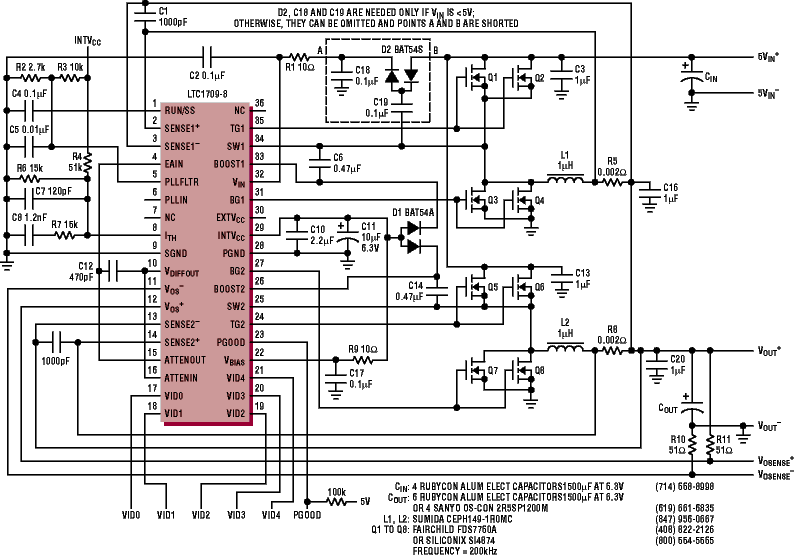
Figure 1. Schematic Diagram of 42A power suply using the LTC1709
Design ExampleFigure 1 shows the schematic diagram of a 42A power supply for the AMD Athlon microprocessor. With only one IC, eight tiny SO-8 MOSFETs and two 1µH low profile, surface mount inductors, an efficiency of 86% is achieved for a 5V input and a 1.6V/42A output. Greater than 85% efficiency can be maintained throughout the load range of 3A–42A, as shown in Figure 2. Because of the low input voltage, the reverse recovery losses in the body diodes of the bottom MOSFETs are not significant. No Schottky diodes are required in parallel with the bottom MOSFETs in this application. |

|
||
Figure 2. Efficiency vs load current for Figure 1's Circuit |
|||
Table 1 compares the input and output ripple currents for single-phase and 2-phase configurations. A
2-phase converter reduces the input ripple current by 50% and the output ripple current by 75% compared to a
single-phase design. The reduction in the cost and size of the input and output capacitors is significant.
| Phases | Input Ripple Current (ARMS) | Output Ripple Current (AP-P) |
|---|---|---|
| 1 | 19.7 | 10.91 |
| 2 | 10.1 | 2.9 |
|
1Assumes that the single-phase circuit uses two 1.0µH/21A inductors in parallel to provide 42A output. |
||
|
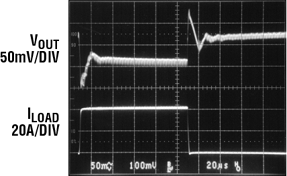
Figure 3 shows the measured load transient waveform. The load current changes between 2A and 42A with a slew rate of about 30A/µs. Output capacitor size and type requirements are dominated by the total ESR of the output capacitor network. Six low cost aluminum electrolytic caps (Rubycon, 1500µF/6.3V) are needed on the output to meet this requirement. The maximum output voltage variations during the load transients are less than 200mVP-P. Active voltage positioning was employed in this design to further reduce the number of output capacitors to six (refer to Linear Technology Design Solutions 10 for more details on the active voltage positioning). R4 and R6 provide the output voltage positioning with no loss of efficiency. If OSCON caps are used, four 1200µF/2.5V (2R51200M) capacitors will be sufficient. |
|
Figure 3. Load transient waveforms at 40A step and 30A/µs slew rate | |
|
|
|||
Conclusion
The LTC1709 based, low voltage, high current power supply described above achieves high efficiency and small
size simultaneously. The savings in the input and output capacitors, inductors and heat sinks help minimize the cost
of the overall power supply. This LTC1709 circuit, with a few modifications, is also suitable for VRM9.0
applications. Refer to Linear Technology Application Note 77 for more information on the PolyPhase technique. 