by James Herr
Introduction
Lithium-ion (Li-Ion) batteries are the power source of choice for today's small handheld electronic devices due to their light weight and high energy density. There are a number of difficulties involved in charging these batteries. If overcharged, they can become hazardous to users.
The LTC1731/LTC1732 are constant-current/constant-voltage linear charger controllers for single-cell lithium-ion batteries. Output voltage accuracy is 1% (max) over the –40°C to 85°C range, thus preventing the possibility of overcharging. The output float potential is internally set to either 4.1V or 4.2V for the LTC1731 and is pin selectable for the LTC1732, eliminating the need for an expensive external 0.1% resistor divider. The charging current is user programmable with 7% accuracy. The small size of the LTC1731 and LTC1732, along with the small number of external parts required, makes them ideal for use in portable and handheld products, where board space is at a premium.
At the beginning of the charging cycle, if the battery voltage is low (less than 2.457V), the LTC1731/LTC1732 will precharge the battery with 10% of the full-scale current to avoid stressing the depleted battery. Charging is terminated by a user-programmed timer. After the timer has run out, the charging can be restarted by removing and reapplying the input voltage source or by shutting down the part momentarily. A built-in end-of-charge (C/10) comparator indicates that the charging current has dropped to 10% of the full scale current. The output of this comparator can also be used to stop charging before the timer runs out.
The LTC1731 is available in the 8pin MSOP and SO packages, whereas the LTC1732 is available in the 10-pin MSOP package.
LTC1731/LTC1732 Features
The LTC1731 and LTC1732 provide the following features:
- Complete linear charger controller
- 1% voltage accuracy
- Preset 4.1V or 4.2V output versions
- Programmable charge termination timer
- Programmable charge current
- C/10 charge current detection output
- Automatic sleep mode when input supply is removed
- Automatic trickle charging of low voltage cells
- Low dropout
- Select pin to set either 4.1V or 4.2V (LTC1732)
- Battery insertion detect and automatic low battery charging (LTC1732)
Circuit Description
Figure 1 is a block diagram of the LTC1731. The charge current is programmed by the combination of a program resistor, RPROG, and a sense resistor, RSENSE. RPROG sets the programming current through an internal, trimmed 800W resistor, setting up a voltage drop from VCC to the input of the current amplifier (CA). The current amplifier controls the gate of an external P-channel MOSFET to force an equal voltage drop across RSENSE, which, in turn, sets the charge current. When the potential at the BAT pin approaches the preset float voltage, the voltage amplifier (VA) starts sinking current, which decreases the required voltage drop across RSENSE, reducing the charge current.
Charging begins when the potential at the
VCC pin rises above the UVLO level and a program resistor
is connected from the PROG pin to ground. At the beginning of the
charge cycle, if the battery voltage is below 2.457V, the charger goes into
trickle charge mode. The trickle charge current is 10% of the full-scale
current. If the battery voltage stays low for one quarter of the total
programmed charge time, the charge sequence will be terminated.

Figure 1. LTC1731-LT1732 block diagram
The charger goes into the fast-charge, constant-current mode after the voltage on the BAT pin rises above 2.457V. In constant-current mode, the charge current is set by the combination of RSENSE and RPROG. When the battery approaches the final float voltage, the voltage loop takes control and the charge current begins to decrease. When the current drops to 10% of the full-scale charge current, an internal comparator turns off the pull-down N-channel MOSFET at the *CHRG pin and connects a weak current source to ground to indicate an end-of-charge (C/10) condition.
An external capacitor on the TIMER pin sets the total charge time. After a time-out occurs, the charging is terminated immediately and the *CHRG pin is forced to a high impedance state. To restart the charge cycle, simply remove the input supply and reapply it or float the PROG pin momentarily.
For batteries such as lithium-ion that require accurate final float potential, the internal 2.457V reference, voltage amplifier and the resistor divider provide regulation with better than 1% accuracy. For NiMH and NiCd batteries, the LTC1731/LTC1732 can be turned into a current source by connecting the TIMER pin to VCC. When in the constant-current only mode, the voltage amplifier, timer and the trickle charge function are disabled.
When the input voltage is not present, the charger goes into a sleep mode, dropping ICC to 7µA. This greatly reduces the current drain on the battery and increases the standby time. The charger can be shut down by floating the PROG pin. An internal current source will pull this pin's voltage high and clamp it at 3.5V.
The LTC1732 is equipped with an AC power (*ACPR) pin to indicate that the input supply (wall adapter) is applied and above the undervoltage lockout level. The SEL pin allows users to set the final float potential of the battery to either 4.1V or 4.2V. The LTC1732 also has an internal comparator that monitors the battery potential and turns the charger back on when VBAT drops below 3.8V. This feature will keep the battery near fully charged after a time-out has occurred while the battery remains inserted.
Programming Charge Current
The formula for the battery charge current is:
IBAT = (IPROG) • (800W/RSENSE)
= (2.457V/RPROG) • (800W/RSENSE)
where RPROG is the total resistance from the PROG pin to ground.
For example, if a 500mA charge current is needed, select a value for RSENSE that will drop 100mV at the maximum charge current.
RSENSE = 0.1V/0.5A = 0.2W,
then calculate:
RPROG = (2.457V/500mA) ·
(800W/0.2W) = 19.656k
For best accuracy over temperature and time, 1% resistors are recommended. The closest 1% resistor value is 19.6k.
Typical Applications
500mA Single-Cell Linear Battery ChargerFigure 2 shows a typical single-cell battery charger using the LTC1732-4 with a 5V to 12V input range and a 500mA charging current. A program resistor (RPROG) sets a 100mV voltage drop across the sense resistor (RSENSE). With RSENSE = 0.2W, the charging current is set at 500mA. When the battery voltage rises to the preset level of 4.1V, the LTC1732 goes into constant voltage mode and the charging current is gradually reduced. When the charging current reaches 10% of the full-scale current, the *CHRG pin output switches from a strong Nchannel MOSFET pull-down to a weak 25µA pull-down current source to indicate the C/10 condition. Once the timer runs out (three hours), the DRV pin is pulled high and the *CHRG pin output goes to a high impedance state. The SEL pin is shorted to ground to set the final battery float potential to 4.1V. |
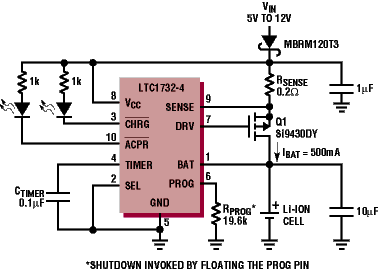
Figure 2. LTC1732-4, 5V to 12V in, single-cell Li-Ion charger |
1.5A Single-Cell Battery ChargerThe LTC1731 can also be connected as a switcher-based battery charger for higher charging current applications (see Figure 3). As in the linear charger, the charge current is set by R3 and R4. The *CHRG pin output will indicate an end-of-charge (C/10) condition when the average current drops down to 10% of the full-scale value. A 220µF bypass capacitor is required at the BAT pin to keep the ripple voltage low. ConclusionThe LTC1731 makes a very compact, low parts count and low cost
lithium-ion battery charger. The onboard programmable timer provides
charge termination without interfacing to a microprocessor. |

Figure 3. LTC1731 configured as a switcher based charger for higher current applications |
