by Richard Markell and John Wright
Introduction
The LT1790 brings ultraprecision, low dropout voltage references to the world of the very small SOT-23 package. This new reference boasts 0.05% initial accuracy and 10ppm/°C temperature coefficient, making it the ideal reference for handheld and portable instrumentation and equipment that requires a minimum of trimming. To ensure that handheld equipment stays calibrated for the long haul, the LT1790 has excellent long-term drift and thermal hysteresis specifications of, typically, 50ppm/(kHr)1/2 and 60ppm, respectively. The part operates as a series mode, low dropout reference on a mere 35µA of supply current. This conserves battery life and also allows battery operation down to only a few tenths of a volt above the output voltage.
The LT1790 has among the lowest noise specifications for a SOT-23 voltage reference at 12µVP-P (4.8ppmP-P) for the 2.5V version. Additionally, the part can operate on supply voltages as high as 18V, which allows battery-powered equipment to be plugged into a wall adapter without the need for peripheral circuitry to limit the voltage input to the reference. The part is guaranteed to be operational from –40°C to 125°C.
Specifications
Table 1 details some of the relevant specifications of the LT1790.
Note that many of the specifications are similar to those of the best
SO-8 reference, yet the LT1790 is in the tiny SOT-23 package. The "bow
tie" curve of Figure 1 shows just how little the output of the reference
changes when initial accuracy and temperature drift are both considered.
| Parameter | Conditions | Min | Typ | Max | Units |
|---|---|---|---|---|---|
| Output Voltage | A Grade | –0.05 | ——— | +0.05 | % |
| B Grade | –0.10 | ——— | +0.10 | ||
| Output Voltage Temperature Coefficient | A Grade | ——— | 5 | 10 | ppm/°C |
| B Grade | ——— | 12 | 25 | ||
| Load Regulation | IOUT Source = 5mA | ——— | 80 | 160 | ppm/mA |
| IOUT Sink = 5mA | ——— | 70 | 110 | ||
| Dropout Voltage | IOUT Source = 5mA | ——— | 0.3 | 0.4 | V |
| Supply Current | ——— | ——— | 35 | 60 | µA |
| Output Voltage Noise | 0.1 < f < 10Hz | ——— | 12 | ——— | µVP-P |
| 4.8 | ppmP-P | ||||
| Long-Term Drift of Output Voltage | ——— | ——— | 50 | ——— | ppm/(kHr)1/2 |
| Thermal Hysteresis | –40°C to 85°C | ——— | 60 | ——— | ppm |
| Abs. Max Operating Voltage | –40°C to 85°C | ——— | ——— | 18 | V |
What's New in References or
|
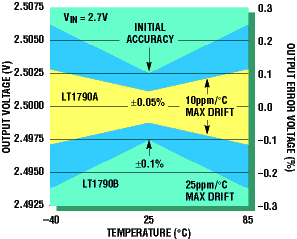
Initial accuracy and temperature drift of the LT1790A and LT1790B |
Long-Term Drift and Hysteresis
The LT1790 has been designed to minimize both long-term drift and thermal hysteresis. Long-term drift and hysteresis (which is an output voltage shift due to temperature cycling) can limit system accuracy. Whereas initial calibration can remove TC and initial accuracy errors, only more frequent and sometimes lengthy calibration procedures can correct for long-term drift and hysteresis components. (For more information on interpreting reference specifications, see Linear Technology Application Note 82.)
The only way long-term drift can be characterized is to measure it over a specified time period. Some manufacturers are promoting ridiculous long-term drift specifications based on accelerated high temperature testing. Actual measurements show that long-term drift data cannot be extrapolated from accelerated high temperature testing. (See "3ppm/°C Micropower Reference Draws Only 50µA and Operates on 2.8V," in Linear Technology IX:4 [November 1999] for more information on measurement of long-term drift.)
To determine long-term drift accurately, data was taken with parts
that were soldered into PC boards, similar to a "real world" application.
These boards were not preconditioned. They were placed into a
constant-temperature oven with TA = 30°C and
their outputs were scanned regularly and measured with an 8.5 digit
DVM. Figure 2 shows the long-term drift of the SOT-23 LT1790S6-2.5.
Initially, data was taken every hour where the largest changes occur (and the
trace is darker), but after several hundred hours the frequency of sampling
was lowered to reduce the amount of data collected. Drift after 1600 hours
was 50ppm.
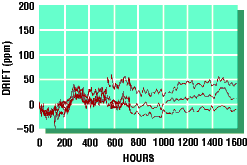
Figure 2. LT1790SOT23-2.5V long-term drift
|
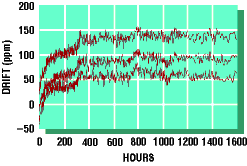
Figure 3. Competitive 2.5V reference long-term drift
|
Figure 3 shows the long-term drift of a competitive reference that claims in its data sheet to have a long-term drift of 0.2ppm/(kHr)1/2. Measured data shows this reference to have drift between 60ppm/(kHr)1/2 and 150ppm/(kHr)1/2 300 to 750 times worse than claimed.
Preconditioning the PC board after the reference has been soldered onto the board can reduce long-term drift. Operating the PC board at room temperature or above stabilizes initial drifts. This "burn-in" of the PC board eliminates the output shift that occurs in the first several hundred hours of operation. Further changes in output voltage are typically quasi-logarithmic and changes after 1000 hours tend to be smaller than before that time. Because of this decreasing characteristic, long-term drift is specified in ppm/(kHr)1/2.
Hysteresis Limits Repeatability
When a reference is soldered onto a PC board, the elevated temperature and subsequent cooling cause stress that influences the output. If the voltage reference is repeatedly temperature cycled, inelastic stress is applied to the chip and the output voltage does not return to the 25°C initial value. The mechanical stress is due to the difference in thermal coefficients of expansion between the silicon chip, its plastic package and the PC board. This error, known as "thermally induced hysteresis," is expressed in ppm and cannot be trimmed out because it is variable and remembers previous temperature excursions. Hysteresis is always worse with higher temperature excursions and differs with die attach and package type.
Hysteresis: Often the "Missing" Spec
Most manufacturers ignore hysteresis specifications, but they can be critical in precision designs. To graphically depict hysteresis, many references were IR reflow soldered onto PC boards and the boards underwent a "heat soak" at 85°C. This ensured that they all had the same initializing temperature. The temperature was then cycled repeatedly between 85°C, 25°C and –40°C and all 25°C output voltages were recorded.
The stabilization time at each temperature was 30 minutes.
The worst-case output voltage changes for the LT1790S6-2.5 at 25°C
are shown in Figure 4. A competitive reference, which makes no mention
of hysteresis on its data sheet, was also measured and is shown in Figure 5.
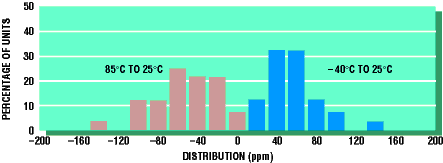
Figure 4. LT1790OS6-2.5 industrial hysteresis

Figure 5. Competitive 2.5V reference industrial hysteresis
Series, Low Dropout and Micropower to BootA series reference is very similar to a 3-terminal voltage regulator, in that it operates in series with its load (see Figure 6). A series voltage reference, such as the LT1790, maintains a stable output voltage regardless of variations in input voltage (there are changes, but they are very small). One of the advantages of a series reference is that at no load the reference consumes a minimal amount of current, sourcing more current as the load demands it. Conversely, a shunt or Zener type of voltage reference (see Figure 7) must idle the maximum current at all times to maintain its output voltage specifications. Thus, the series reference can boost battery life in portable units considerably because it need not deliver its full load current until required. |
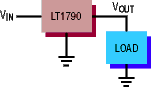
Figure 6. LT1790 series voltage reference |
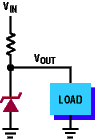
Figure 7. Typical shunt voltage reference configuration |
The LT1790 not only consumes a mere 35µA of quiescent current, but also boasts a very low dropout voltage of 0.2V at 1mA output current. Both of these features optimize battery lifetime and minimize current consumption.
The LT1790 Sources and Sinks Current
Another feature of the LT1790 is that it will source and sink up to 5mA
of current. Figure 8 shows the LT1790 configured as a –2.5V negative
series regulator that will supply up to 50mA of output current.

Figure 8. –2.5V negative 50mA series reference
Voltage Options
The LT1790 SOT-23 voltage reference is now available with the 2.5V output voltage option in both A and B grades. Many additional voltage options will be available shortly, including 1.25V, 3.0V, 3.3V, 4.096V and 5V. These options will be available in both A and B grades in the SOT-23 package.
Conclusion
Linear Technology continues to innovate by crafting the LT1790
series of precision voltage references in SOT23 packages. The LT1790,
like other LTC products, is conservatively specified and includes
specifications for long-term drift and thermal hysteresis. The LT1790 excels in
all specifications that set system performance. 