by Albert Wu
IntroductionThe LT1931 is the industry's highest power SOT-23 inverting switching regulator. The on-chip 1A switch allows high output currents to be generated. In a typical 5V to –5V application, the part can deliver 350mA; a 5V to –12V application can provide 150mA. The LT1931 switches at a fixed frequency of 1.2MHz, allowing the use of tiny, low cost capacitors and inductors of 2mm or less in height. The constant switching frequency keeps the output voltage noise low and predictable, making designs with output voltage ripple less than 5mVP-P easily achievable. An integrated shutdown feature limits the supply current to less then 1µA when the part is disabled, extending battery life. The high power and low noise LT1931 comes in a tiny 5-lead SOT-23 package, saving valuable board space. The part is pin-for-pin compatible with the LT1611, providing a simple upgrade path for users of the older parts who need more power. 5V to –5V Local SupplyFigure 1 shows a 5V to –5V application that can deliver up to 350mA of output current. The output voltage ripple for the circuit is less than 3mVP-P, as shown in Figure 2. Figure 3 is an oscillograph of the transient response as the load current steps from 100mA to 200mA and back again. The output voltage and inductor current produce a nicely damped response and recover within 100µs. The voltage overshoot and undershoot is approximately 30mV. Figure 4 shows the efficiency of the circuit. The efficiency stays above 75% over a wide load range of 60mA to the full load current, reaching as high as 79% at 150mA. This solution can fit in a board area as small as 0.19in2 (0.5in • 0.38in). |

Figure 1. 5V to –5V/350mA inverting converterVendors of non-LTC components used in this application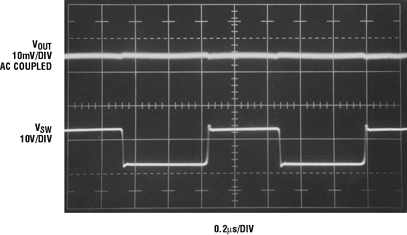
Figure 2. Output voltage ripple for Figure 1's circuit |

Figure 3. Transient response for Figure 1's circuit |
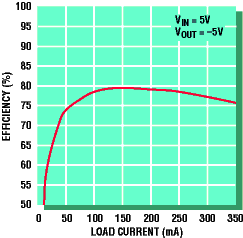
Figure 4. Efficiency of Figure 1's circuit |
5V to –12V Local Supply
Figure 5 shows a 5V to –12V converter that can provide 150mA
of output current. The output voltage ripple is less than
10mVP-P. The efficiency, shown in Figure 6, stays
above 80% from a load current of 50mA to the full load current. This
solution can fit within a 0.19in2 area.

Figure 5. 5V to –12V inverting DC/DC converterVendors of non-LTC components used in this application |
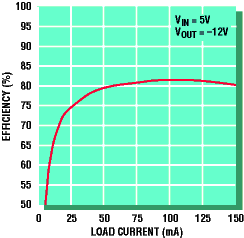
Figure 6. Efficiency of Figure 5's circuit |
Tiny 5V to –5V Converter
In order for the previous applications to achieve high current
outputs, slightly larger coupled inductors were used. Although the total solution
still remained small, further reductions in size can be made if a lower
maximum output current can be tolerated. Figure 7 shows such a circuit.
The circuit uses tiny uncoupled inductors, enabling the solution to fit
within a 0.1in2 (0.33in • 0.3in) area.
This circuit can provide 300mA of output current and has an output
voltage ripple of only 6mVP-P.
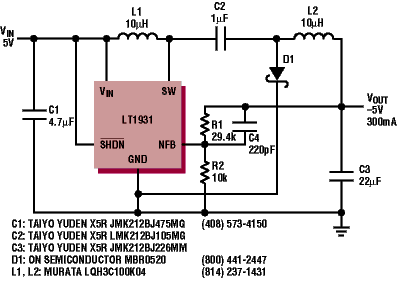
Figure 7. 5V to –5V converter fits in 0.1in2
Vendors of non-LTC components used in this applicationSoft Start
In applications where soft start is required, the simple circuit
shown driving the shutdown pin in Figure 8 can be used. This circuit, which
consists of only a resistor, a diode and a capacitor, effectively limits
how quickly VOUT can be charged. Figure
9 shows the soft-start circuit at work. After
VSS is driven high, the input current slowly ramps up to a
peak value of 350mA. The output voltage takes 1.6ms to reach its final value
of –5V. The values of RSS and
CSS can be adjusted to obtain the desired
start-up performance.

Figure 8. RSS and CSS at the *SHDN pin provide soft start to LT1931 inverting converter
Vendors of non-LTC components used in this application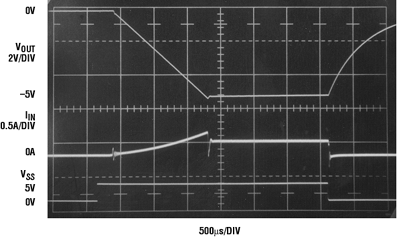
Figure 9. Soft-start waveforms of Figure 8's circuit; RSS = 15k, CSS = 68nF
Conclusion
The LT1931 is the highest power SOT-23 inverting DC/DC converter in
the industry. The circuits presented here demonstrate the high output
currents and low output noise achievable with the LT1931. The high
switching frequency of the part allows the total solution to fit in an area as small
as 1/10th of a square inch. 