by Jaime Tseng
High switching frequencies and low quiescent currents are no longer conflicting requirements in the design of battery-powered products. Linear Technology's LTC3404 is the industry's first step-down switching regulator that runs at 1.4MHz while drawing only 10µA of supply current (using Burst Mode operation) at no load. This impressive feat allows for better than 90% efficiency over three decades of output load current while allowing the use of tiny external components. With the on-chip main and synchronous switches, minimal external components are necessary to make a complete, high efficiency (up to 95%) step-down regulator. Low component count and the LTC3404's tiny MSOP package provide a minimum-area solution to meet the limited space requirements of today's portable applications.
The LTC3404 incorporates a constant-frequency, current mode architecture that provides low noise and fast transient response. Its input voltage supply range of 2.65V to 6V and 100% duty cycle capability for low dropout make the LTC3404 ideal for moderate current (up to 600mA) battery-powered applications.
For maximum efficiency over the widest range of output load current, Burst Mode operation can be selected by driving SYNC/MODE pin HIGH with a logic-level signal or by tying it to VIN. For lower noise, pulse skipping mode can be selected by driving the SYNC/MODE pin LOW with a logic level signal or by tying it to ground. In this case, constant-frequency operation is maintained at lower load currents together with lower output ripple. If the load current is low enough, cycle skipping will eventually occur to maintain regulation. In this mode, the efficiency will be lower at very light loads, but becomes comparable to Burst Mode operation when the output load exceeds 50mA. For switching-frequency-sensitive applications, the LTC3404 can be externally synchronized to frequencies from 1MHz to 1.7MHz by applying an external clock signal to the SYNC/MODE pin. During synchronization, Burst Mode operation is inhibited and pulse skipping mode is selected.
3.1V/600mA Step-Down Regulator
Figure 1 shows a typical application suitable for a single Li-Ion cell or 3-
to 4-cell NiCd or NiMH battery input. Note the small component values
used in this application, made possible by the high switching frequency of
the LTC3404. Also, because of the part's internal synchronous switch,
the Schottky diode normally seen on the SW pin is absent from Figure 1.
This regulator occupies only 0.47" x
0.31" (0.146in2) of board area.

Figure 1. 3.1V/600mA step-down regulator |

Figure 2. Efficiency vs load current for Figure 1's circuit (Burst Mode operation enabled) |
|
Figure 2 shows the efficiency for three different input voltages. The efficiency for a 3.6V input exceeds 90% over three decades of output current. The efficiency remains high down to loads as small as 100µA due to the LTC3404's ultralow quiescent current. Even though the quiescent current is very low, the transient performance is not compromised. Innovative new circuitry ensures that the error amplifier, while operating on less than 10µA at no load, can quickly respond to load changes. The oscilloscope photo in Figure 3 shows the part's outstanding transient performance when subjected to a 550mA load step. Note how the inductor current ripple is reduced as the load step forces the part into continuous switching operation from Burst Mode operation. At the maximum output load, the inductor ripple current is at its lowest due to the increased duty cycle caused by the IR drop of the main switch. |
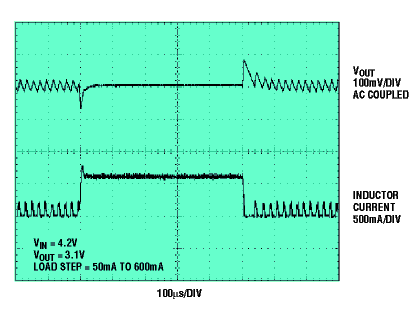
Figure 3. Load-step response for Figure 1's circuit |
Externally Synchronized 3.1V/600mA Step-Down Regulator
Figure 4 shows an application for low switching frequency noise.
The LTC3404 is synchronized to an external clock signal whereby Burst
Mode operation is disabled automatically. This provides
constant-frequency operation at lower load
currents, reducing the ripple voltage. In this mode the efficiency is lower at
light loads, as shown in Figure 5. However, the efficiency becomes comparable
to that of Burst Mode operation when the output load exceeds 50mA.

Figure 4. Externally synchronized 3.1V/600mA stepdown regulator |
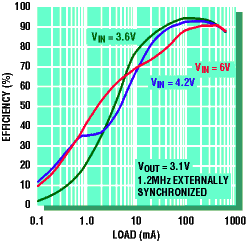
Figure 5. Efficiency vs load current for Figure 4's circuit (Burst Mode operation disabled) |
|
The LTC3404 uses an internal phase-locked loop circuit to synchronize to an external signal. A voltage-controlled oscillator and a phase detector comprise the phase-locked loop. Filter components CLP and RLP smooth out the current pulses from the phase detector to provide a stable input to the voltage controlled oscillator. These components determine how fast the loop acquires lock. With the components shown in Figure 4, the loop acquires lock in about 100µs. When not synchronized to an external clock, the internal connection to the VCO is disconnected to prevent noise from altering the internal oscillator frequency. The oscilloscope photo in Figure 6 shows the transient performance with a 550mA load step. At a 600mA output load, the inductor ripple current is reduced due to the increase in duty cycle to compensate for the IR drop in the main switch. |
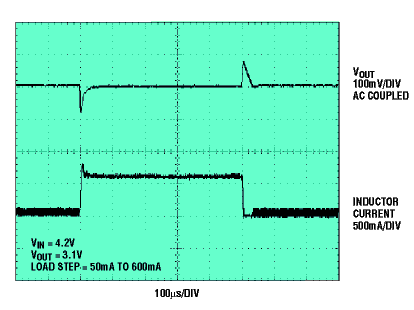
Figure 6. Load-step response for Figure 4's circuit |
Conclusion
The LTC3404 demonstrates that high switching frequency and low
quiescent current can coexist, and thereby opens up a world of new
possibilities in the design of battery-powered products. 