|
|
Circuit Description
This single-ended forward converter operates at a nominal switching
frequency of 200kHz. Referring to the schematic in Figure 6, pulse
width modulation is controlled by U1, an LT1247 current mode PWM
controller. Transformer T2 and optocoupler Q7 provide galvanic isolation. C2 is
a local bypass cap to reduce common mode–induced current.
To achieve fast start-up time, a hysteretic buck regulator is used
for the bias supply power. U2, an LT1431 shunt voltage regulator, provides
control for this function, with Q1 acting as the switch element; L2 and
C21 provide output filtering. Q2 and Q4 protect the circuit during a hot
plug, making this a very robust design; it is also impervious to output short
circuits. The input surge voltage is limited to 80V by the rating of Q1–Q4.
The main switching power path through T2 comprises L1 and C18
as the input filter, Q6 as the primary switch, D7 as the secondary
rectifier and L3 and C14, C16, C17 and C20 as the secondary filter. Transient
voltage suppressor D8 is used to protect Schottky diode D7 during
large-signal transient conditions. Power is transferred during the on cycle of
Q6 and integrated by the output filter, just as in a buck regulator. The
input filter component values for L1 and C18 are optimal and should not
be changed without careful evaluation. C19 damps the input filter and
will provide adequate stability for large values of input inductance. See
LTC Application Note 19 for a discussion of input filter stability analysis.
Output voltage feedback is controlled using U3, another
LT1431 shunt voltage regulator, as an error amplifier. In the event of a fault on
the output power or sense lines, Z1/Q5 will override U3 and provide
overvoltage protection. R10 and R21 are sized to handle any overvoltage condition. During an output short-circuit condition, the LT1247 is able to
decrease the on time of Q6 to less than 200ns. This results in good control of
the output short-circuit current, keeping power dissipation to a
manageable level. The demonstration circuit uses surface mount devices for Q6 and
D7. For elevated temperature operation at the full rated load, TO-220
devices can by mounted on a standard half-brick heat sink. For –48V inputs that require hot swap capability, the LT1640H
negative voltage HotSwap controller provides a seamless
interface. Demonstration circuit DC223A-B using
the LT1640HCS8 is the recommended solution for use with
the DC227A.
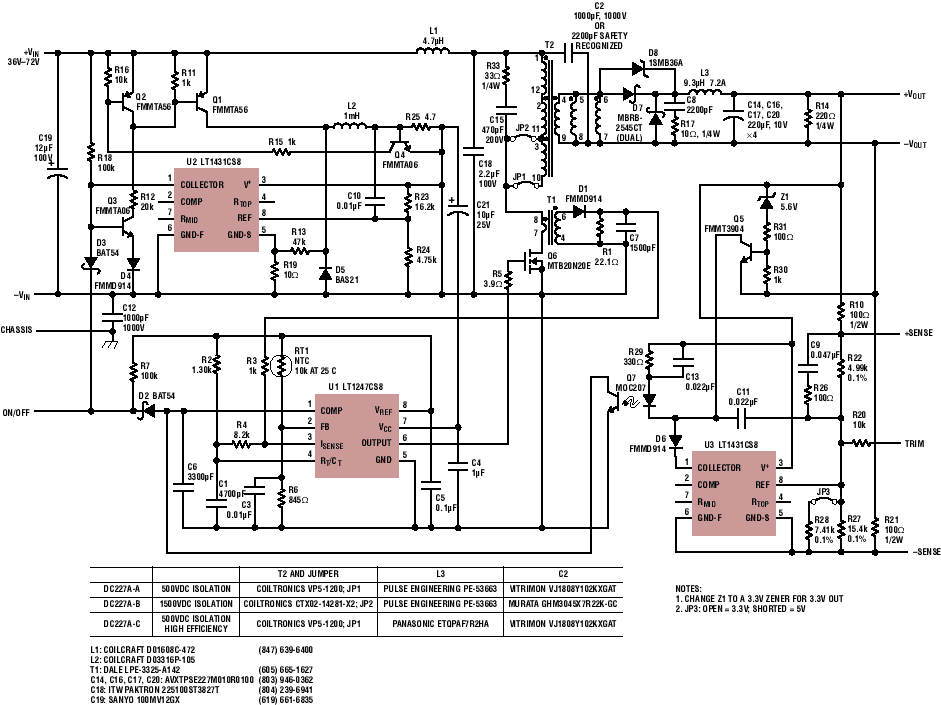
Figure 6. 35W isolated DC/DC converter schematic diagram
Conclusion
At 35 watts, the topology presented here is one of the most common
used by the module manufacturers. This is only one solution for isolated
power, and opens up many possibilities for other input and output
voltage combinations. For lower power, demonstration circuit DC211 using
the LT1425 isolated flyback switching regulator is designed for 10
watts. Demonstration circuit DC259 using the LT1339 adds synchronous
rectification, providing a high efficiency solution for 50 watts. See the
DC/DC Converter Module section of LTC's Volume 1 1999 New Products
Catalog for additional information. 
VERSA-PAC is a trademark of Coiltronics, Inc.
|
|