 |
Radiofrequency Radiation
|
|
Radiofrequency Radiation
|

 ) and conductivity (
 ).
Both properties change with temperature and, strongly, with
frequency. As a matter of fact, as the frequency increases
from a few hertz to gigahertz, the dielectric constant
decreases from several million to only a few units;
concurrently, the conductivity increases from a few millimhos
per centimeter to nearly a thousand.
).
Both properties change with temperature and, strongly, with
frequency. As a matter of fact, as the frequency increases
from a few hertz to gigahertz, the dielectric constant
decreases from several million to only a few units;
concurrently, the conductivity increases from a few millimhos
per centimeter to nearly a thousand.
 ,
,  , and
, and  --of the dielectric constant at low,
medium, and very high frequencies. In its simplest form each
of these relaxation regions is characterized by equations of
the Debye type as follows,
, , and dispersions. They include for the -effect, apparent membrane property changes as described in the text; for the -effect, tissue structure (Maxwell-Wagner effect); and for the -effect, polarity of the water molecule (Debye effect). Fine structural effects are responsible for deviations as indicated by the dashed lines. These include contributions from subcellular organelles, proteins, and counterion relation effects.
--of the dielectric constant at low,
medium, and very high frequencies. In its simplest form each
of these relaxation regions is characterized by equations of
the Debye type as follows,
, , and dispersions. They include for the -effect, apparent membrane property changes as described in the text; for the -effect, tissue structure (Maxwell-Wagner effect); and for the -effect, polarity of the water molecule (Debye effect). Fine structural effects are responsible for deviations as indicated by the dashed lines. These include contributions from subcellular organelles, proteins, and counterion relation effects.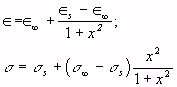 (Equation 4.1)-dispersion--the polarization resulting from the charging of interfaces, i.e., membranes through intra- and extracellular fluids (Maxwell-Wagner effect). A typical example is presented in Figure 4.2 in the form of an impedance locus.
The dielectric properties of muscle tissue are seen to closely conform to a suppressed circle, i.e. , to a
Cole-Cole distribution function of relaxation times. A small
second circle at low frequencies represents the -dispersion
effect. Rotation of molecules having a permanent dipole
moment, such as water and proteins, is responsible for the
-dispersion (water) and a small addition to the tail of the
-dispersion resulting from a corresponding 1dispersion of
proteins. The tissue proteins only slightly elevate the
high-frequency tail of the tissue's -dispersion because the
addition of the1- effect caused by tissue proteins is
small compared to the Maxwell-Wagner effect and occurs at
somewhat higher frequencies. Another contribution to the
-dispersion is caused by smaller subcellular structures,
such as mitochondria, cell nuclei, and other subcellular
organelles. Since these structures are smaller in size than
the surrounding cell, their relaxation frequency is higher
but their total dielectric increment smaller. They therefore
contribute another addition to the tail of the -dispersion
(1).
-dispersion and the small one from the -dispersion. The plot does not include the -dispersion.-dispersion is due solely to water and its
relaxational behavior near about 20 GHz. A minor additional
relaxation (
(Equation 4.1)-dispersion--the polarization resulting from the charging of interfaces, i.e., membranes through intra- and extracellular fluids (Maxwell-Wagner effect). A typical example is presented in Figure 4.2 in the form of an impedance locus.
The dielectric properties of muscle tissue are seen to closely conform to a suppressed circle, i.e. , to a
Cole-Cole distribution function of relaxation times. A small
second circle at low frequencies represents the -dispersion
effect. Rotation of molecules having a permanent dipole
moment, such as water and proteins, is responsible for the
-dispersion (water) and a small addition to the tail of the
-dispersion resulting from a corresponding 1dispersion of
proteins. The tissue proteins only slightly elevate the
high-frequency tail of the tissue's -dispersion because the
addition of the1- effect caused by tissue proteins is
small compared to the Maxwell-Wagner effect and occurs at
somewhat higher frequencies. Another contribution to the
-dispersion is caused by smaller subcellular structures,
such as mitochondria, cell nuclei, and other subcellular
organelles. Since these structures are smaller in size than
the surrounding cell, their relaxation frequency is higher
but their total dielectric increment smaller. They therefore
contribute another addition to the tail of the -dispersion
(1).
-dispersion and the small one from the -dispersion. The plot does not include the -dispersion.-dispersion is due solely to water and its
relaxational behavior near about 20 GHz. A minor additional
relaxation (  ) between and -dispersion is caused in part
by rotation of amino acids, partial rotation of charged side
groups of proteins, and relaxation of protein-bound water
which occurs somewhere between 300 and 2000 MHz.
-dispersion is presently the least clarified.
Intracellular structures, such as the tubular apparatus in
muscle cells, that connect with the outer cell membranes
could be responsible in tissues that contain such cell
structures. Relaxation of counterions about the charged
cellular surface is another mechanism we suggest. Last but
not least, relaxational behavior of membranes per se, such as
reported for the giant squid axon membrane, can account for
the -dispersion (Takashima and Schwan, 1974). The relative
contribution of the various mechanisms varies, no doubt, from
one case to another and needs further elaboration.
, , , and from one biological object to another. For example, blood cells
display a weak -dispersion centered at about 2 kHz, while
muscle displays a very strong one near 0.1 kHz. The
-dispersion of blood is near 3 MHz, that of muscle tissue
near 0.1 MHz. The considerable variation depends on cellular
size and other factors. The variation may not be as strong in
the -case as in the - and -dispersion frequencies. The
-dispersion, however, is always sharply defined at the same
frequency range.
-,
-, -, and -Dispersion Effects-dispersion characteristic of water. To the water's
-dispersion, biological macromolecules add a -dispersion.
It is caused by bound water and rotating side groups in the
case of proteins, and by rotation of the total molecule in
the case of the amino acids; in particular, proteins and
nucleic acids add further dispersions in the - and -range
as indicated. Suspensions of cells free of protein would
display a Maxwell-Wagner -dispersion and the -dispersion of water. If the cells contain protein an additional,
comparatively weak -dispersion due to the polarity of
protein is added, and a -dispersion. If the cells carry a
net charge, an -mechanism due to counterion relaxation is
added; and if their membranes relax on their own as some excitable membranes
do, an additional mechanism may appear.
) between and -dispersion is caused in part
by rotation of amino acids, partial rotation of charged side
groups of proteins, and relaxation of protein-bound water
which occurs somewhere between 300 and 2000 MHz.
-dispersion is presently the least clarified.
Intracellular structures, such as the tubular apparatus in
muscle cells, that connect with the outer cell membranes
could be responsible in tissues that contain such cell
structures. Relaxation of counterions about the charged
cellular surface is another mechanism we suggest. Last but
not least, relaxational behavior of membranes per se, such as
reported for the giant squid axon membrane, can account for
the -dispersion (Takashima and Schwan, 1974). The relative
contribution of the various mechanisms varies, no doubt, from
one case to another and needs further elaboration.
, , , and from one biological object to another. For example, blood cells
display a weak -dispersion centered at about 2 kHz, while
muscle displays a very strong one near 0.1 kHz. The
-dispersion of blood is near 3 MHz, that of muscle tissue
near 0.1 MHz. The considerable variation depends on cellular
size and other factors. The variation may not be as strong in
the -case as in the - and -dispersion frequencies. The
-dispersion, however, is always sharply defined at the same
frequency range.
-,
-, -, and -Dispersion Effects-dispersion characteristic of water. To the water's
-dispersion, biological macromolecules add a -dispersion.
It is caused by bound water and rotating side groups in the
case of proteins, and by rotation of the total molecule in
the case of the amino acids; in particular, proteins and
nucleic acids add further dispersions in the - and -range
as indicated. Suspensions of cells free of protein would
display a Maxwell-Wagner -dispersion and the -dispersion of water. If the cells contain protein an additional,
comparatively weak -dispersion due to the polarity of
protein is added, and a -dispersion. If the cells carry a
net charge, an -mechanism due to counterion relaxation is
added; and if their membranes relax on their own as some excitable membranes
do, an additional mechanism may appear.
s term
in Equation 4.1 due to the ionic conductance of the dissolved
ion species. The static dielectric permittivity of
electrolytes of usual physiological strength (0.15 N) is
about two units lower than that of pure water (Hasted, 1963),
a negligible change.
s, observed at f << fc = 20 GHz
' and " = / o are the components of the complex
dielectric constant r = ' - j". The frequency at
the peak of the circle is the characteristic frequency of
the dispersion and identical with that of normal water,
demonstrating the identity of tissue water in normal water
from a dielectric point of view.-dispersion found in tissues and cell suspensions.
-dispersion by Grant. It was first
noted for hemoglobin (Schwan, 1965b) and then carefully
examined for hemoglobin (Pennock and Schwan, 1969) and
albumin (Grant et al., 1968). This dispersion is
characterized by a fairly broad spectrum of characteristic
frequencies extending from some hundred to some thousand
megahertz. Its magnitude is considerably smaller than that of
the other two dispersions, and it is thought to be caused by
a corresponding dispersion of protein-bound water and/or
partial rotation of polar subgroups.
o are the components of the complex
dielectric constant r = ' - j". The frequency at
the peak of the circle is the characteristic frequency of
the dispersion and identical with that of normal water,
demonstrating the identity of tissue water in normal water
from a dielectric point of view.-dispersion found in tissues and cell suspensions.
-dispersion by Grant. It was first
noted for hemoglobin (Schwan, 1965b) and then carefully
examined for hemoglobin (Pennock and Schwan, 1969) and
albumin (Grant et al., 1968). This dispersion is
characterized by a fairly broad spectrum of characteristic
frequencies extending from some hundred to some thousand
megahertz. Its magnitude is considerably smaller than that of
the other two dispersions, and it is thought to be caused by
a corresponding dispersion of protein-bound water and/or
partial rotation of polar subgroups.
 -benzyl-L-glutamate) at 50 kV/cm
(Jones et al., 1969), which is in good agreement with the
Langevin estimate. Any irreversible changes in protein
structure that accompany its rotational responses to an
electrical field are unlikely to occur at field levels
smaller than required for complete orientation, i.e.,
dielectric saturation. The thermal energy kT (where k is the
Boltzmann constant, and T the absolute temperature) is in
this case greater than the product
-benzyl-L-glutamate) at 50 kV/cm
(Jones et al., 1969), which is in good agreement with the
Langevin estimate. Any irreversible changes in protein
structure that accompany its rotational responses to an
electrical field are unlikely to occur at field levels
smaller than required for complete orientation, i.e.,
dielectric saturation. The thermal energy kT (where k is the
Boltzmann constant, and T the absolute temperature) is in
this case greater than the product  E (where is the dipole
moment, and E the field strength), representing the change in
potential energy that occurs with rotation. Thus changes in
protein structure caused by nonsaturating electric fields
would probably occur spontaneously in the absence of any
exciting field at normal temperatures.
E (where is the dipole
moment, and E the field strength), representing the change in
potential energy that occurs with rotation. Thus changes in
protein structure caused by nonsaturating electric fields
would probably occur spontaneously in the absence of any
exciting field at normal temperatures.
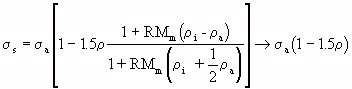
 (Equation 4.2)
 (Equation 4.3)
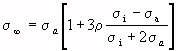 (Equation 4.4)
for the limit values of the simple dispersion that characterizes the frequency dependence. The time constant is
 (Equation 4.5)
In these equations, Cm and G m are capacitance and
conductance per square centimeter of the cell membrane; R is
the cell radius;  is the cellular volume fraction, and i =
1/ i and a = l/ a are the conductivities of the cell
interior and suspending medium. The equations apply for
small-volume fractions, , and assume that the radius of the
cell is very large compared with the membrane thickness. More
elaborate closed-form expressions have been developed for
cases when these assumptions are no longer valid (Schwan and
Morowitz, 1962; Schwan et al., 1970), and an exact
representation of the suspension dielectric properties as a
sum of two dispersions is available (Pauly and Schwan, 1959).
If, as is usually the case, the membrane conductance is
sufficiently low, Equations 4.2-4.5 reduce to the simple
forms to the right of the arrows.
is the cellular volume fraction, and i =
1/ i and a = l/ a are the conductivities of the cell
interior and suspending medium. The equations apply for
small-volume fractions, , and assume that the radius of the
cell is very large compared with the membrane thickness. More
elaborate closed-form expressions have been developed for
cases when these assumptions are no longer valid (Schwan and
Morowitz, 1962; Schwan et al., 1970), and an exact
representation of the suspension dielectric properties as a
sum of two dispersions is available (Pauly and Schwan, 1959).
If, as is usually the case, the membrane conductance is
sufficiently low, Equations 4.2-4.5 reduce to the simple
forms to the right of the arrows.
-dispersion of a cell suspension and corresponding plot in the complex dielectric constant plane (Schwan and Foster, 1980).i + a/2, while the term a (1-1.5 ) provides for the conductance of the shunting extracellular fluid. Hence, the time constant,  , which determines the frequency where the impedances 1/CmR and (i + a/2) are equal is given as Equation 4.5. Using typical values of i, a ~ 0.01 mho/cm, Cm = 1 F/cm2, R = 10 m, and = 0.5, with Equations 4.2-4.5 we see that the dispersion must occur at RF's and that its magnitude, s -
  , is exceptionally high.
s, ,
s - ), and , the three quantities Cm, i, and a, can be determined with an additional equation available to check for internal consistency. Values for extracellular and intracellular resistivities thus obtained agree well with independent measurements. Dispersions disappear as expected after destroying the cell membranes, and their characteristic frequencies are readily shifted to higher or lower frequencies as intracellular or extracellular ionic strengths are experimentally changed. This gives confidence in the model, whose validity is now generally accepted.
F/cm2. This value
is apparently independent of frequency in the total RF range;
at low audio frequencies, capacitance values increase with
decreasing frequencies due to additional relaxation
mechanisms in or near the membranes. These mechanisms will
not be discussed here and have been summarized elsewhere
(Schwan, 1957; Schwan, 1965a).
i + a/2) ,
and the membrane behaves electrically like a short circuit.
Since intracellular and extracellular conductivities are
comparable, the average current density through the tissue is
comparable to that in the membrane. For an in situ field of 1
V/cm (induced by an external microwave-field flux of about 10
mW/cm²), the current density, i, through the membrane is
about 10 mA/cm² since typical resistivities of tissues
are of the order of 100
, is exceptionally high.
s, ,
s - ), and , the three quantities Cm, i, and a, can be determined with an additional equation available to check for internal consistency. Values for extracellular and intracellular resistivities thus obtained agree well with independent measurements. Dispersions disappear as expected after destroying the cell membranes, and their characteristic frequencies are readily shifted to higher or lower frequencies as intracellular or extracellular ionic strengths are experimentally changed. This gives confidence in the model, whose validity is now generally accepted.
F/cm2. This value
is apparently independent of frequency in the total RF range;
at low audio frequencies, capacitance values increase with
decreasing frequencies due to additional relaxation
mechanisms in or near the membranes. These mechanisms will
not be discussed here and have been summarized elsewhere
(Schwan, 1957; Schwan, 1965a).
i + a/2) ,
and the membrane behaves electrically like a short circuit.
Since intracellular and extracellular conductivities are
comparable, the average current density through the tissue is
comparable to that in the membrane. For an in situ field of 1
V/cm (induced by an external microwave-field flux of about 10
mW/cm²), the current density, i, through the membrane is
about 10 mA/cm² since typical resistivities of tissues
are of the order of 100  -cm at microwave frequencies. Thus
the evoked membrane potential,
-cm at microwave frequencies. Thus
the evoked membrane potential,  V = i/jCm, is about 0.5 V
at 3 GHz and diminishes with increasing frequency. This value
is 1000 times lower than potentials recognized as being
biologically significant. Action potentials can be triggered
by potentials of about 10 mV across the membrane, but (dc)
transmembrane potentials somewhat below 1 mV have been
recognized as being important (Schmitt et al., 1976).
V, across a
spherical cell is V = 1.5 ER, where E represents the applied
external field. Thus the cell samples the external-field
strength over its dimensions and delivers this integrated
voltage to the membranes, which is a few millivolts at these
low frequencies for cells larger than 10 m and external
fields of about 1 V/cm. These transmembrane potentials can be
biologically significant.
V = i/jCm, is about 0.5 V
at 3 GHz and diminishes with increasing frequency. This value
is 1000 times lower than potentials recognized as being
biologically significant. Action potentials can be triggered
by potentials of about 10 mV across the membrane, but (dc)
transmembrane potentials somewhat below 1 mV have been
recognized as being important (Schmitt et al., 1976).
V, across a
spherical cell is V = 1.5 ER, where E represents the applied
external field. Thus the cell samples the external-field
strength over its dimensions and delivers this integrated
voltage to the membranes, which is a few millivolts at these
low frequencies for cells larger than 10 m and external
fields of about 1 V/cm. These transmembrane potentials can be
biologically significant.
Go to Chapter 4.1.2
Return to Table of Contents.
Last modified: June 24, 1997
© October 1986, USAF School of Aerospace Medicine, Aerospace Medical Division (AFSC), Brooks Air Force Base, TX 78235-5301
This is a Department of Defense computer system for authorized use only. DoD computer systems may be monitored for all lawful purposes, including to ensure that their use is authorized, for management of the system, to facilitate against unauthorized access, and to verify security procedures, survivability, and operational security. Using this system constitutes consent to monitoring. All information, including personal information, placed on or sent over this system may be obtained during monitoring. Unauthorized use could result in criminal prosecution.
POC: AFRL/HEDM, (210)536-6816, DSN 240-6816